
When a Ship’s Steering Fails, Skilled Work Takes Over
A New Orleans collision shows how marine crews, mechanics, rescuers, and investigators respond when a critical system breaks.
Print it — all four files
The student packet has no answers in it. The teacher copy is the same pages plus a note on each question and the answer keys. Both languages carry the same story, the same picture and the same vocabulary.
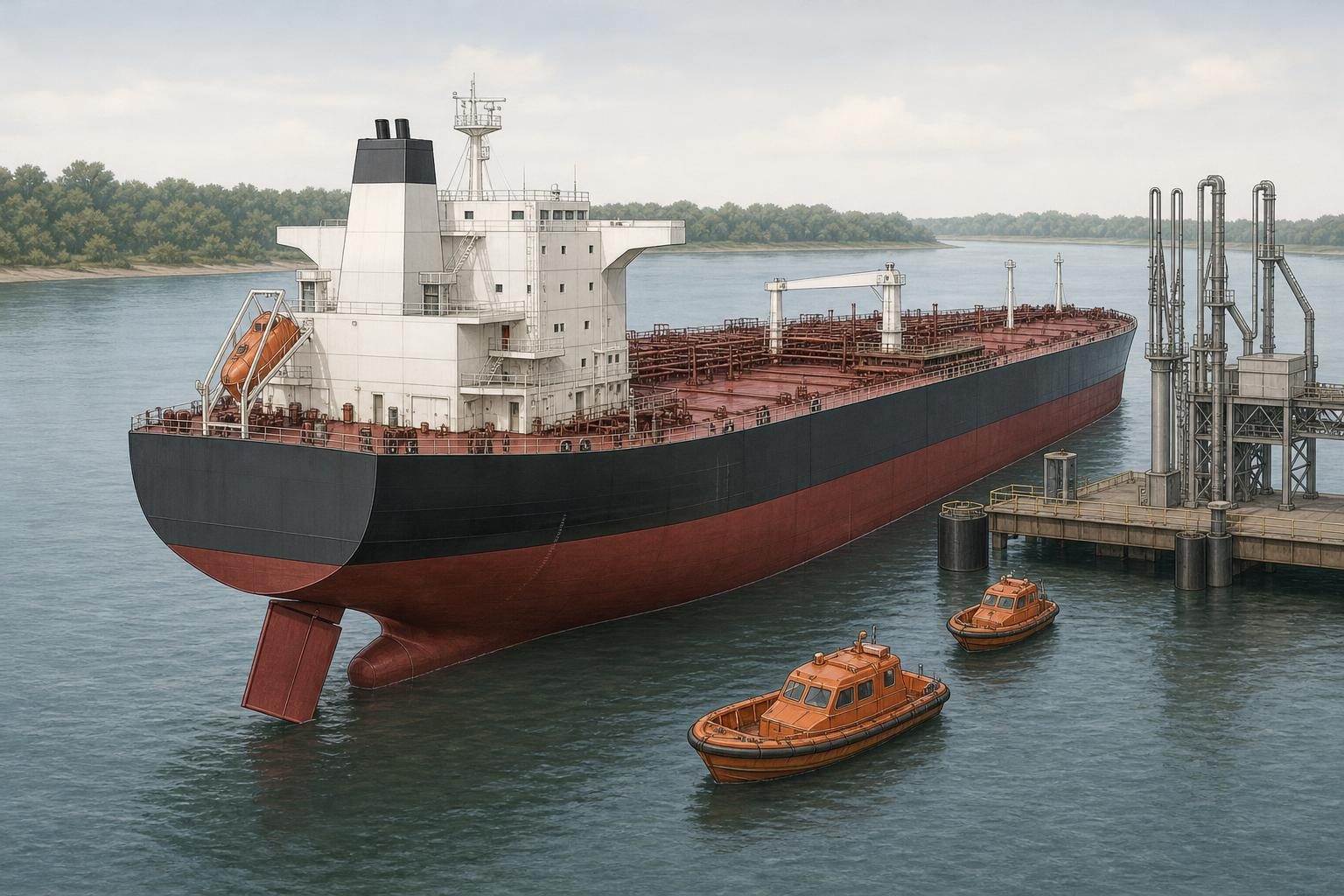
A tanker’s steering system failed before it crashed into a docked cruise ship in New Orleans, according to reporting by PBS NewsHour and the Associated Press. The National Transportation Safety Board, the federal agency that investigates major transportation accidents, said the tanker’s rudder stayed turned to starboard, meaning to the right side of the vessel. A rudder is the underwater steering surface at the back of a ship. With that steering surface stuck, the 520-foot tanker veered toward the east bank of the Mississippi River and hit the 300-foot cruise ship about two minutes later.
The crash matters because large vessels are not just vehicles; they are moving workplaces. The tanker had a crew of 19. The cruise ship had 140 passengers and 50 crew members on board. Officials said 32 people were taken to the hospital, including two police officers who were thrown into the river when the cruise ship rolled. None of the injuries were described as critical, and six people remained hospitalized as of Sunday. The cruise ship capsized, or turned over in the water, in 22 minutes.
For career and technical education, the most important part of this story may be the work that started the moment routine operations became an emergency. On a vessel, the bridge crew handles navigation, communication, speed, and steering orders. Engineering and maintenance workers keep systems operating below deck and throughout the ship. Port workers, police, rescue crews, and private vessels can become part of the response when something goes wrong near a busy riverfront. In this case, officials said the ship’s data recorder captured sounds consistent with the whistle, radio warnings, requests for assistance, commands to deploy anchors, and emergency ship-handling orders.
A ship’s data recorder is an electronic system that stores information such as bridge audio and vessel operations so investigators can reconstruct what happened. That matters because the first explanation after an accident is often incomplete. The NTSB’s preliminary finding says the steering failed, but officials have not yet said why it failed. A steering system on a large vessel can involve mechanical parts, hydraulic power that uses pressurized fluid to move heavy equipment, electrical controls, alarms, and human procedures. Investigators will have to sort out which parts worked, which did not, and what the crew could reasonably do in the time available.
That is also how many technical jobs work: the visible failure is not always the root cause. A stuck rudder could be the final symptom of a problem that began somewhere else in the system. Good troubleshooting means checking evidence in order, not guessing. In a shop, that might mean tracing a circuit, checking fluid pressure, inspecting a linkage, reading a fault code, and comparing what the machine did with what it was supposed to do. On a ship, the scale is larger and the stakes are higher, but the habits are familiar: document the problem, communicate clearly, follow emergency procedures, and preserve evidence.
The hiring side of maritime and port work reflects that safety culture. Employers in vessel operations, marine maintenance, terminal work, and emergency response look for people who can do technical tasks while following procedures exactly. Reading schematics, using radios professionally, understanding alarms, maintaining logs, and working under supervision are not “extra” skills in this field; they are part of the job. So are soft skills that are not really soft in an emergency: staying calm, using standard terms, listening to commands, and handing off accurate information to the next crew.
The investigation will continue. Officials asked people with photos or video of the crash to share them with the NTSB, and the agency expects a preliminary report within 30 days. The Port of New Orleans also filed a federal lawsuit saying the tanker caused at least $1 million in damage to its terminal, and a judge gave federal officials control of the ship for now. Those legal and financial issues will matter, but the technical question remains central: how did a steering failure on a working vessel turn into a collision so quickly, and what can crews, mechanics, inspectors, and port operators learn from the evidence?
Written from reporting by PBS NewsHour, “Officials say a tanker's steering failed before it crashed into a cruise ship in New Orleans”.
Discussion questions
- When a machine failure gives a crew only minutes to react, how should responsibility be divided among equipment design, maintenance, training, and operator decisions?
- Should employers in high-risk technical fields prioritize hiring for hands-on mechanical skill, procedure-following, communication, or calm under pressure? Defend a ranking.
- What kinds of evidence would be most useful for investigators trying to learn from this crash, and what evidence might be misleading without context?