
A Supercomputer Rebuilds the Young Universe
The Lumina simulation shows how astronomy now depends on code, chips, data, and teams that can test a model against the sky.
Print it — all four files
The student packet has no answers in it. The teacher copy is the same pages plus a note on each question and the answer keys. Both languages carry the same story, the same picture and the same vocabulary.
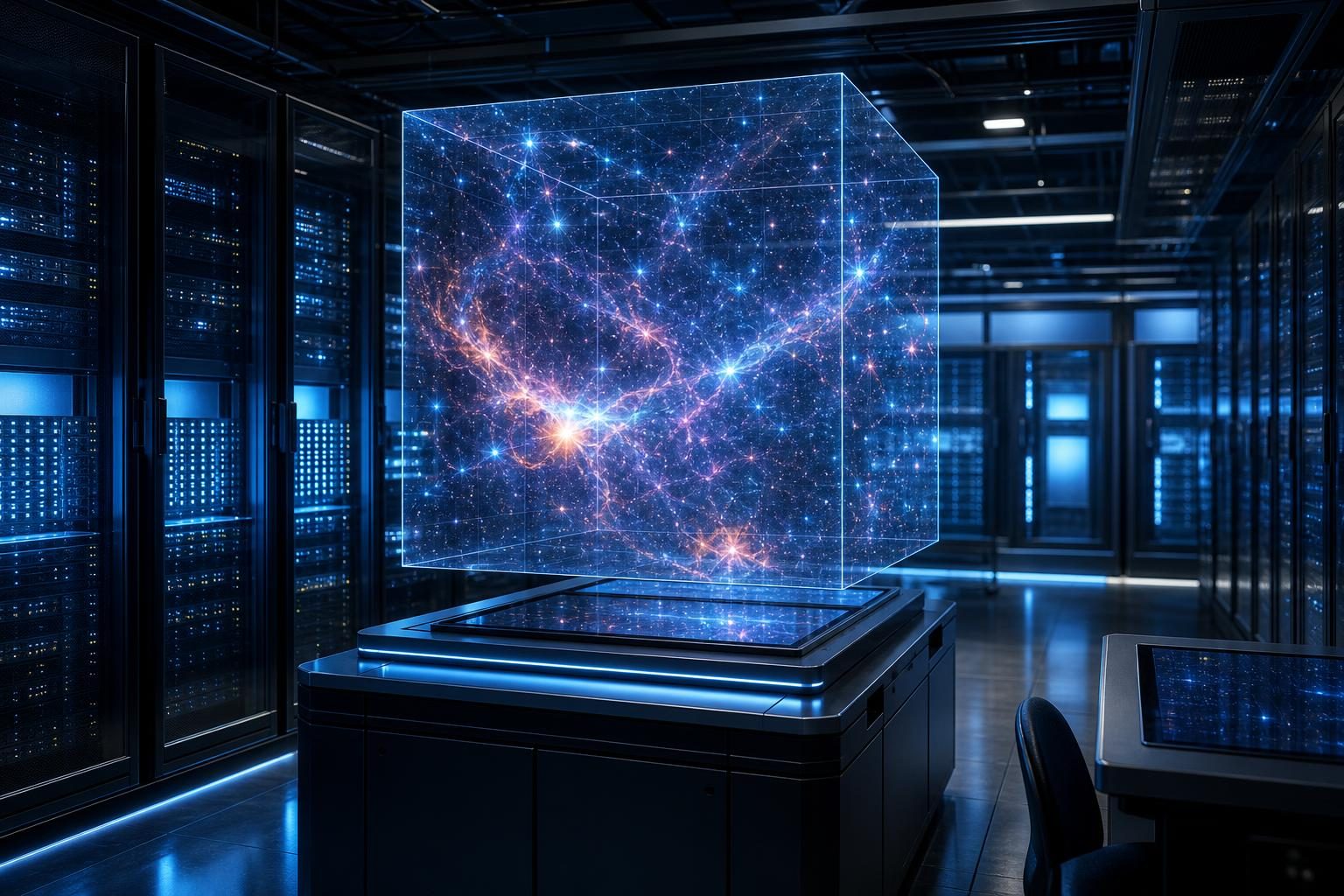
Researchers have built Lumina, a huge computer simulation of the universe’s first 2 billion years, to help explain what new space telescopes are seeing. According to reporting by Phys.org on research published in Monthly Notices of the Royal Astronomical Society, the model was developed by researchers at the Center for Astrophysics | Harvard & Smithsonian and is designed to compare telescope observations with detailed predictions about how the early universe evolved.
That matters because the James Webb Space Telescope and the Nancy Roman Space Telescope are giving astronomers sharper views of the universe’s earliest chapters. A telescope can collect light from faraway galaxies, but scientists still need a way to test what that light means. Lumina models ordinary matter, dark matter, and radiation. Dark matter is matter that does not give off light but can be detected because its gravity affects visible matter. Radiation, in this context, means energy traveling through space, including light. If the real sky matches the model, scientists gain confidence in their theories. If it does not, the mismatch can point toward something missing in the science.
Lumina is described as one of the largest and most detailed early-universe simulations ever created. It covers a cube of space about 1.5 billion light-years on each side, meaning light would take 1.5 billion years to cross one edge of the modeled region. Phys.org reports that this is more than 100 times the volume of previous comparable simulations. The point is not just to make a bigger digital universe. The point is to keep enough detail inside that enormous volume to follow how galaxies, stars, black holes, gas, and light affected one another over time.
The trade vocabulary here is computational, not construction or automotive, but it is still about tools, materials, and workflow. Lumina is a cosmological radiation-hydrodynamics simulation. Cosmological means it deals with the large-scale universe. Hydrodynamics is the study of how fluids move; in this case, the fluid is mostly gas spread through space. Radiation-hydrodynamics means the program calculates both gas motion and energy from light or other radiation, including how they change each other. This is not an animation made after the fact. It is a working model that follows rules and produces results that can be checked against telescope data.
The simulation also follows hydrogen and helium reionization. Reionization is the process in which atoms that had electrons attached later had electrons stripped away again by energetic radiation. Hydrogen and helium are the two lightest chemical elements, and they filled much of the early universe. The article says Lumina is the first simulation to capture helium reionization as it happened while also letting its effects immediately influence the rest of the evolving model. That detail is important because early stars, galaxies, and black holes did not develop in empty space; they developed inside gas that was being heated, ionized, pushed, and reshaped.
For a career and technical education classroom, the job story is that modern astronomy is not only done by people looking through telescopes. It is also done by people who write code, maintain high-performance computing systems, manage large data sets, test software, and understand enough physics to know whether a result makes sense. Creating Lumina required more than 15,000 graphics processing units, or GPUs, running on Frontier, a supercomputer at Oak Ridge National Laboratory in Tennessee. A GPU is a computer chip designed to handle many calculations at the same time, which makes it useful for graphics, artificial intelligence, and scientific modeling. A supercomputer is a system built from many processors working together on problems too large for a normal computer.
The people behind a project like this include astrophysicists, computational scientists, software developers, data specialists, and supercomputing staff. Some are doctoral researchers building theories about the universe. Others focus on making code run efficiently across thousands of chips without crashing or wasting machine time. The source article does not list job requirements, but the work points to skills employers in technical fields recognize: programming, math, troubleshooting, documentation, teamwork, and the ability to compare a digital output with real-world measurements. In this workplace, a bad assumption in the code can matter as much as a bad measurement in a lab.
Lumina is also a reminder that a model is not the same as proof. It is a tool for asking sharper questions. Future studies will use it to investigate how gas moves between galaxies, how radiation from the big bang shaped cosmic evolution, and how regions of intense star formation developed. The next step is comparison: telescope teams gather observations, simulation teams produce predictions, and researchers look for agreement or tension between them. The work is slow, technical, and collaborative. It shows a version of science where the shop floor is a server room, the instrument is software, and the finished product is a better test of how the universe came to look the way it does.
Written from reporting by Phys.org, “Lumina simulation brings the early universe to life on a record-breaking scale”.
Discussion questions
- When should scientists trust a computer simulation enough to use it as evidence, and what limits should they keep in mind?
- If a school wanted to prepare students for work connected to projects like Lumina, which skills should it prioritize and why?
- Does building larger simulations automatically make science better, or can size create new problems?