
Wild Quail Return After Crews Rebuild Habitat
A Tennessee project shows how conservation work depends on fire, forestry, field skills, and long-term land management.
Print it — all four files
The student packet has no answers in it. The teacher copy is the same pages plus a note on each question and the answer keys. Both languages carry the same story, the same picture and the same vocabulary.
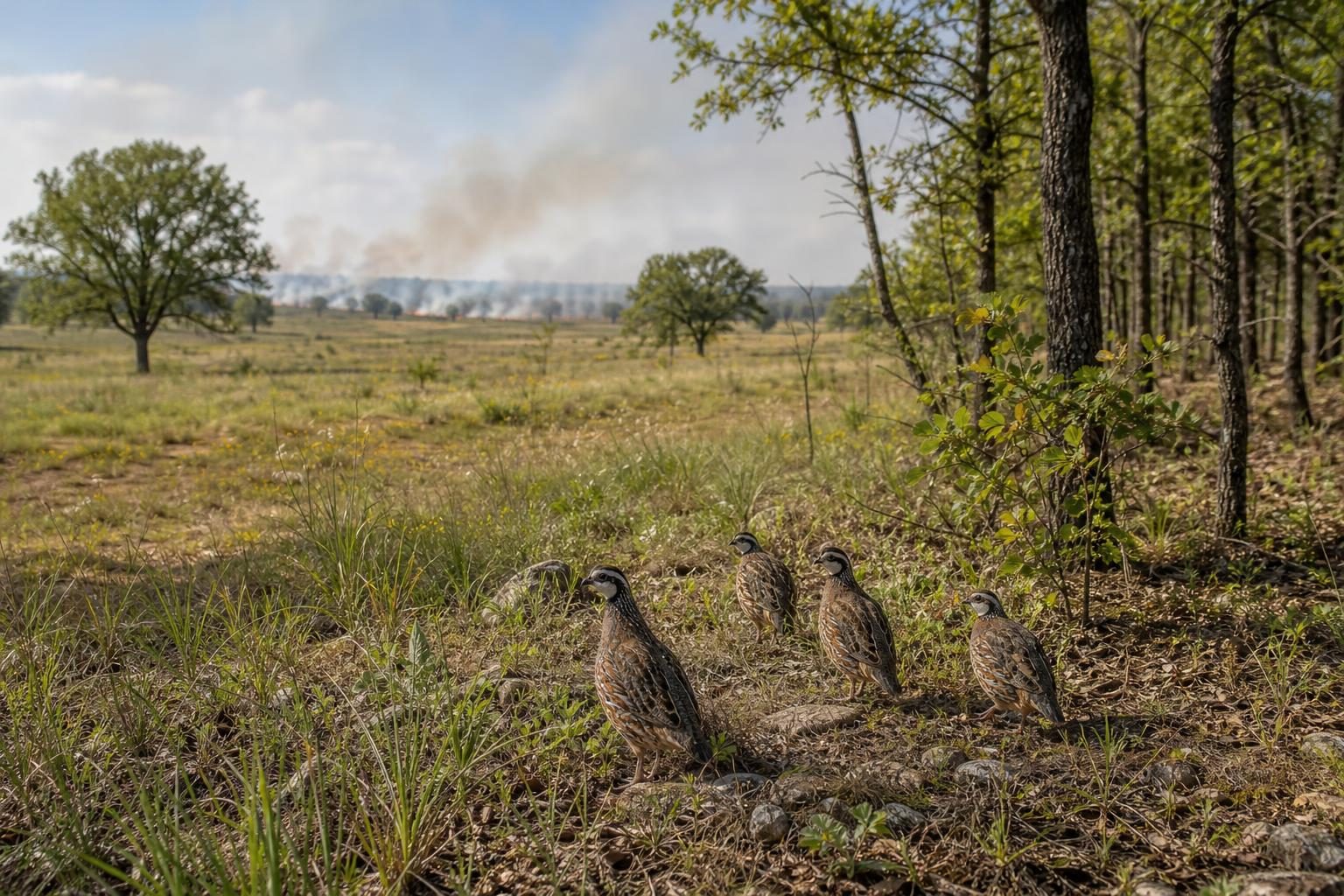
Wild bobwhite quail have been spotted at the University of Tennessee’s Ames AgResearch and Education Center after crews began restoring the land they need to survive, according to Phys.org. Multiple coveys, or small groups of quail, were seen during the second year of a partnership between UT AgResearch and Tall Timbers, a nonprofit that works on natural resource research and education. The project covers more than 5,000 acres of bird dog competition grounds at Ames, a site that hosts the National Championship for Bird Dogs and draws thousands of visitors each year.
The sighting matters because it suggests that the land is starting to function differently. Bobwhite quail have become scarce enough at the center that competitions have relied on pen-raised birds, which are birds raised by people and released for an event. The restoration project is not just putting more birds on the ground. It is changing the ground itself so wild birds can nest, raise young, find cover, and make it through the year. For people interested in trade and technical careers, this is a good example of conservation as physical work, not just an idea.
The main job is habitat restoration, which means changing a site so it can support the plants and animals that belong there. At Ames, teams are turning dense, closed-canopy forest into open savanna. A closed canopy is a forest where the tree crowns meet overhead and block much of the sunlight. An open savanna has scattered trees, more sunlight at ground level, and a mix of grasses, shrubs, and other plants. Bobwhites need that structure for nesting and brood-rearing, which means protecting and feeding young birds after they hatch.
Since the project began in 2025, about 1,500 acres have been managed through tree thinning, mulching, and prescribed fire. Tree thinning removes selected trees so light reaches the ground. Mulching grinds woody material into chips or small pieces, often using heavy equipment. Prescribed fire is a planned burn carried out under set conditions to reduce unwanted growth and improve habitat. Each of those tasks depends on crews who can follow a work plan, read site conditions, operate equipment safely, and understand how one action affects the next.
This kind of worksite would likely involve several skill sets at once. Forestry and equipment crews handle thinning and mulching. Natural resource staff plan which areas need treatment and when. Fire crews carry out prescribed burns, where timing, weather, fuel conditions, and safety procedures matter. Wildlife professionals monitor whether the habitat is helping the target species. Agricultural research center staff also have to balance conservation work with the field trial courses used for competitions. The article does not list job openings or credentials, but the tasks point to the kinds of competencies employers would care about: safety, equipment awareness, land management knowledge, teamwork, and accurate field observation.
The quail sighting is encouraging, but it is not the finish line. In places where too few wild quail remain to respond quickly to better habitat, Tall Timbers uses translocation, which means moving wild birds from one location to another. At Ames, a multiyear translocation process is planned as a tool to speed population recovery. That adds another layer of field work: capturing, transporting, releasing, and tracking wildlife must be done carefully because the goal is a permanent wild population, not a one-time release.
Long-term management will continue after the first restoration phase. Plans include annual prescribed burns across about half of the field trial courses, herbicide applications to control undesirable and invasive plants, supplemental feeding in winter, and predator management during the summer nesting season. An invasive plant is a nonnative plant that spreads in ways that can damage the existing ecosystem. Herbicide work requires precision because the goal is to control certain plants without undoing the habitat gains. Predator management is also a technical choice, because it is aimed at improving reproductive success during the part of the year when nests and young birds are most vulnerable.
The project timeline depends on timber markets, weather, and costs, which is another real-world lesson. Outdoor work does not happen on a perfect classroom schedule. Timber markets affect whether removed trees have value. Weather affects burning, equipment access, and crew safety. Costs affect how fast thousands of acres can be treated. The next phase will use Ames as a place to teach landowners and organizations about bobwhite conservation and the role of prescribed fire in ecosystem health. In other words, the work includes both doing the job and explaining the job well enough that other land managers can repeat it.
Written from reporting by Phys.org, “Wild bobwhite quail spotted after habitat restoration project”.
Discussion questions
- When a conservation project also supports a public event like bird dog competitions, how should managers balance wildlife goals with visitor and business interests?
- Prescribed fire can improve habitat but also requires planning, training, and public trust. What would make it a responsible tool rather than a risky shortcut?
- If you were hiring for a project like this, which matters more: equipment experience, wildlife knowledge, or ability to work safely on a team? Defend your ranking.