
A Capybara Tooth Hints at a Wetter Desert
A tiny fossil from Chile may show that today’s Atacama Desert once had rivers, plants, and water-loving animals.
Print it — all four files
The student packet has no answers in it. The teacher copy is the same pages plus a note on each question and the answer keys. Both languages carry the same story, the same picture and the same vocabulary.
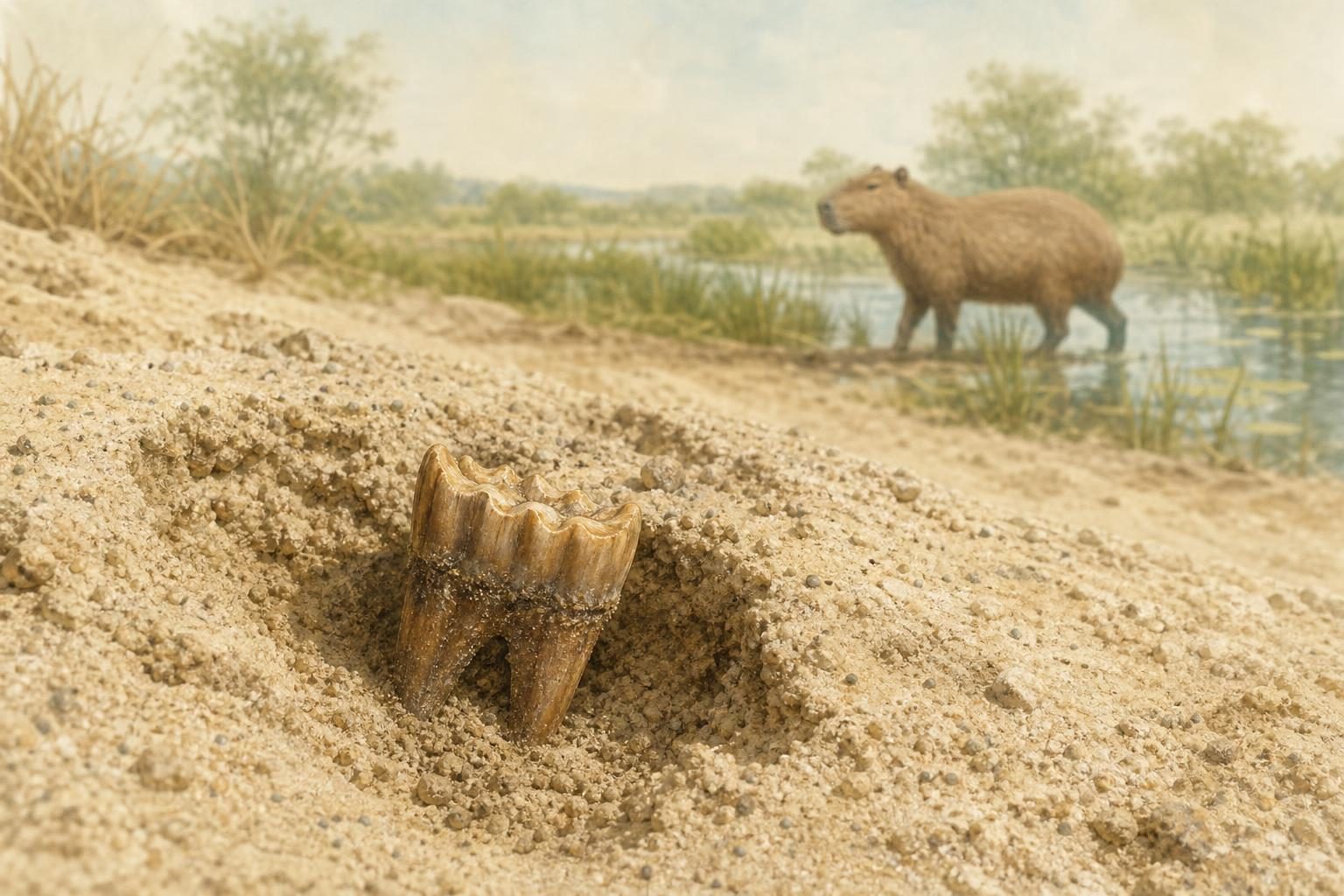
Scientists found an old tooth in a very surprising place. It came from a large relative of a capybara. A capybara is the world’s biggest rodent. It looks a little like a giant guinea pig.
According to reporting by Live Science, the tooth was found in the Atacama Desert of northern Chile. The Atacama is one of the driest places on Earth. Some parts get almost no rain.
That is why the tooth matters. Capybaras and their close relatives need steady fresh water. They eat plants that also need water. Today, a capybara would not choose a dry desert as a home.
The tooth is a fossil, which means it is an ancient body part turned to stone over time. It is a molar, a back tooth used for grinding food. Scientists say it is about 9 million years old.
Finding it is like finding a snow boot in the middle of a sandy beach. It does not match the place you see now. It is a clue that the place was different long ago.
The tooth was found in a layer of rock from an old shallow sea area. Scientists also found tiny pieces of ancient plants. These are called phytoliths, which are small plant bits that can last in soil and rock.
Those plant clues point to palms, grasses, gingers, and other flowering plants. The area may once have had a subtropical forest. That means a warm, wet forest.
Other fossils had already hinted at a wetter Atacama. Scientists have found clues of crocodiles and freshwater fish there. The capybara relative adds another piece to the puzzle.
The scientists do not know exactly how the animal got there. The Andes Mountains are very high today. They stand between many capybara homes and the desert.
One idea is that ancient capybara relatives moved along the coast. They may have followed wetlands, rivers, and other watery places.
A single tooth cannot tell the whole story. But it can change what scientists ask next. If a water-loving animal lived there, the desert may not have always been dry.
That is how Earth science often works. A small find can open a big window into the past.
Written from reporting by Live Science, “'Freakish' discovery of 9 million-year-old capybara tooth supports idea that Atacama wasn't always a desert”.
Discussion questions
- How strong is one fossil tooth as evidence that a desert was once wetter? Defend your view.
- Why might scientists be careful before saying exactly what the Atacama looked like 9 million years ago?
- If you found an animal fossil in a place where that animal could not live today, what questions would you ask next?