
Voyager 1 Is Now One Light-Day From Earth
NASA’s farthest spacecraft reached a record distance, where every message takes a whole day to arrive.
Print it — all four files
The student packet has no answers in it. The teacher copy is the same pages plus a note on each question and the answer keys. Both languages carry the same story, the same picture and the same vocabulary.
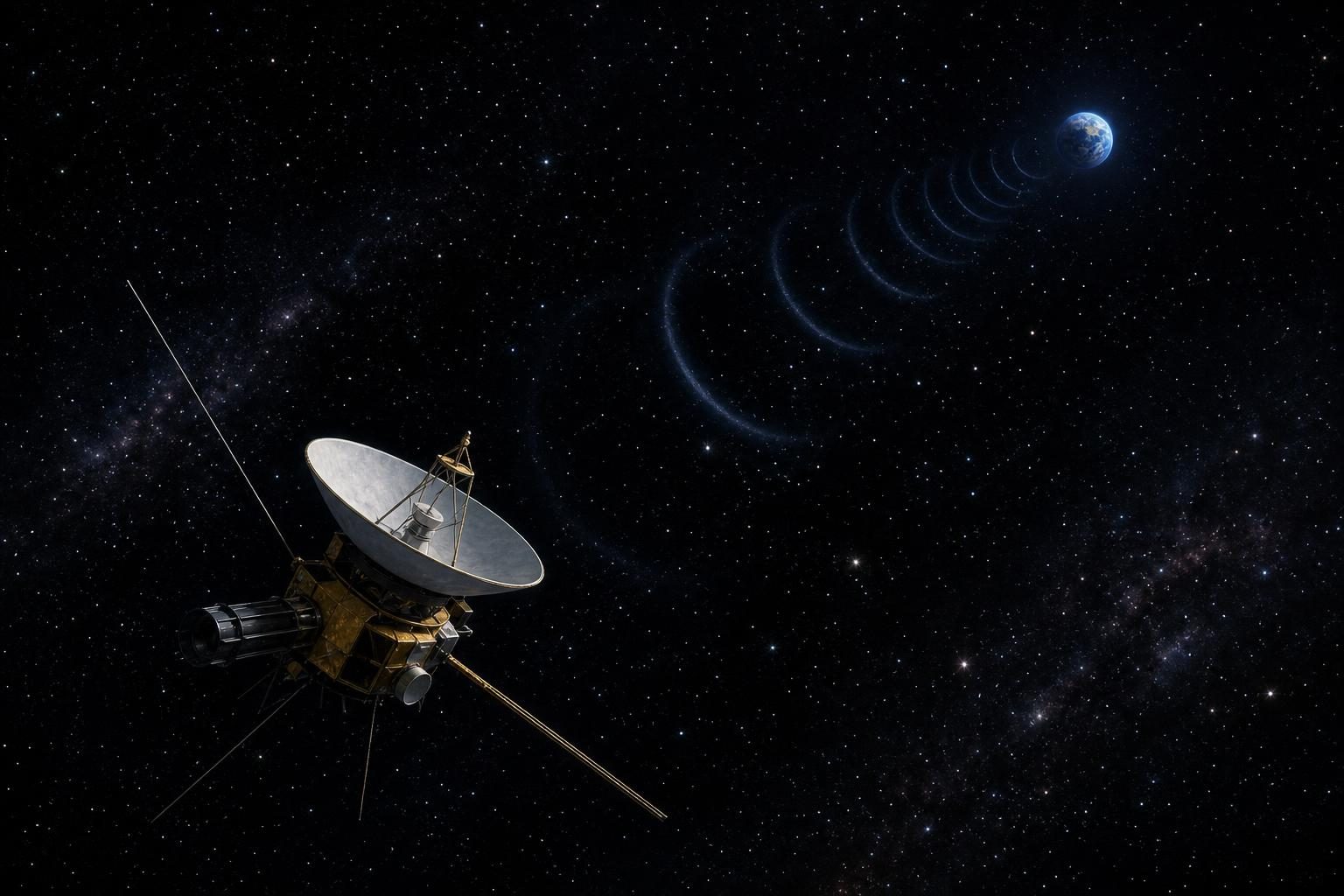
Voyager 1 has become the first human-made object to sit one light-day from Earth. According to reporting by Live Science, NASA confirmed the milestone on Nov. 18. A light-day is the distance light travels in one day. For Voyager 1, that is about 16.1 billion miles, or 25.9 billion kilometers.
That distance changes what “talking” to a spacecraft means. A radio message from Earth needs a full day to reach Voyager 1. A reply needs another full day to come back. If engineers send one careful instruction on Monday, they may not know the result until Wednesday.
Voyager 1 launched in 1977. It flew past planets, then kept going. In 2012, it entered interstellar space. That means the space between stars. Only Voyager 1 and Voyager 2 have been there.
The spacecraft is also having a problem. On Nov. 14, the team saw that Voyager 1 had stopped sending science data. Science data means the measurements its instruments collect. NASA still detected a carrier signal. That signal is like a steady radio hum. It tells engineers the spacecraft has power and points the right way.
The problem is not like fixing a tablet at home. Voyager 1 is nearly 50 years old. Its computer is old, too. The team thinks the trouble may involve the computer that gathers instrument readings. It also sends them in a form people can read.
NASA has solved a similar problem before. The team had trouble getting Voyager 1 science data in 2023 and 2024. This time, engineers are trying a similar plan. They must move slowly because every question and answer takes two days.
If the fix works, Voyager 1 can keep using two science instruments. One is a magnetometer, which measures magnetic fields. The other measures plasma waves. Plasma is a gas with tiny charged pieces in it. These tools help scientists study interstellar space close up.
Voyager 1 will not last forever. NASA has already turned off some instruments to save power. But the spacecraft is still carrying something special. Its Golden Record holds sounds and pictures chosen to represent Earth.
The light-day milestone is not just a huge number. It is a new way to feel distance. A message can cross Earth in a blink. To reach Voyager 1, even light needs a whole day.
Written from reporting by Live Science, “Voyager 1 stops sending science data ahead of its light-day milestone — but NASA has a plan”.
Discussion questions
- Should NASA spend time trying to fix a very old spacecraft, or focus only on building new ones? Defend your answer.
- How would a two-day wait for answers change the way engineers make choices?
- What would you want to know before deciding how long to keep the Voyager 1 mission going?