
A Moon-Like Rock Patch Shows Up on Earth
An astronaut photo of Madagascar shows how one bright rock can help scientists study both Earth and the Moon.
Print it — all four files
The student packet has no answers in it. The teacher copy is the same pages plus a note on each question and the answer keys. Both languages carry the same story, the same picture and the same vocabulary.
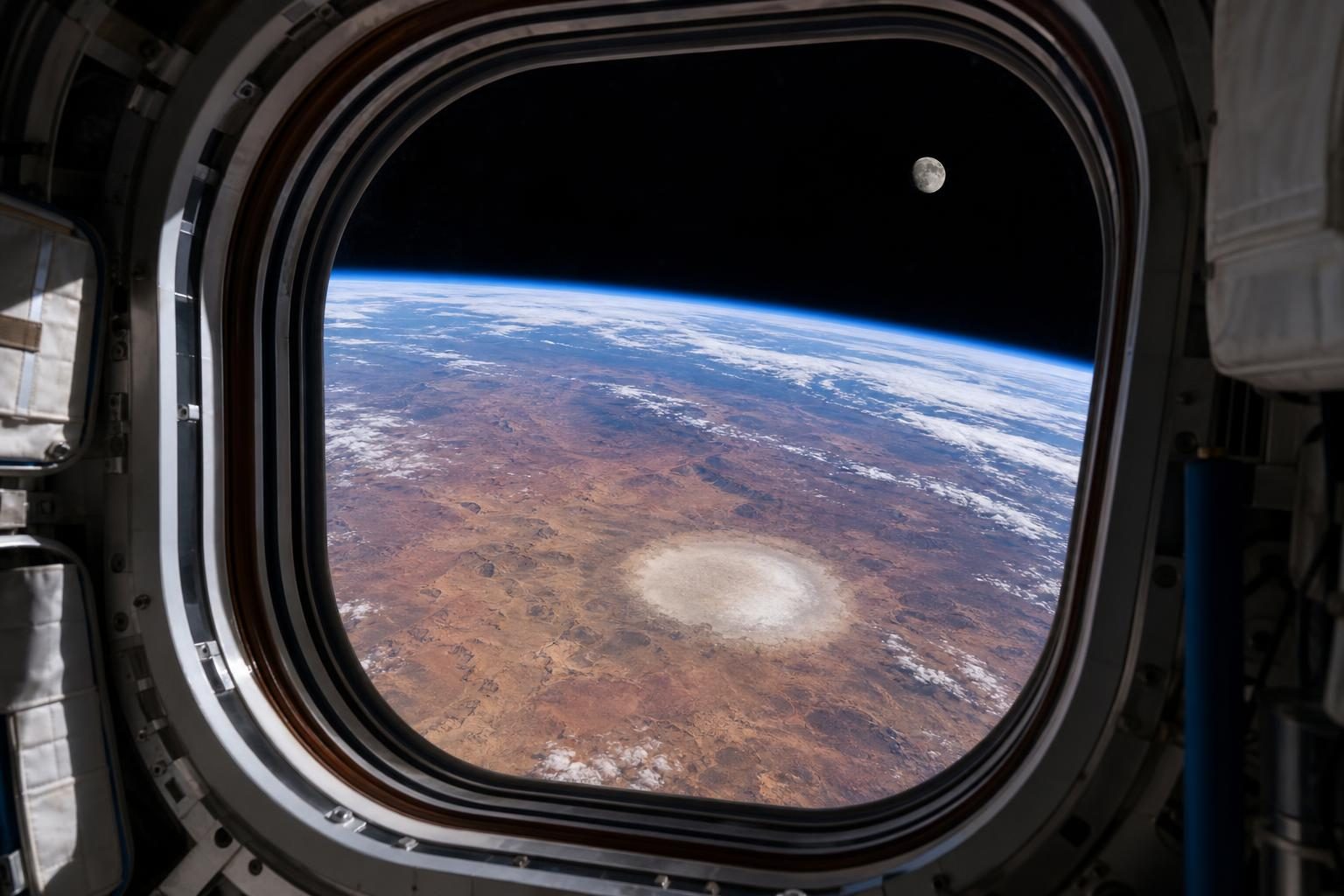
NASA’s Earth Observatory shared a new astronaut photo of a bright rock patch in southern Madagascar. From the International Space Station, the patch stands out in dry land around it. It looks almost like something that belongs on the Moon.
According to NASA’s Earth Observatory, the rock is called anorthosite. Anorthosite is a pale rock made mostly of large mineral crystals. It is common on the Moon’s surface. On Earth, it shows up in only some places, including Madagascar. The same kind of rock makes the Moon’s light areas shine. Those light areas are called lunar highlands, which means high, bright Moon land.
The photo shows the Saririaky anorthosite massif. A massif is a large block of rock. Scientists think this one formed at least 600 million years ago. It covers about 40 square miles today. That is a big area, but from space it looks like one bright shape. The astronaut took the photo on August 28, 2026. NASA released the story on October 5.
This matters because rocks can be clues. The Madagascar rock formed from magma, or melted rock, that cooled under the ground. Later, the rocks around it were squeezed and changed by heat and pressure. Scientists call that change metamorphism. The lines in the nearby rocks show that the area had a busy past.
NASA says those changes may connect to Gondwana. Gondwana was a supercontinent, a giant landmass made from smaller pieces. Pieces that are now Africa, India, Madagascar, Australia, and Antarctica were colliding. Colliding means pushing together. That slow crash bent and reshaped rocks. It may even have pulled one rock body away from another nearby one.
For a geologist, a scientist who studies rocks, this is not just a pretty picture. Moon rocks are hard to get. Apollo astronauts brought some back to Earth, but there is only a limited amount. So scientists also study Earth rocks that are like Moon rocks. These are called analogs, which means stand-ins for comparison.
A classroom rock can tell a local story. A space photo can connect that story to a whole planet. This Madagascar photo does both. It shows that Earth still keeps records from deep time. Deep time means time so long that it is hard to imagine. It also reminds scientists to look closely at familiar places. Sometimes a clue about the Moon is sitting on Earth.
Written from reporting by NASA, “Moon-Like Madagascar”.
Discussion questions
- How can a photo taken from space help scientists notice things they might miss from the ground?
- Should scientists use Earth rocks as stand-ins for Moon rocks? Why or why not?
- Which would tell a better science story: one powerful picture, one rock sample, or both together?