
A Space Telescope’s Long Watch Comes to an End
NASA’s Swift telescope lasted far longer than planned and helped scientists study powerful flashes across space.
Print it — all four files
The student packet has no answers in it. The teacher copy is the same pages plus a note on each question and the answer keys. Both languages carry the same story, the same picture and the same vocabulary.
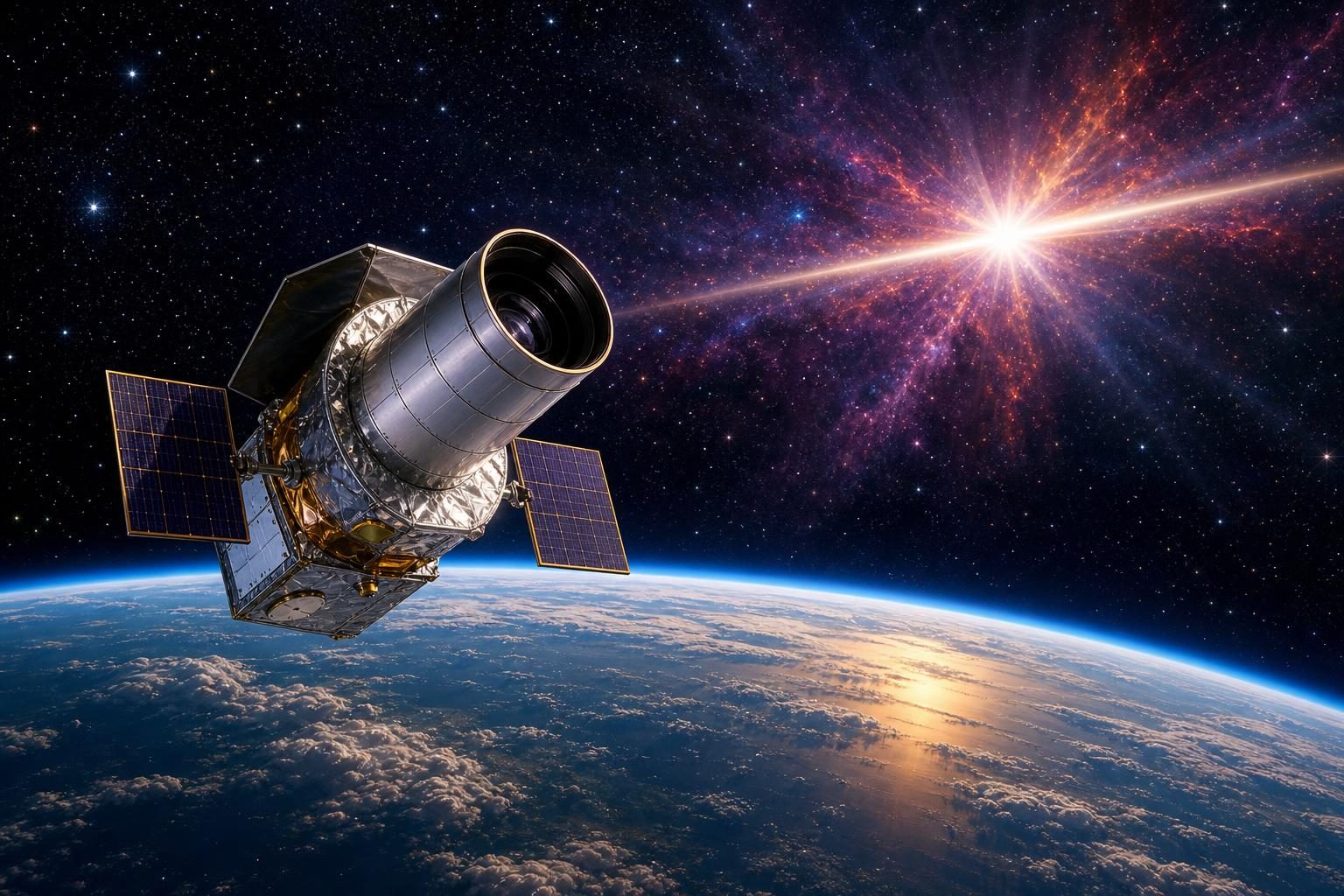
NASA’s Swift space telescope has ended its long job in space. According to Live Science, NASA’s Swift burned up this week over Indonesia’s North Sumatra region. It was an observatory, a tool for watching space. It reentered Earth’s atmosphere, the blanket of air around our planet. NASA expected most of the spacecraft to burn up. No damage or injuries have been reported.
That ending sounds dramatic. But for scientists, Swift was a success story. It was built for a two-year mission. Instead, it worked for nearly 22 years. During that time, it helped study some of the biggest events in the universe.
Swift’s main job was to spot gamma-ray bursts. These are powerful blasts of light from far away in space. They can happen when very large stars explode, or during other huge space events. Swift could notice one quickly. Then it could turn, or swivel, toward the right part of the sky in just minutes.
That speed mattered. Imagine hearing a strange sound outside and turning your head right away. Swift did something like that with space. It caught events while they were still changing. Its three telescopes looked at different kinds of light, including X-rays, which people use in hospitals to see inside bodies.
Swift also helped scientists study supernovas and black holes. A supernova is an exploding star. A black hole is a place in space where gravity pulls so strongly that even light cannot escape. These things are too far away for anyone to visit. Telescopes let scientists collect clues from Earth and from space.
NASA says Swift’s observations helped with about 7,000 research papers. Those papers are how scientists share what they learn. Even though Swift is gone, its data can still be studied. Data means the information a tool collects.
Swift came down because of atmospheric drag. Drag is a slowing push, like when air pushes against your hand out a car window. Increased activity from the sun made that drag stronger. That lowered Swift’s path around Earth.
Swift’s mission was planned to be short. Its records will keep helping scientists study new questions about space for years.
Written from reporting by Live Science, “Swift has fallen: NASA's 22-year-old space telescope burns up over Sumatra”.
Discussion questions
- Was Swift more valuable because it lasted much longer than planned, or because it could turn quickly to catch sudden space events? Defend your choice.
- If NASA built a new telescope like Swift, what should matter most: lasting longer, seeing more kinds of light, or moving faster? Explain your priority.
- What else would you want to know before deciding how successful Swift's mission was?