
City Lights Tell NASA a Story Before Sunrise
A space station photo shows the Midwest glowing in the dark, and those lights help scientists study how cities change.
Print it — all four files
The student packet has no answers in it. The teacher copy is the same pages plus a note on each question and the answer keys. Both languages carry the same story, the same picture and the same vocabulary.
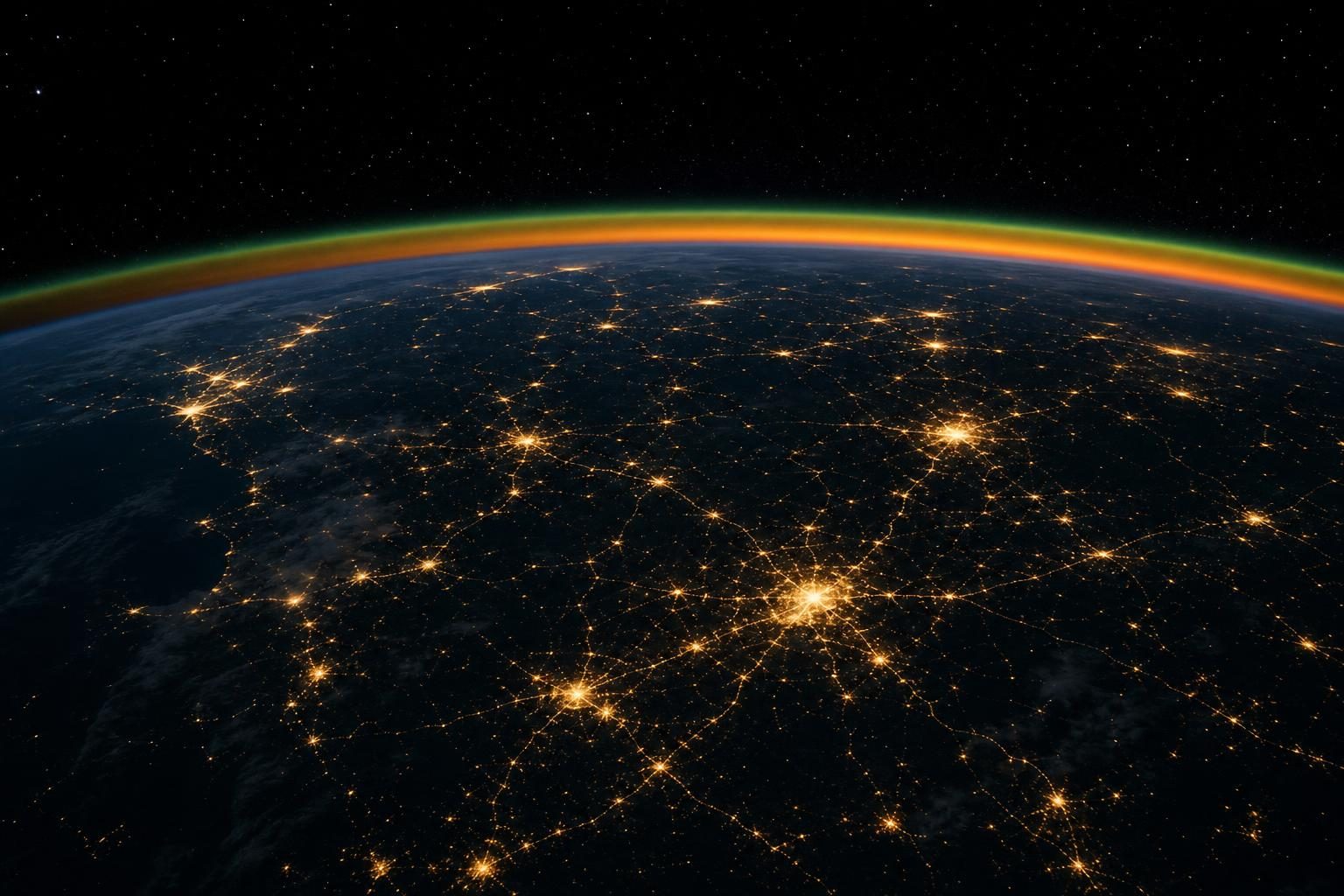
NASA’s Earth Observatory shared a new astronaut photo of the U.S. Midwest before sunrise, according to NASA’s Earth Observatory. An astronaut on the International Space Station took it on October 18, 2026, at 4:54 a.m. Central time. The International Space Station is a science lab that travels around Earth.
The picture shows clear skies over much of the eastern United States. Down below, cities glow in the dark. Big places like Chicago, Illinois, and Detroit, Michigan, shine very brightly. Smaller city areas also show up. Indianapolis, Cincinnati, and Louisville glow too. Highways connect many of these lights, like thin shining paths.
Imagine looking out a window from far above Earth. You would not see people or cars. You would see patterns. A city might look like a bright patch. A road might look like a line of tiny beads. The land between cities would look much darker.
The photo also shows a soft green and orange band near the edge of Earth. That glow is called airglow. Airglow happens high in the atmosphere, the blanket of gases around Earth. Sunlight hits tiny pieces of air and makes them give off light. In the photo, sunrise was still about an hour away on the East Coast.
The photo is not only pretty. Scientists can learn from nighttime lights. They can study how bright a city is. They can study where lights spread over time. They can also study the color of lights. Different kinds of lights can make different colors.
NASA says these pictures help scientists track the built environment. That means places people have made, such as homes, roads, stores, and factories. Other NASA tools also watch nighttime lights from satellites. A satellite is a machine that moves around Earth in space.
These views can help after big storms, too. Scientists can look for places where lights went out. Later, they can watch where lights come back on. That can show how power is being restored.
From the ground, one streetlight may not seem like much. From space, millions of lights make a pattern. That pattern can tell a story about where people live, how they travel, and how cities grow.
Written from reporting by NASA, “Before the Dawn in America’s Heartland”.
Discussion questions
- Should scientists use nighttime lights to understand how a city is changing? Why or why not?
- If a town wants bright streets but also darker skies, how should leaders decide where lights belong?
- What could an astronaut photo show that a person standing in one city could miss?