
Lightning Looks Different From Space
A new NASA image shows city lights, fishing boats, and lightning glowing together above the South China Sea.
Print it — all four files
The student packet has no answers in it. The teacher copy is the same pages plus a note on each question and the answer keys. Both languages carry the same story, the same picture and the same vocabulary.
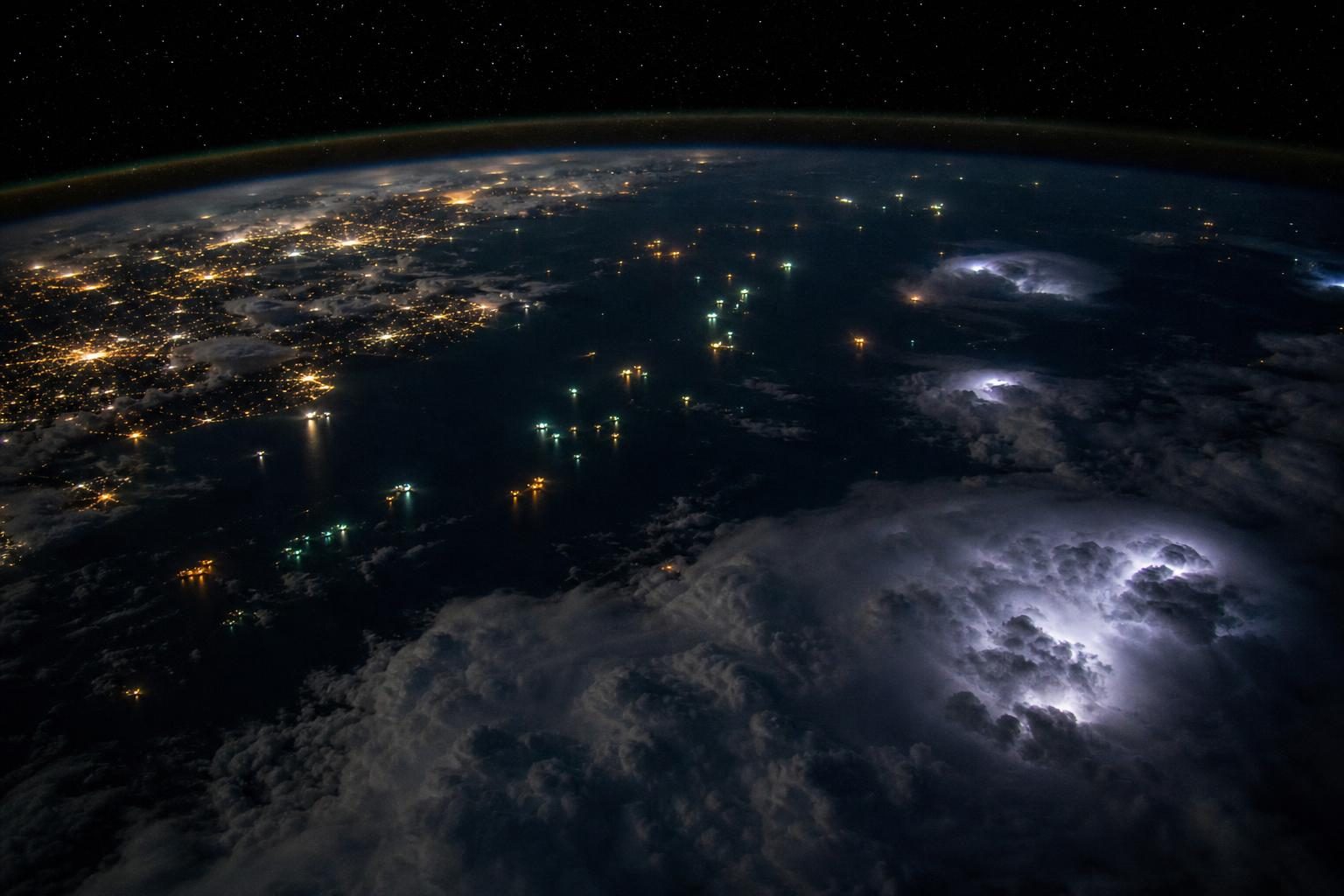
An astronaut on the International Space Station took a nighttime photo of Earth on October 28. NASA’s Earth Observatory shared the image on November 17. It shows the South China Sea near Borneo. Bright city lights, fishing boats, and lightning all appear at once. From space, the lightning looks like glowing bursts inside the tops of clouds.
The International Space Station is a science lab that circles Earth. It moves high above the planet, so astronauts can look down on weather and cities. Most people see lightning from the ground, below the storm. Astronauts see it from above. In the photo, flashes light up tall storm clouds like lamps under a blanket.
NASA says some storm clouds in the picture had overshooting tops. Those are rounded bumps that rise above the flat top of a thunderstorm. They form when fast-rising air pushes cloud material very high. That rising air is called an updraft. NASA says these shapes can be signs of strong thunderstorms.
The same picture also shows human lights. Singapore is visible on one side. Singapore is a city-state, which means one city is also its own country. Nearby, a group of blue lights likely came from fishing boats. Some boats use bright lights at night to attract squid or small fish.
The photo matters because it shows Earth as one connected place. A storm, a city, and boats can all fit in one wide view. Weather does not stop at borders. Light from people can be seen far away. A photo from space can help people notice patterns that are hard to see from the ground.
NASA says about 2,000 thunderstorms are happening on Earth at any moment. Together, they make nearly 60 lightning flashes each second. That is roughly 5 million flashes each day. From a classroom window, one storm can seem huge. From orbit, it becomes one tiny part of a busy planet.
Written from reporting by NASA, “Tossing Fireworks from Cloud to Cloud”.
Discussion questions
- How might seeing Earth from space change the way people think about weather near their own home?
- Do you think this kind of space photo is more useful for science, for art, or for both? Defend your choice.
- What important questions can this photo not answer by itself?