
NASA Tracks an Eclipse From Earth, Air, and Space
NASA watched the Aug. 12 eclipse from Spain, Maine, space, a research jet, and science balloons.
Print it — all four files
The student packet has no answers in it. The teacher copy is the same pages plus a note on each question and the answer keys. Both languages carry the same story, the same picture and the same vocabulary.
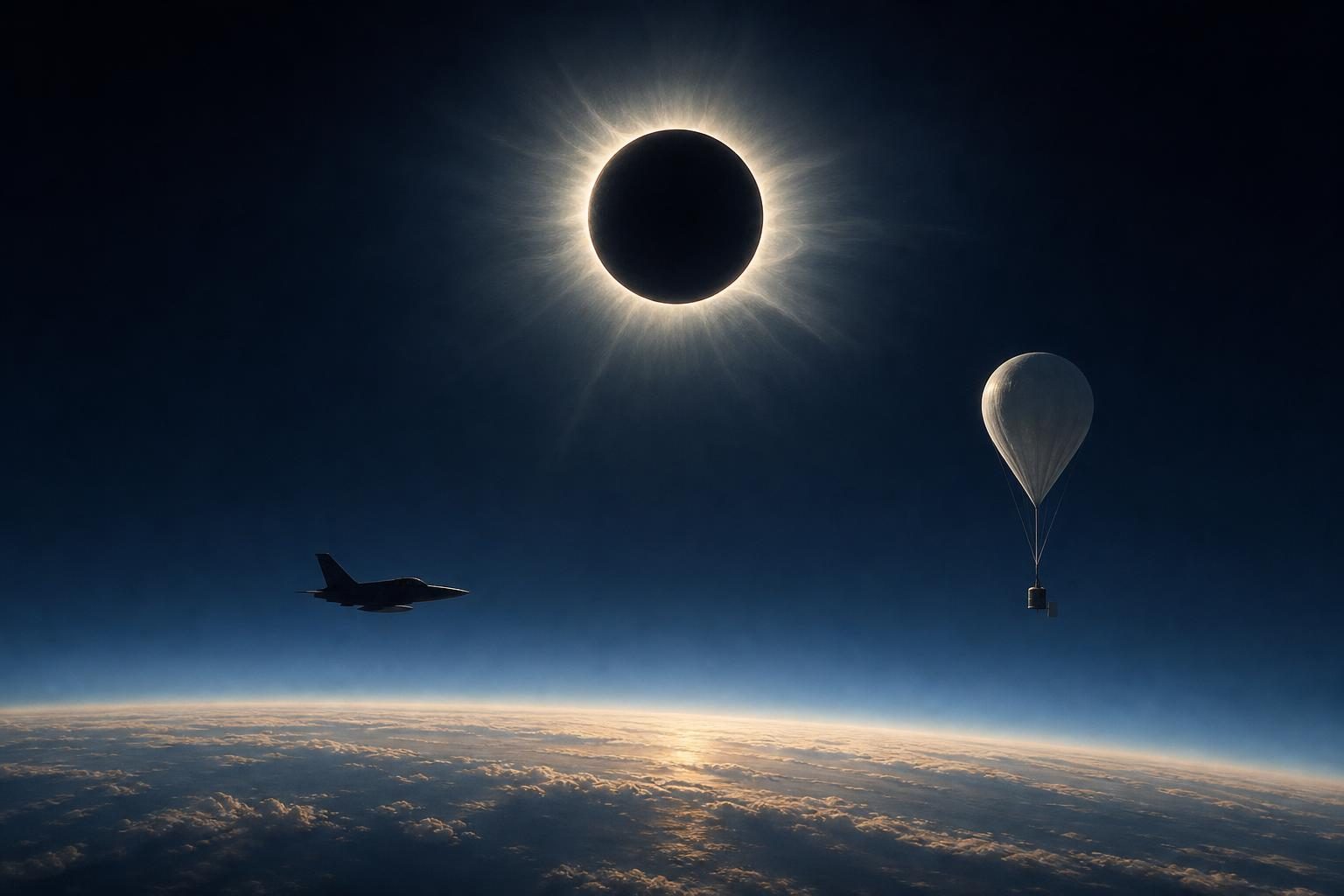
NASA shared new views of the Aug. 12 solar eclipse this week, according to NASA. A solar eclipse happens when the Moon moves between Earth and the Sun. In a total solar eclipse, the Moon covers the Sun completely for a short time.
The eclipse made the sky grow dim over Greenland, Iceland, and Spain. People in the right strip of Earth saw totality, the short time when the Sun is fully covered. If clouds stayed away, they could see the corona. The corona is the Sun’s thin outer air, which looks like pale wisps.
NASA did not watch from one place. A photographer in Spain took pictures as the Moon slid across the Sun. The same photographer kept taking pictures until the Sun set.
In northern Maine, the eclipse was only partial. That means the Moon covered just part of the Sun. A NASA photographer there caught the International Space Station crossing the Sun’s face. The station is a science lab that circles Earth. Seven people were aboard it.
The view was different from space. An astronaut on the station took photos from about 250 miles above the ground. From there, the eclipse was seen from above Earth.
NASA also flew a WB-57F research jet. A research jet is a plane packed with tools for science. It flew at 50,000 feet, far above most clouds. The plane passed through the eclipse’s shadow. That gave its cameras more time to study the corona. The cameras also looked at prominences, which are bright plumes of charged gas rising from the Sun.
Students helped, too. In Iceland and Spain, teams launched science balloons. The balloons carried instruments, or tools that measure things. They took pictures of the Moon’s shadow. They also studied how the short loss of light and heat changed the lower atmosphere. The atmosphere is the blanket of air around Earth. Clouds hid the eclipse from the ground in Iceland. But the balloon instruments could still gather information.
Scientists will study the pictures and measurements over the coming months. They want to learn more about the Sun and how it affects Earth. They also want to get ready for future eclipses. One longer total eclipse will be visible from southern Spain and northern Africa on Aug. 2, 2027.
Written from reporting by NASA, “NASA Shares Views of August Solar Eclipse from Ground, Air, Space”.
Discussion questions
- If NASA could choose only one place to watch an eclipse, should it choose the ground, a plane, space, or balloons? Defend your choice.
- Clouds blocked the view from the ground in Iceland, but balloons still collected information. What does this show about good planning in science?
- An eclipse can be both beautiful to watch and useful for science. How should people decide what matters most during a rare event like this?