
New NASA Telescope Opens Its Eyes in Space
Roman’s first test image shows green rings now, but sharper sky pictures are expected after more checks.
Print it — all four files
The student packet has no answers in it. The teacher copy is the same pages plus a note on each question and the answer keys. Both languages carry the same story, the same picture and the same vocabulary.
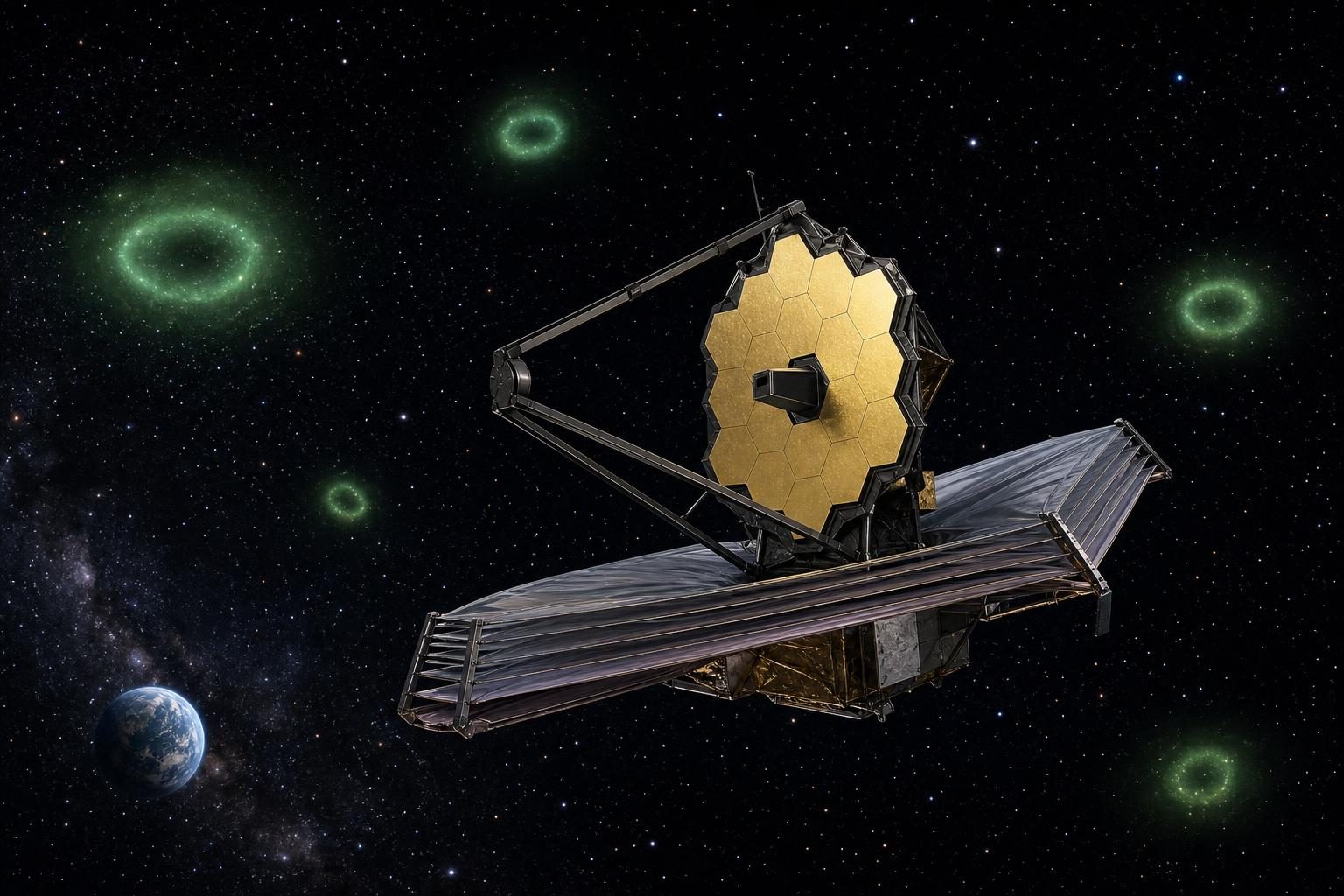
NASA’s Nancy Grace Roman Space Telescope has sent back its first test picture, according to Live Science, which reported on a NASA statement. The picture is not sharp yet. The stars look like bright green rings, almost like tiny doughnuts scattered across space.
That odd look is actually good news. Roman’s big camera has turned on in space. Engineers, the people who build and test machines, are still focusing it. A test is like the first try with a new camera. You do not expect the perfect school photo on the first click.
Roman launched on Aug. 30. It is traveling toward a place in space called L2. That is a steady parking spot far from Earth. There, the pull of Earth and the sun can help hold a spacecraft in place. The James Webb Space Telescope also works near that area.
Roman’s camera is called the Wide Field Instrument. It has 18 detectors. A detector is a part that catches light and changes it into information a computer can use. Together, they make a camera with 300 megapixels. A megapixel is a way to count tiny picture dots.
When Roman is ready, NASA expects its space pictures to be very sharp. They should be as detailed as pictures from the Hubble Space Telescope. But each Roman picture will show a much bigger patch of sky. Live Science reported that one Roman image will cover 100 times more area than Hubble.
That matters because space is huge. Imagine searching a playground with a paper towel tube. Then imagine using a wide window. Roman is more like the wide window. It can help scientists study many stars and galaxies at once. A galaxy is a giant group of stars.
Roman may help answer big questions. Scientists want to learn how the universe is expanding, or spreading out. They also plan to look for exoplanets, which are planets outside our solar system. Roman has a tool that can block a star’s bright light. That can make nearby planets easier to see.
For now, Roman is still getting ready. Scientists are checking its parts during a trip of about a million miles. The first green rings are not the final picture. They are more like a wink from a new telescope, saying its eyes are open.
Written from reporting by Live Science, “'We are on our way to groundbreaking science': Stars turn neon-green in first test image from NASA's Roman telescope — Space photo of the week”.
Discussion questions
- Should NASA share early test pictures, even when they look strange and unfinished? Why or why not?
- Roman will see a much wider patch of sky than Hubble. What kinds of discoveries might a wide view help with most?
- If you were planning a science tool, would you rather make it see one tiny thing very clearly or many things at once? Defend your choice.