
One Picture Holds 313 Glowing Space Clouds
A new NASA-featured image shows how many hours it can take to photograph faint objects in the night sky.
Print it — all four files
The student packet has no answers in it. The teacher copy is the same pages plus a note on each question and the answer keys. Both languages carry the same story, the same picture and the same vocabulary.
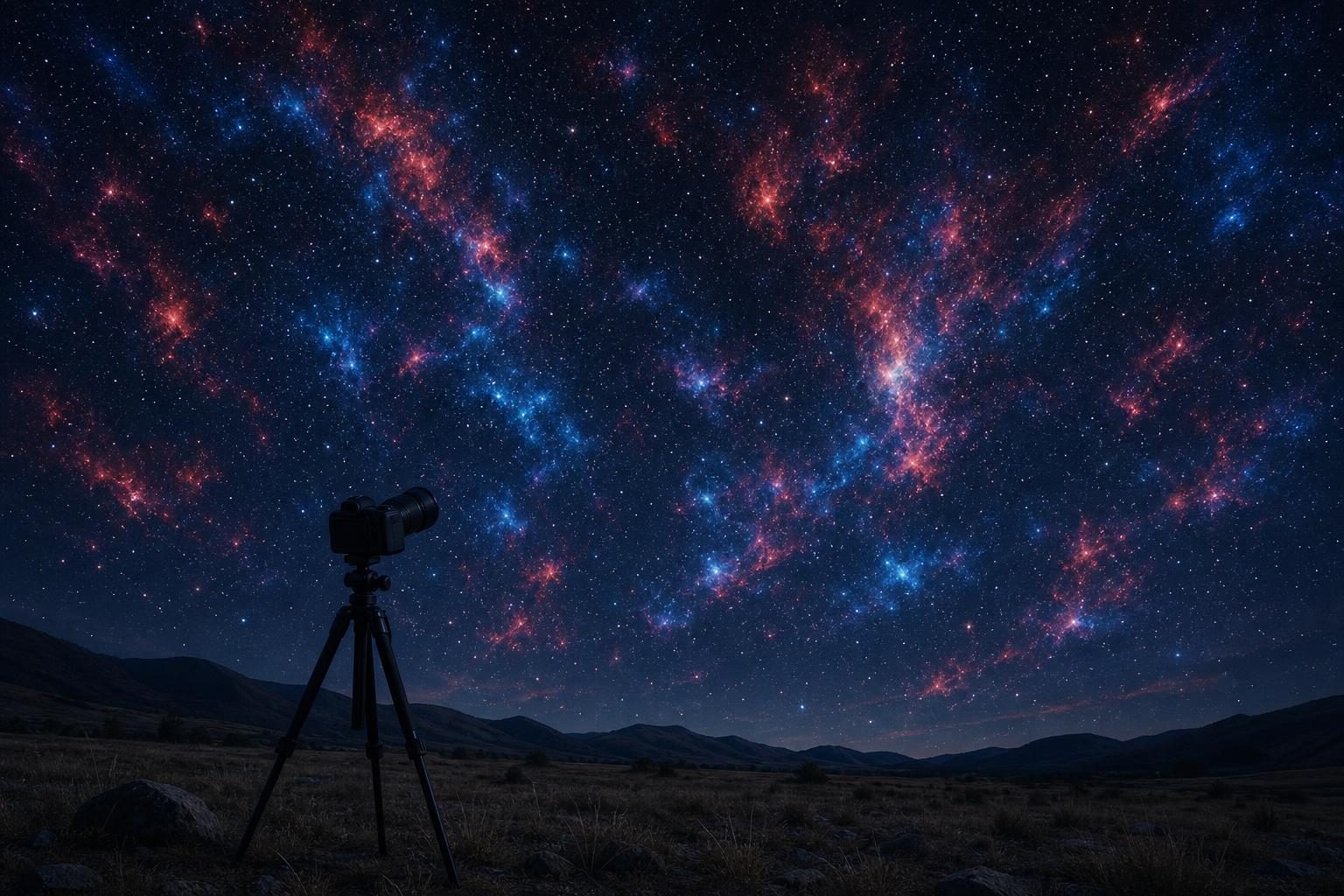
NASA’s Astronomy Picture of the Day shared a giant space image on Oct. 2. According to NASA, the picture brings together the complete Sharpless Catalog, an organized list, or catalog, of 313 glowing objects in space.
Most of the objects are nebulas. A nebula is a huge cloud of gas and dust in space. Some look like soft red smoke. Some have shapes that earned them nicknames, such as the Eagle, Heart, and Orion nebulas.
This picture matters because it shows how patient space watching can be. The astrophotographer, Bing Xin, traveled under dark skies in Eastern China and Inner Mongolia to collect the images. Each object took two to six hours to capture. NASA says the whole catalog took about 800 hours.
That is like spending many school days on one project. But the work could not be rushed. Very faint space clouds do not shine like a lamp in a room. A camera has to gather their light for a long time.
Xin also used special filters. A filter is like a pair of colored glasses for a camera. Some filters mostly caught light from hydrogen and oxygen. Those are gases found in many space clouds. Other filters caught red, green, and blue light, the colors cameras use to build a full-color picture.
NASA says the catalog is a list of H II regions. That means clouds where hydrogen gas is glowing. But the set is not only that. It also includes other kinds of space objects. That matters because a label can help scientists organize things, even when the real universe is messier than the label.
Imagine standing where the sky is very dark. There are no bright city lights nearby. The camera points at one patch of sky for hours. Then it moves to another. Night after night, the separate pictures become one huge collection.
For a classroom, the image is also a reminder about labels. A catalog can sound dry, like a list in a notebook. But this catalog is full of color, shape, and careful work. It shows that science is not only about sudden discoveries. Sometimes it is about keeping at a task until a hidden pattern becomes visible.
Written from reporting by NASA, “APOD: 2026 October 2 – The Complete Sharpless Catalog: 313 Nebulas”.
Discussion questions
- If a project takes 800 hours, what would make it worth doing?
- What can a giant catalog show that one beautiful space picture cannot?
- Do camera filters make a space image less real or more useful? Defend your view.