
Voyager 1 Nears a One-Day Message Delay
NASA’s farthest spacecraft will soon be so distant that a hello takes a day to arrive.
Print it — all four files
The student packet has no answers in it. The teacher copy is the same pages plus a note on each question and the answer keys. Both languages carry the same story, the same picture and the same vocabulary.
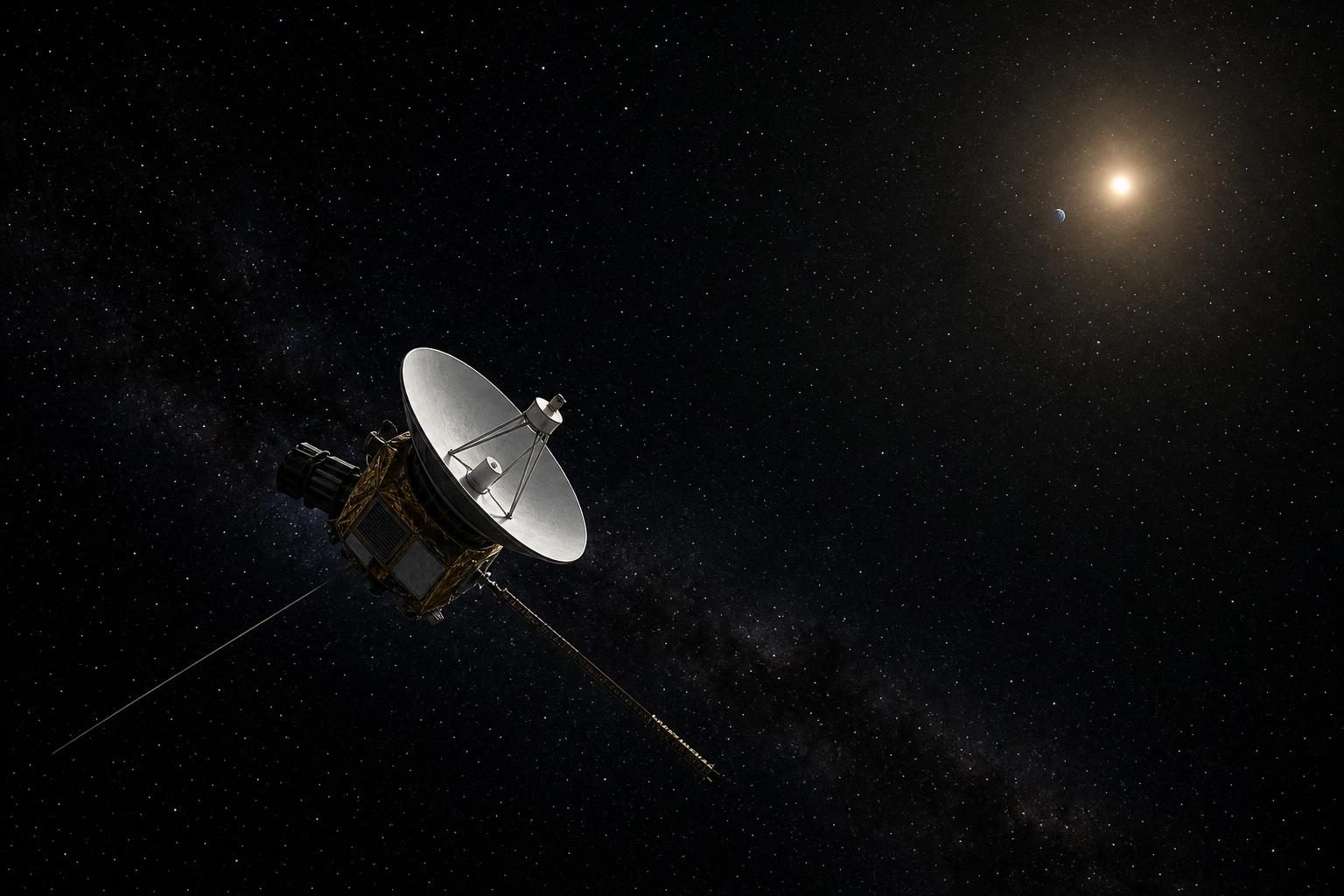
Voyager 1 is about to become one light-day from Earth. That means light needs a full day to travel from Earth to the spacecraft. According to Live Science, the NASA probe will reach that mark on Nov. 18.
A probe is a robot spacecraft. It travels where people cannot go. Voyager 1 launched in September 1977. It has been flying for more than 49 years. It is already the farthest human-made object in space.
The number is hard to picture. Voyager 1 is nearly 16 billion miles from Earth. It is moving at nearly 38,000 miles per hour. That sounds fast. In space, it is still a tiny step. Scientists say it will take about 300 more years to reach the inner edge of the Oort Cloud. That is a huge shell of icy objects around our solar system.
The light-day mark matters because it shows how big space is. If NASA sends Voyager 1 a radio message, the message travels at light speed. It will take 24 hours to get there. Then a reply would take another 24 hours to come back. Saying hello would mean waiting about two days.
That wait is not the only challenge. Far from the sun, sunlight is too weak for solar panels. Voyager 1 uses nuclear batteries. These batteries make electricity from heat. Their power is slowly running down. NASA has turned off some tools to save energy.
Even so, Voyager 1 still has a job. It sends back information from beyond the heliosphere. The heliosphere is a bubble made by the sun. It surrounds the planets and helps shield them from some space radiation, which is strong energy moving through space. Voyager 1 crossed beyond that bubble in 2012.
Imagine being in the control room. Nothing feels fast. There is no quick answer on a screen. A command leaves Earth, crosses darkness for a day, and reaches a machine older than many parents. Then everyone waits.
Voyager 1 also shows what long teamwork can do. Some people who built the mission are gone. New workers now help care for the same spacecraft. The mission is like a relay race, but the baton is far beyond the planets.
One day, Voyager 1 may go silent. For now, it is still moving outward. It is a small machine in a very large place, carrying human curiosity with it.
Written from reporting by Live Science, “'Out there, moving into the unknown': As Voyager 1 reaches one light-day from Earth, scientists reflect on its past — and its future”.
Discussion questions
- Is it worth caring for a spacecraft that takes two days to answer a message? Defend your view.
- How should scientists change their planning when they cannot get quick answers from a machine?
- Should a future mission study nearby worlds closely, or travel far like Voyager 1? Explain your choice.