
Saturn Puts On a Clear Show
A new NASA sky image shows Saturn, its rings, and moons in sharp detail.
Print it — all four files
The student packet has no answers in it. The teacher copy is the same pages plus a note on each question and the answer keys. Both languages carry the same story, the same picture and the same vocabulary.
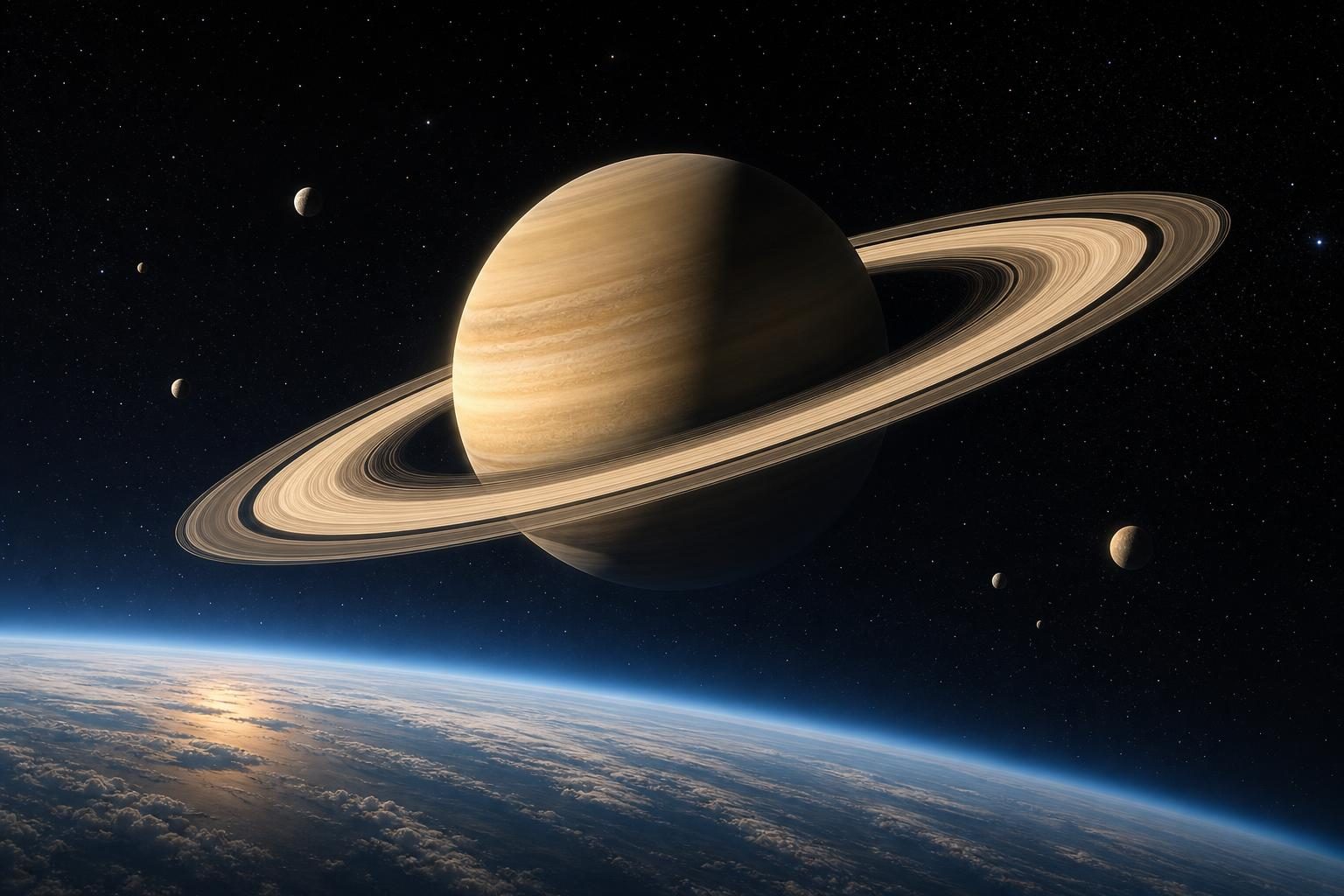
NASA shared a very clear picture of Saturn on October 8. According to NASA’s Astronomy Picture of the Day, astrophotographer Tom Williams made the image from the United Kingdom. It shows the Saturn system, meaning Saturn, its rings, and nearby moons.
The picture was not just lucky because the sky was cloudless. The air above Earth also had to be unusually calm. Air is not empty. It has moving pockets that can be warmer, cooler, thicker, or thinner. Those pockets bend light as it travels through the atmosphere, which is the blanket of air around Earth.
Astronomers call this problem “seeing.” Bad seeing makes a planet look wiggly or blurry. It is a little like looking at a coin at the bottom of a swimming pool. When the water moves, the coin seems to shimmer. When the water is still, the coin looks sharper.
Williams also used a method called lucky imaging. In this method, a fast camera takes thousands of very short pictures. Some pictures are clearer than others because the air changes from moment to moment. The clearest pictures are chosen and added together. That can make one much sharper final image.
The result is a space scene with many things to notice. Saturn’s rings show dark gaps. NASA also points out possible “spokes,” which are faint marks in the rings. The image includes Titan, Saturn’s largest moon. It also includes Enceladus, an icy moon with bright stripes.
This is a good time to look for Saturn from Earth. Saturn reached opposition on October 4. Opposition means Earth passed between Saturn and the Sun. Around that time, Saturn is well lit by the Sun from our point of view. It is also closer to Earth than at many other times in its path.
You would not see this much detail with just your eyes. To your eyes, Saturn looks like a steady bright point. But the same planet is there. The photo shows how careful timing, calm air, and many tiny choices can turn a dot in the sky into a world with rings and moons.
Written from reporting by NASA, “APOD: 2026 October 8 – The Saturn System Smörgåsbord”.
Discussion questions
- If a class could plan one night to look for Saturn, what should matter more: the date in Saturn’s orbit or the weather in Earth’s air? Defend your choice.
- Lucky imaging uses many quick pictures instead of trusting one picture. Where else might taking many tries help people learn or make something better?
- Does this story make Earth seem like a good place or a difficult place for studying space? Explain both sides.