
Tiny Rock Sample May Help Solve Mars Moon Mystery
Japan’s MMX mission is heading to Phobos to bring back a piece of Mars’s lumpy little moon.
Print it — all four files
The student packet has no answers in it. The teacher copy is the same pages plus a note on each question and the answer keys. Both languages carry the same story, the same picture and the same vocabulary.
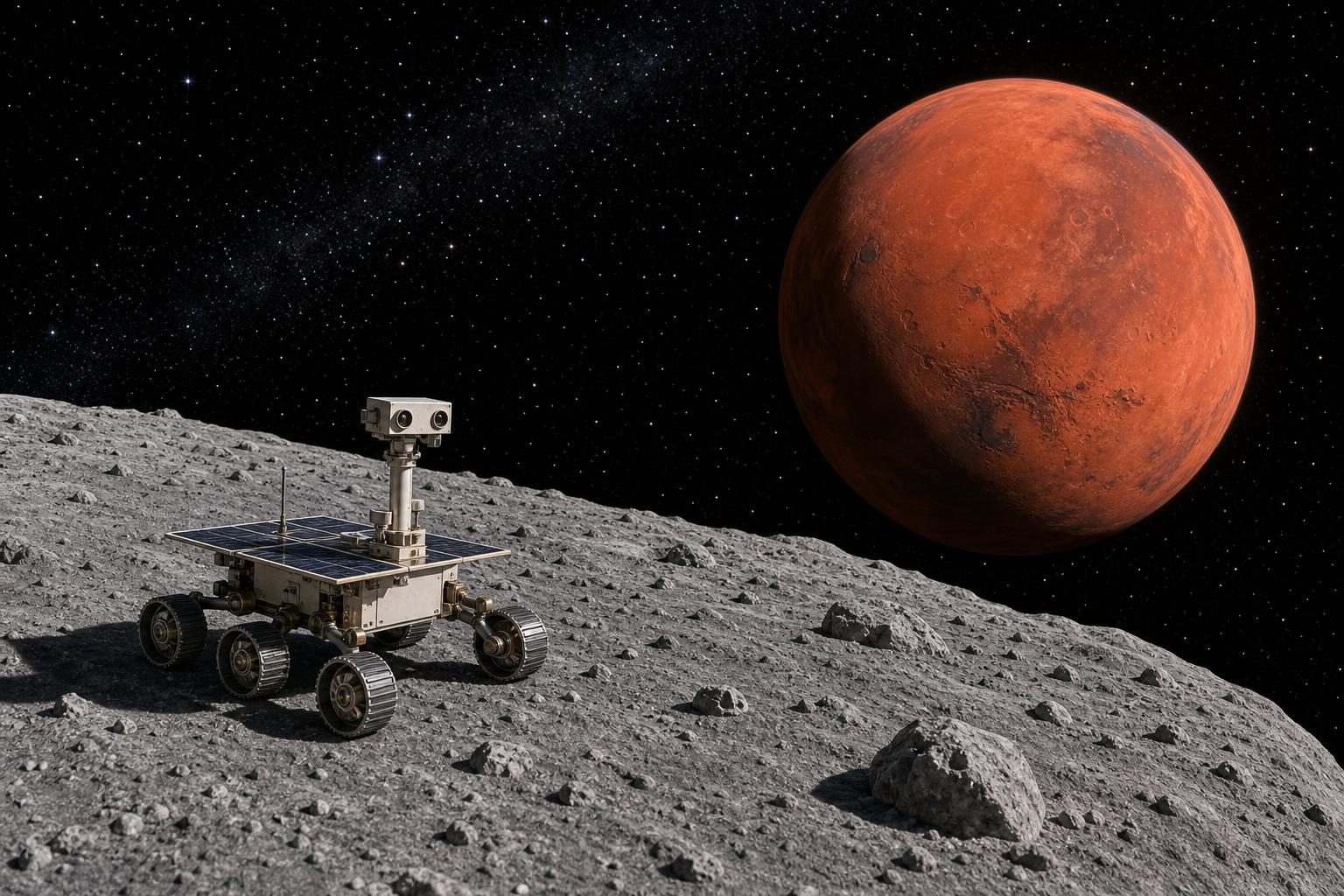
A Japanese-led space mission blasted off on Monday, October 19, to visit Phobos, the larger of Mars’s two moons, according to BBC Newsround. The mission is called Mars Moons Exploration, or MMX. It is run by Japan’s space agency, Jaxa, which is like Japan’s NASA.
The spacecraft is traveling from Earth to Phobos. If the plan works, a rover will land there in August 2027. A rover is a small robot made to explore a place. It will scoop up a tiny sample, which means a bit of rock and dust from the surface.
That would be a first. No mission has ever brought home a piece of one of Mars’s moons. The sample is expected to come back to Earth in 2031. The landing spot is planned for a desert in South Australia. The sample will be only 10 grams, about as heavy as a dry tea bag.
That may sound too small to matter. Scientists say it is not. Dr. Chrysa Avdellidou of Leicester University told BBC News that it is “worth every gram.” Scientists can study tiny bits of rock with special tools. They can look for clues about what the moon is made of, and where it came from.
The big question is how Phobos and Deimos began. Deimos is Mars’s other moon. Scientists have two main ideas. One idea is that the moons formed from debris, or broken pieces, after Martian rock smashed apart. The other idea is that they are asteroids, which are rocky space objects, from the outer Solar System.
Phobos and Deimos are very different from Earth’s Moon. Our Moon looks round in the sky. Phobos is about 20 kilometers, or 12 miles, wide. Deimos is about 10 kilometers, or 6 miles, wide. BBC Newsround describes them as shaped like lumpy potatoes. Imagine trying to land gently on a small, uneven rock far from home.
The mission connects to something simple: crumbs can tell a story. A crumb on a plate can show what someone ate. A tiny rock from Phobos may show whether Mars’s moons were born near Mars, or traveled in from farther away. That is why a tea-bag-sized sample can be a big deal.
Written from reporting by BBC Newsround, “Mission to solve Mars moon mysteries”.
Discussion questions
- Do you think it is worth sending a spacecraft so far away for a sample as small as a dry tea bag? Defend your answer.
- Which origin story would be more surprising to you: that Phobos came from broken Martian rock, or that it began as an asteroid? Explain why.
- Before you trusted scientists’ answer about where Phobos came from, what would you want them to show or explain?