
Four Footprints Show a T. rex on the Move
A rare row of tracks helps scientists picture how a giant dinosaur walked.
Print it — all four files
The student packet has no answers in it. The teacher copy is the same pages plus a note on each question and the answer keys. Both languages carry the same story, the same picture and the same vocabulary.
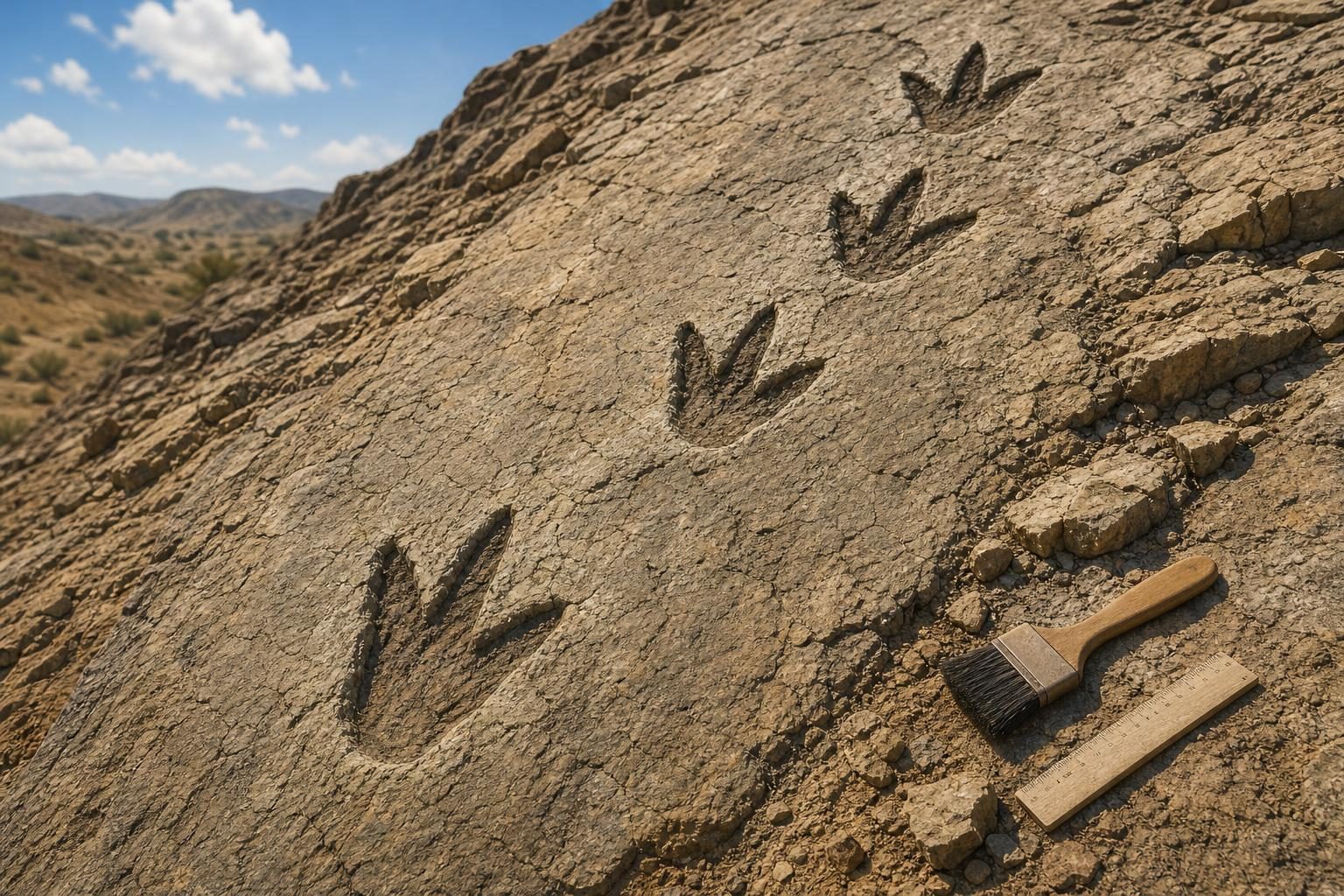
Four fossilized footprints are giving scientists a rare look at how an adult Tyrannosaurus rex moved. According to Science News Explores, the prints are likely the first known trackway from an adult T. rex. A trackway means three or more footprints in a row. That matters because one footprint is like one still photo. A row of prints is more like a short movie.
The trackway was found in North Dakota by Kent Hups, a high school teacher and paleontologist. A paleontologist is a scientist who studies ancient life. Hups was fossil hunting last year when he noticed a huge three-toed print. It stuck out from a steep hillside. The print was 80 centimeters, or 31.5 inches, across. He thought it had to be from T. rex.
The footprints were not open holes anymore. Mud had filled the old prints, hardened, and turned into fossil rock. Later, softer rock around them wore away. That left the filled-in footprints standing out. This is a little like mud drying around a shoeprint after recess. The difference is time. These prints were left about 66.5 million years ago.
The scientists used the spaces between the steps to estimate speed. Estimate means make a careful answer from clues. They figured the animal moved about 1.6 meters each second. That would feel like a quick walk for a person. It does not show a chase. It shows an enormous animal walking along, placing one foot after another.
The team cannot be completely sure the maker was T. rex. The footprints are not perfectly preserved, which means some details were damaged or lost. But the toes were slender. Fossils from the same area also point to T. rex. Peter Falkingham, another paleontologist on the team, said T. rex is the best match with what scientists know now.
Better tracks could answer even more questions. They might show whether the foot landed flat or rolled from toe to heel. They might show how the pads under the foot held the animal’s weight. There may even be another footprint still hidden in the hill. The team is waiting for weather to wear away more rock. Sometimes science moves at a walking pace too.
Written from reporting by Science News Explores, “Four T. rex footprints hint at how fast it traveled”.
Discussion questions
- Why can a row of footprints tell scientists more than one footprint by itself?
- Should scientists wait for nature to uncover more of the hill, or should they dig sooner? Defend your choice.
- What information is still missing before scientists can feel more certain about how this T. rex walked?