
When Our Moon Passed in Front of Jupiter
A NASA image shows Earth's Moon and four of Jupiter's moons lined up in one night-sky view.
Print it — all four files
The student packet has no answers in it. The teacher copy is the same pages plus a note on each question and the answer keys. Both languages carry the same story, the same picture and the same vocabulary.
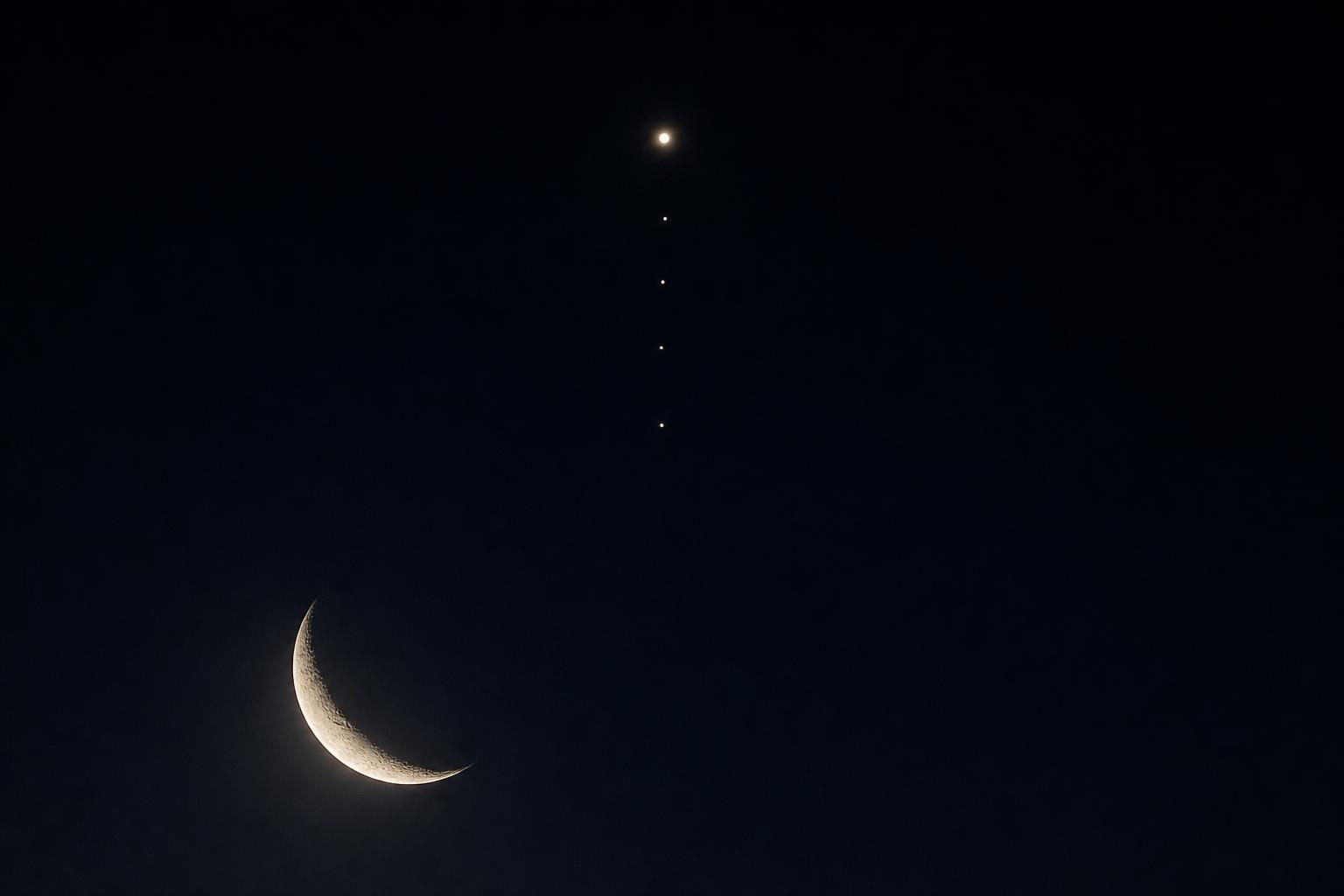
According to NASA’s Astronomy Picture of the Day, a sky view joined Earth’s Moon with Jupiter and four of Jupiter’s moons. The picture was made in Westchester, New York, after Earth’s Moon moved directly in front of Jupiter last week.
In space, the objects were still very far apart. They only looked close from Earth. That is called an alignment, when things line up from one point of view. Think of holding your thumb in front of a faraway tree. Your thumb did not touch the tree. It only blocked your view.
The NASA image shows five moons in all. One is Earth’s Moon. The other four circle Jupiter. Orbit means to travel around something in space. Their names are Ganymede, Io, Callisto, and Europa.
In the picture, Earth’s Moon sits low on the left. Its bright crescent is sunlit. A crescent is the curved sliver shape you see when only part of the Moon looks bright. That bright part is overexposed. Overexposed means so bright in a photo that details get washed out.
The darker part of our Moon is not fully black. It is faintly lit by Earthshine, which is dim light from Earth. Above our Moon, the four moons of Jupiter appear in a nearly straight line. NASA lists them from bottom to top as Ganymede, Io, Callisto, and Europa.
The sizes may surprise people. Callisto, Ganymede, and Io are each larger than Earth’s Moon. Europa is only a little smaller than Earth’s Moon. From Earth, though, they look like tiny points of light near giant Jupiter.
The image was made from a series of exposures. An exposure is a photo that lets in light for a set time. Different exposures can help show bright and dim things in one scene. That matters because Earth’s Moon and Jupiter’s moons do not shine equally.
NASA also says its robotic spacecraft Juno is orbiting Jupiter now. A robotic spacecraft has no people on board. Juno has made close passes near three of these moons.
The picture matters because it shows how much depends on where you stand. A familiar Moon can seem to meet a faraway planet. A photograph can help people notice that the night sky is not flat. It is full of moving worlds, lined up for a moment from home.
Written from reporting by NASA, “APOD: 2026 October 12 – Jupiter and the Moons”.
Discussion questions
- Why might a photograph like this teach something that words alone might not?
- The moons looked close even though they were far apart. Where else can point of view change what something seems to be?
- Should science pictures show what our eyes would see, or show details our eyes might miss?