
China slows a Moon mission in the race for the lunar south pole
A delayed launch shows how space programs balance safety, timing, and national competition.
Print it — all four files
The student packet has no answers in it. The teacher copy is the same pages plus a note on each question and the answer keys. Both languages carry the same story, the same picture and the same vocabulary.
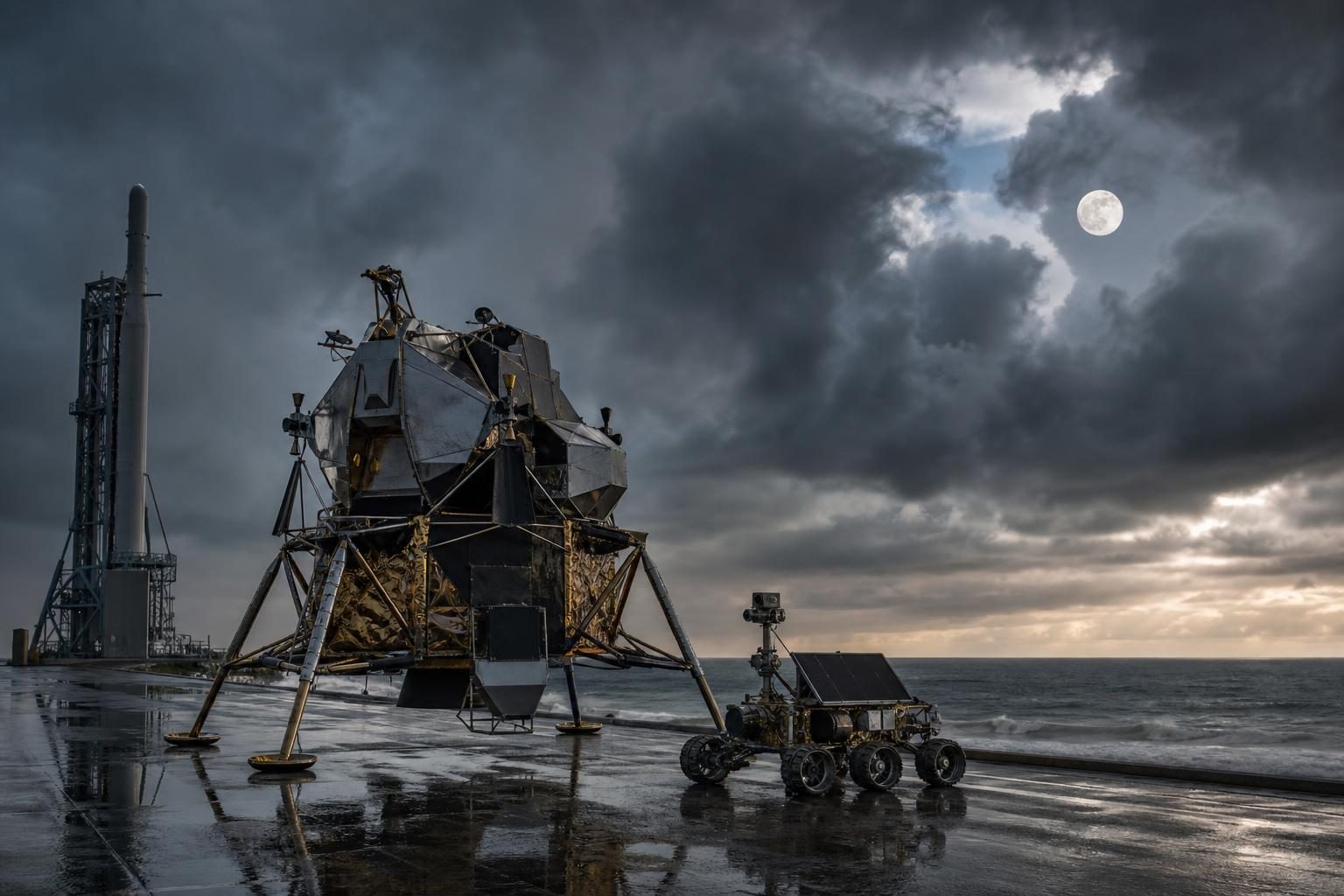
China has delayed Chang’e 7, a major robotic Moon mission that had been expected to launch as early as Sunday, according to reporting by Ars Technica. China’s Manned Space program said the mission did not meet the conditions for launch during this year’s planned window, but it did not give a specific reason. The announcement matters because Chang’e 7 is not just another science probe. It is meant to scout the Moon’s south pole, a region both China and the United States see as important for future astronaut missions.
A launch window is the limited period when a spacecraft can leave Earth and still reach its target using the planned route and amount of fuel. Missing that window can mean waiting weeks or months, depending on the mission. Ars Technica reported that the delay could push the mission into 2027, though Chinese officials have not confirmed a new date. The spacecraft was supposed to ride on a Long March 5 rocket from the Wenchang Space Launch Site on Hainan island in southern China.
The official explanation was brief: after a review, the mission would not proceed because China wanted prudence, reliability, and what it called absolute success. That phrase points to the central tension. Space programs are under pressure to move quickly, especially when another country is racing toward the same goal. But rockets and deep-space missions are expensive, dangerous, and unforgiving. A failed launch can destroy years of engineering work in minutes.
The possible cause may be ordinary weather rather than a dramatic technical failure. Ars Technica noted that Typhoon Narra, with 45-mile-per-hour winds, was moving near the waterway between Hainan and mainland China. A typhoon is a tropical cyclone in the western Pacific, the same kind of storm called a hurricane in the Atlantic. The Joint Typhoon Warning Center expected the storm to linger in the area for two or three days, which could have made conditions at the launch site unsafe or unreliable. Chinese officials, however, have not confirmed that weather was the reason.
There is another reason outsiders are watching closely. Two weeks earlier, China lost a Long March 7A rocket during ascent after what the state news agency called an anomaly, meaning something went wrong but was not immediately described in detail. The delayed Chang’e 7 mission uses a different rocket, the Long March 5, but Ars Technica reported that the two rockets share an engine type. The article says an engine issue seems unlikely to be the reason for the delay, because China had continued moving toward launch in recent days. Still, recent failure can make any space agency more cautious.
Chang’e 7 is designed as a package of machines: an orbiter to circle the Moon, a lander to touch down, a rover to drive across the surface, and a small hopping probe that could move in short jumps. Its destination is near Shackleton Crater, very close to the lunar south pole. A crater is a bowl-shaped depression, usually made by an impact. The south pole is valuable because some crater interiors are permanently shadowed, meaning sunlight never reaches them. These areas are called cold traps because ice and other materials may have stayed frozen there for billions of years.
That possible ice is the reason the region attracts so much attention. Water is heavy and expensive to carry from Earth. If future crews could use lunar ice, it might support drinking water, oxygen, or rocket fuel. That does not mean a Moon base is easy or guaranteed. It does mean that a relatively small part of the Moon could matter a great deal to countries planning long-term exploration.
No country has softly landed a spacecraft at the lunar poles, according to Ars Technica. A soft landing means touching down without crashing, so the spacecraft can keep working. Polar landings are harder than landings near the Moon’s equator because of lighting, terrain, and communication challenges. Chang’e 7 is meant to help prepare for later human missions, and China has said it aims to land astronauts on the Moon before 2030.
The delay also affects the United States’ plans. NASA’s Artemis program is the American effort to return astronauts to the Moon and build a longer-lasting presence there. Ars Technica reported that Blue Origin’s Blue Moon Mark 1 lander, carrying two NASA probes, could also try to reach the lunar south pole. But that mission has its own problems: Blue Origin’s New Glenn rocket and its Florida launch pad were damaged during a static fire test in May. A static fire test is when a rocket’s engines are fired while the rocket is held down on the ground.
So this is not a simple story of one country falling behind and another speeding ahead. Both sides are trying to reach a difficult place with complex machines, and both have reasons to avoid failure. The disagreement is partly about priorities. Moving fast can bring prestige and scientific advantage. Waiting can protect hardware, reputation, and human plans that depend on earlier robotic missions. In space exploration, caution can look like weakness from the outside, but it can also be the difference between a mission that works and a bright object breaking apart in the sky.
Written from reporting by Ars Technica, “Due to need for 'absolute success,' China delays critical Moon launch to 2027”.
Discussion questions
- When a space mission is part science project and part national competition, how should leaders decide whether to delay it?
- Should governments be expected to explain launch delays in detail, or can secrecy be justified in high-stakes space programs?
- If only a few areas of the Moon are especially useful for future missions, what principles should guide how countries use or claim access to them?