
Dutch Rice Tests a New Future for Sinking Peatlands
A small harvest asks whether wet farming can protect land and climate without creating new problems.
Print it — all four files
The student packet has no answers in it. The teacher copy is the same pages plus a note on each question and the answer keys. Both languages carry the same story, the same picture and the same vocabulary.
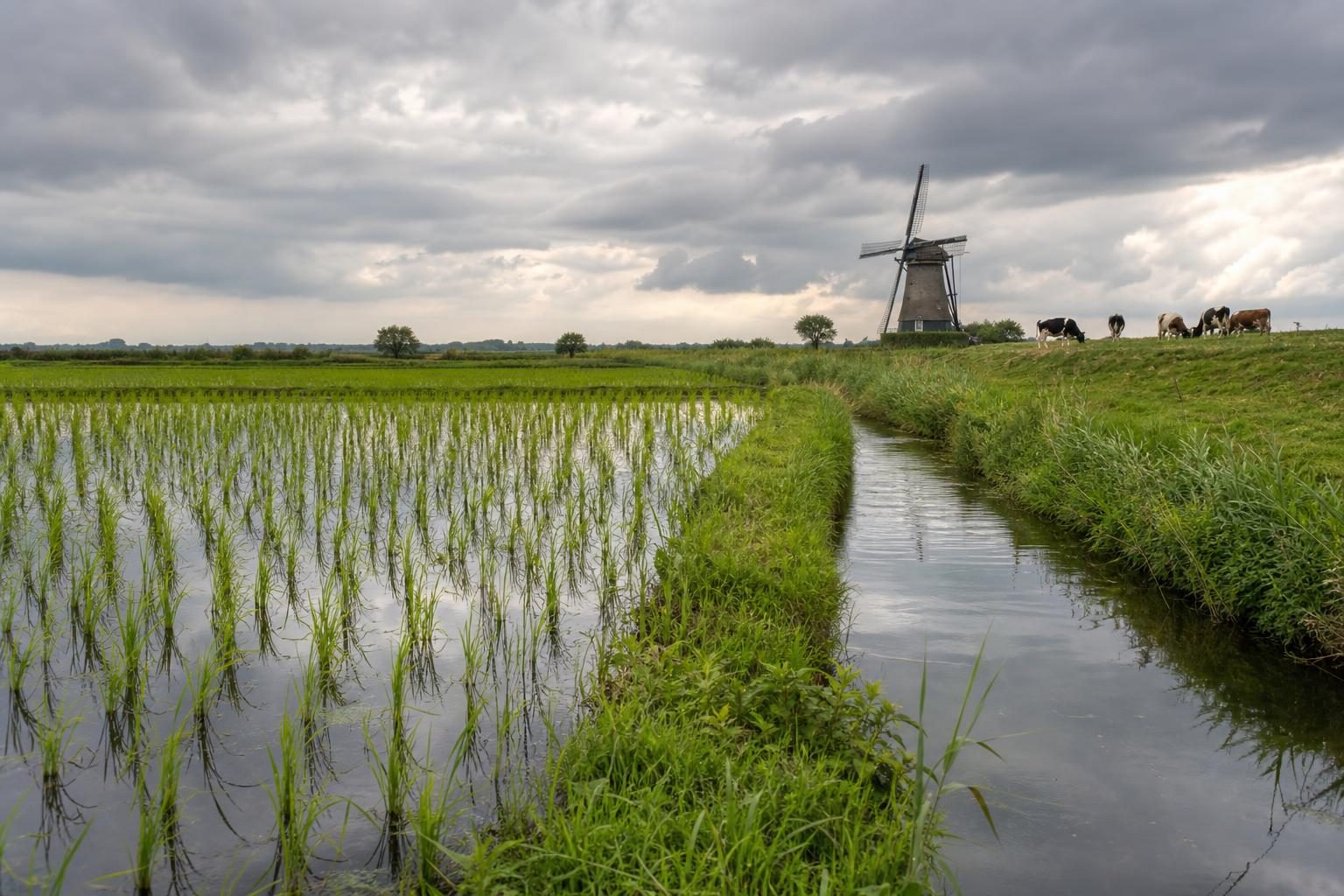
A farmer in the Netherlands has harvested rice from a small, soggy field between Amsterdam and The Hague, testing whether a crop more often associated with Asia could help solve a Dutch climate problem. According to reporting published by Phys.org, the pilot field covers just 0.6 hectares, or about 1.5 acres, but researchers are watching it for a much larger reason: it may offer farmers a way to keep peat soils wet instead of draining them for dairy pasture.
That matters because peatland is land made of partly decayed plant material that has built up over long periods in wet conditions. When peat stays wet, much of that carbon-rich material remains locked in place. When farmers drain peatland so grass can grow for cattle, the peat dries, breaks down, releases carbon dioxide, and the land surface sinks. Carbon dioxide is a heat-trapping gas that contributes to climate change. In the worst-affected Dutch areas, the ground can subside, meaning sink downward, by several centimeters a year.
The Netherlands has a special stake in that problem. Much of the country is low-lying, and the rice field described in the article sits in polders, which are areas of land protected by dikes and managed with canals and pumps. The surrounding landscape is familiar Dutch farm country: canals, windmills, cows, and grassland. But roughly one-tenth of the country is peatland, and Wageningen University says emissions from Dutch peat soils account for about 2% to 3% of the country’s total greenhouse gas emissions. Greenhouse gases are gases that trap heat in the atmosphere.
The trade-off is not simple. Keeping peat wet can slow sinking land and reduce carbon dioxide emissions, but wet fields are not useful for the same kind of dairy farming that has shaped the Dutch countryside for centuries. Farmers need income, not just good intentions. If a field can no longer grow grass for cows, it needs another crop or another business model. Rice could be one answer because it grows in wet conditions. The pilot project is trying to show that wetland farming does not have to mean abandoning production.
The experiment is also a sign of a changing climate. A warmer climate has already made it possible for some Dutch farmers to produce wine, and now researchers are testing rice, once considered unrealistic in the country’s cool, wet climate. The project team is trying about 30 rice cultivars, meaning plant varieties selected for different traits, from places including Russia, China, Japan, and Uzbekistan. The current harvest uses a short-grain rice suitable for foods such as sushi or risotto, and the organizers hope the test plot will produce around three tonnes.
That possibility has two sides. On one hand, rice in the Netherlands could be an example of adaptation, which means changing human systems so people can live with the effects of climate change already underway. On the other hand, the fact that rice can now be tested there is unsettling evidence that the climate itself has shifted. One project leader described the idea as extraordinary but also frightening because it shows what has become possible.
Researchers also see a chance for mitigation, which means reducing the causes of climate change, not just coping with the results. If rice lets farmers keep peat soils wet, it could help stop peat from degrading and releasing carbon dioxide. That would make the crop more than a novelty. It could become part of a strategy for places in northern Europe where drained peatlands create similar problems, including parts of Germany, Belgium, and the Baltic states.
But rice is not an automatic climate win. Wet rice fields can produce methane, another heat-trapping gas. Methane does not stay in the atmosphere as long as carbon dioxide, but it is powerful while it is there. The Dutch researchers are therefore comparing the carbon dioxide and methane released from rice cultivation with the emissions from drained grassland. One researcher said the early results are promising, but the project is still a pilot. If wet rice fields cut carbon dioxide but release too much methane, the benefits could shrink or disappear.
There is also a cultural and economic question. Dutch dairy farming is not just an industry; in some areas it is part of the landscape and local identity. Switching from cows and grass to rice paddies would change how fields look, how farms operate, and what skills farmers need. Local restaurants have already shown interest in Dutch-grown rice as a premium product, but restaurant curiosity is not the same as a stable market for many farms. A small harvest can prove possibility; it cannot yet prove profitability.
That is why this story is less about rice itself than about how societies decide what to protect when conditions change. The old system of drained peatland supports familiar farming but contributes to emissions and sinking ground. A new wet-farming system might reduce those harms, but it asks farmers and communities to accept different crops, new risks, and uncertain markets. The Dutch pilot does not settle the question. It makes the choice visible.
Written from reporting by Phys.org, “Rice work: Dutch test new crop to save sinking peatlands”.
Discussion questions
- If keeping peatlands wet helps prevent emissions and sinking land, how much should society ask farmers to change long-standing ways of farming?
- Should a crop made possible by a warming climate be seen mainly as smart adaptation, or as a warning sign?
- What information would you need before deciding whether Dutch rice is a good climate solution rather than just an interesting experiment?