
Kenya’s First Ebola Case Tests Public Health Trust
Officials are tracing contacts after one death, while communities weigh safety measures against fear, disruption, and mistrust.
Print it — all four files
The student packet has no answers in it. The teacher copy is the same pages plus a note on each question and the answer keys. Both languages carry the same story, the same picture and the same vocabulary.
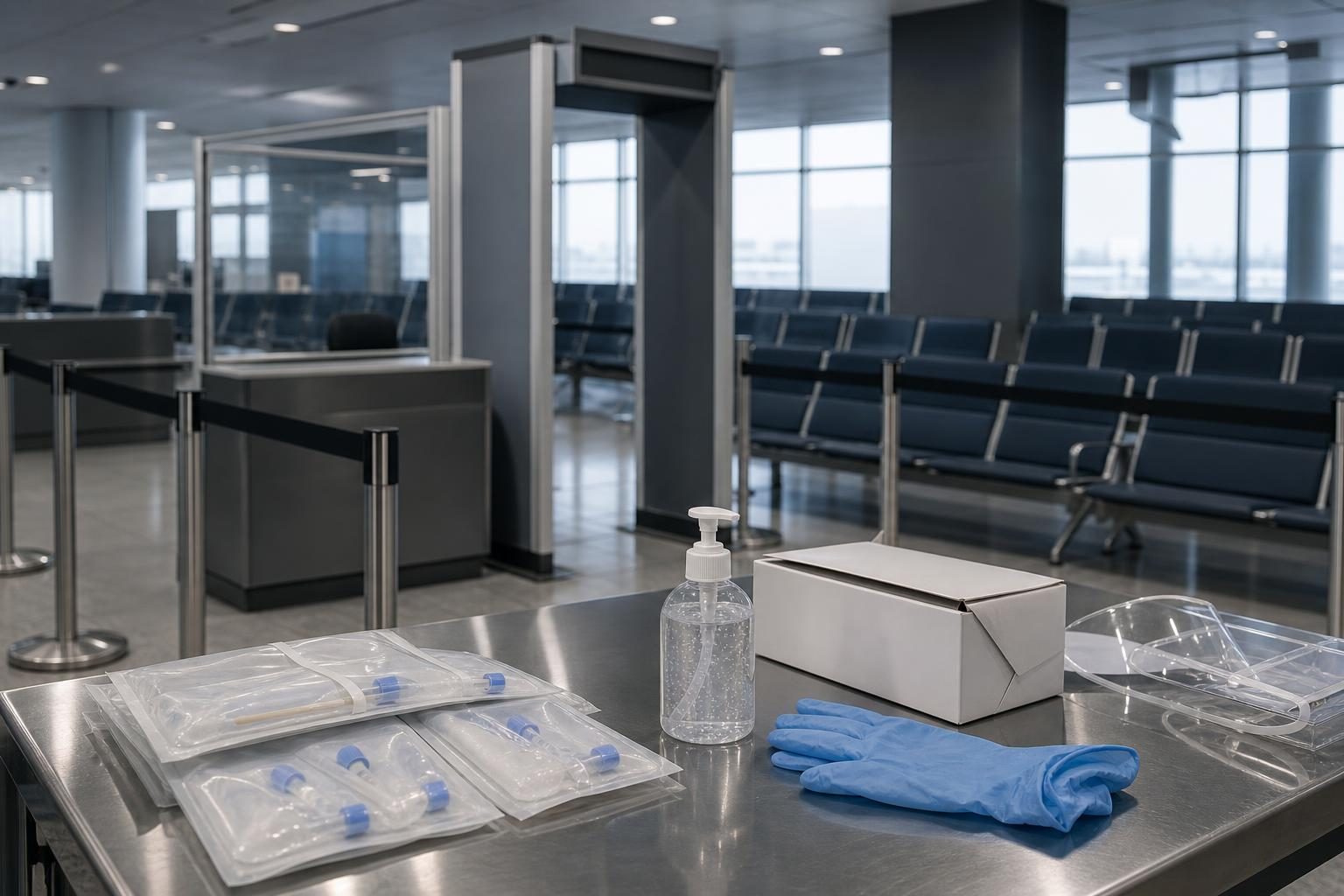
Kenya has reported its first confirmed Ebola case and its first death from the disease, after a Kenyan citizen who had been living in Congo returned to Nairobi and later tested positive. According to Associated Press reporting published by PBS NewsHour, Kenyan health officials said the man arrived in the capital on Saturday, was isolated at Nairobi Hospital, tested positive for Ebola, and died late Monday.
The immediate issue is containment. Ebola is a dangerous viral disease that spreads through contact with bodily fluids or contaminated materials such as bedding and clothing. Kenyan officials said they had identified 28 contacts, including family members and health workers, and were tracing 23 passengers and four crew members from the flight the man took from Uganda to Kenya. Contact tracing means finding people who may have been exposed so health workers can monitor them and act quickly if symptoms appear.
The man’s route shows why even one case can create a large response. Officials said he had lived in Congo for seven years and became ill about a month ago. He was treated at several hospitals before traveling by road to Kampala, Uganda, then flying to Nairobi. After arriving in Kenya, relatives took him by private vehicle to Nairobi Hospital, where he was immediately isolated. Health officials said the contacts would stay in isolation for 21 days and be released after testing negative for the virus.
That kind of response can save lives, but it also raises hard questions. Isolation protects the public by separating people who might become contagious, but it can also disrupt families, jobs, travel, and trust in authorities. Kenya has placed border points on high alert and is watching for possible additional cases. The source does not report that anyone else in Kenya has tested positive, but public health officials are acting before they know whether the virus has spread. That is often the point of emergency disease control: move early, because waiting for certainty can mean waiting too long.
The tension is not only medical. Kenya already hosts a United States-funded isolation center for American citizens exposed to Ebola, where people could quarantine for 21 days before returning to the United States. The AP reports that the facility faced legal battles and deadly protests from local residents who feared it was exposing them to the virus. That history matters because public health rules work best when people believe officials are protecting them, not hiding risks or imposing danger on one community for someone else’s benefit.
The case is tied to a much larger outbreak. The current outbreak was declared in mid-May after spreading for months in a remote part of eastern Congo. Government data cited in the report lists at least 8,400 cases and more than 4,000 deaths, making it the fastest-growing Ebola outbreak in history. Kenya is now the fourth country to record a case in this outbreak, after Congo, Uganda, and France. Uganda recorded 20 cases and France one; before Kenya’s case, there had been no active cases outside Congo since Uganda declared its outbreak over in late August.
International groups are now trying to help Kenya prevent wider spread. The World Health Organization said it was working with Kenya and had delivered about 1,000 Ebola tests and 1,000 personal protective equipment kits to high-risk counties. The Africa Centers for Disease Control and Prevention said it had sent a high-level team to support Kenya. These steps show another trade-off: outbreaks do not respect borders, but each country still has to make decisions that affect its own residents, travelers, health workers, and neighbors.
Conditions in Congo make the outbreak harder to stop. The AP reports that the disease has spread to seven provinces, while responders have faced attacks on health teams, misinformation, failure by some residents to report symptoms, and rebel violence that limits access to treatment centers. Cases have slowed in Ituri province, the outbreak’s epicenter, but the disease is spreading in emerging hot spots in North Kivu and South Kivu. The World Health Organization has warned that this outbreak could surpass the deadliest Ebola outbreak in history, which killed more than 11,000 people in West Africa more than a decade ago.
Kenya’s first case is therefore both a local emergency and a reminder of how fragile disease control can be. A strong response may require isolation, testing, tracing, and limits that feel severe to people who are not sick. A weak response may allow a deadly virus to move faster than health systems can follow. The hardest part is not choosing safety or freedom as if only one matters. It is deciding what level of restriction is justified, how to apply it fairly, and how to keep public trust while acting quickly.
Written from reporting by PBS NewsHour, “Man living in Congo who went back to Kenya is country's 1st confirmed Ebola case and death”.
Discussion questions
- When a country has one confirmed case of a deadly disease, how much disruption is justified before officials know whether it has spread?
- Why might communities resist isolation centers or contact-tracing efforts, even when those tools can protect public health?
- In an outbreak that crosses borders, who should carry the main responsibility for containment: the country with the outbreak, neighboring countries, or international organizations?