
Russia Tests NATO’s Airspace—and Its Nerves
A surge in drones, missiles, and aircraft crossing NATO borders raises a hard question: when does restraint become weakness?
Print it — all four files
The student packet has no answers in it. The teacher copy is the same pages plus a note on each question and the answer keys. Both languages carry the same story, the same picture and the same vocabulary.
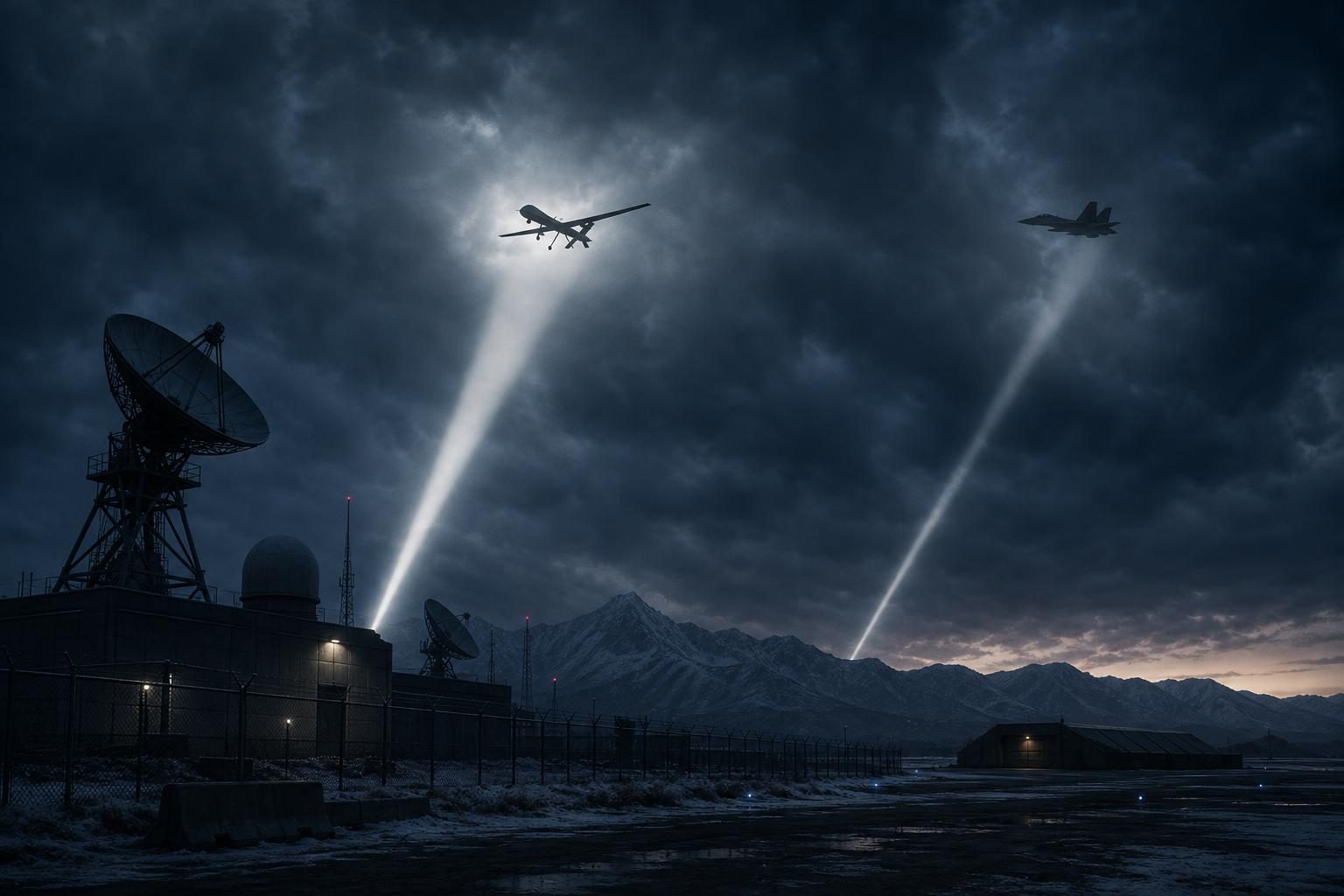
NATO held an urgent meeting on Nov. 23 after objects believed to be Russian weapons crashed in Poland, according to an analysis published by The Conversation. Three days earlier, three objects described as likely two missiles and a drone entered Poland during Russia’s war against Ukraine. Poland’s prime minister called the incident a deliberate provocation. NATO, the North Atlantic Treaty Organization, is a military alliance whose members pledge that an attack on one can be treated as an attack on all. That promise is meant to deter enemies. It also makes any violation of a member’s airspace unusually tense.
Airspace is the sky above a country’s territory, and an airspace violation happens when an aircraft, missile, or drone enters it without permission. Some violations can be brief or accidental, especially during a war near a border. Others can look like tests: how quickly radars notice, how fast fighter jets respond, whether governments protest, and whether the alliance stays united. The central problem for NATO is that every response carries risk. If it reacts too mildly, Russia may read that as permission to keep pushing. If it reacts too forcefully, NATO could help turn a border incident into a larger confrontation.
The Conversation analysis says Russian aircraft, drones, and missiles have violated NATO airspace dozens of times since Russia’s full-scale invasion of Ukraine began in February 2022. The author conducted a systematic review of international news reports, NATO press releases, and outside military assessments. The review included some drones that were strongly suspected to be Russian but could not be confirmed with complete certainty. That uncertainty matters. A country deciding whether to respond militarily may not have perfect information in the moment, especially when a drone crashes, debris is found later, or a missile passes through airspace quickly.
The pattern described in the analysis is what makes the issue more serious than one stray drone. From 2022 through 2024, the number of recorded incidents rose slowly: four in 2022, five in 2023, and six in 2024. Then the count jumped to 18 in 2025. In 2026, through Nov. 20, NATO members recorded 25 attributed Russian airspace violations. The analysis says those 2026 incidents make up 43% of all recorded violations over the five-year period. In other words, the question is not only whether any single incident was intentional. The question is whether the overall pattern shows a deliberate campaign to pressure NATO.
The type of incidents also changed. Early violations included brief fighter incursions, a reconnaissance drone crash in Romania, and a Russian cruise missile later discovered in Poland. A reconnaissance drone is an unmanned aircraft used to observe and gather information. By 2025, the analysis says more incidents had high-severity features, including deeper penetration into NATO territory, repeated drone entries, and larger swarms. One Russian drone reportedly traveled nearly 60 miles into Poland before crashing near Osiny. Another remained inside Romanian airspace for about four hours. A swarm of 21 drones over Poland forced major civilian airports to close temporarily. Those details suggest not just danger, but pressure on ordinary life: air travel, emergency planning, and public trust.
The violations were not limited to drones. Russian military aircraft also entered or approached NATO airspace in ways that raised concern. The analysis describes Russian MiG-31 interceptors flying over Estonia for about 12 minutes with transponders switched off. Transponders are devices that send an aircraft’s identity and altitude to air traffic control and defense systems; turning them off makes tracking more difficult and increases danger for civilian and military aircraft. In another case, a Russian Su-30 fighter and an Il-78 refueling tanker entered Lithuanian airspace. A tanker’s role is to refuel aircraft in flight, which can signal longer-range planning rather than a simple navigation mistake.
In 2026, the analysis says the incidents became more dangerous. In May, a Russian drone struck an apartment block in Galați, Romania, injuring two people. It was described as the first civilian injuries on NATO soil from this kind of incursion. On July 30, a Russian Kh-101 cruise missile flew about 60 miles into Poland before exploding in a field near Lublin. A cruise missile is a guided weapon that flies through the atmosphere toward a target, often at low altitude. On Nov. 20, during a mass Russian strike on Ukraine, a Kh-101, likely a second missile, and a jet-powered drone entered Polish airspace.
For NATO, the dilemma is not just military. It is political. The alliance has to show that its borders matter while avoiding a spiral in which each side answers the other with stronger moves. Russia can benefit from ambiguity: if a drone might be accidental, NATO may hesitate; if NATO hesitates too often, Russia may learn that probing is cheap. But NATO also benefits from caution: shooting down objects, scrambling jets, or expanding defenses can prevent damage, yet each action can be misread or used for propaganda. The hard question is where to draw the line between patience and deterrence. A single incident may be explained away. A repeated pattern is harder to ignore.
Written from reporting by The Conversation, “NATO witnesses a surge of airspace violations by Russia as Moscow seeks to test alliance”.
Discussion questions
- When should a repeated pattern of small violations be treated as a major threat, even if each single incident could be explained as accidental?
- What kind of response would best protect NATO members without making a wider war more likely?
- How should governments communicate uncertain threats to the public without causing panic or minimizing real danger?