
Supreme Court Asked to Weigh Mail Ballot Rules
A fight over postal rules pits election uniformity against state control and deadlines already underway.
Print it — all four files
The student packet has no answers in it. The teacher copy is the same pages plus a note on each question and the answer keys. Both languages carry the same story, the same picture and the same vocabulary.
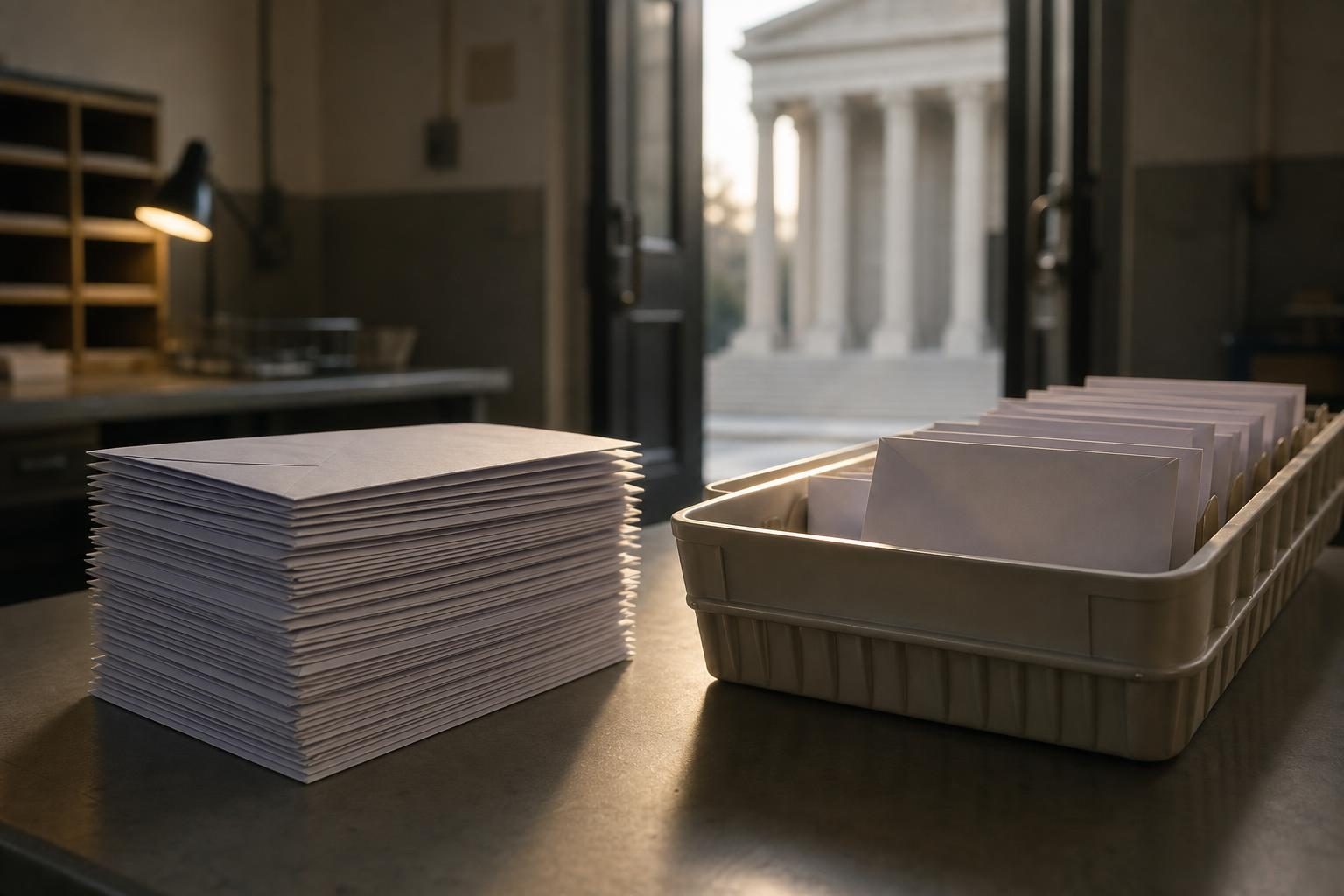
The Trump administration asked the Supreme Court on Thursday to let it enforce new rules for mail ballots, even as a federal judge questioned whether the system needed to carry out those rules was ready. According to Associated Press reporting published by PBS NewsHour, the emergency appeal came just before North Carolina was scheduled to begin sending mail ballots for the November midterm elections, the congressional elections held halfway through a president’s four-year term.
The dispute matters because it sits at the point where two parts of democracy meet: the legal rules for elections and the ordinary logistics that make voting possible. The administration says the U.S. Postal Service can set requirements for election mail, including envelope design and address information, because states are using the federal mail system. Its opponents say the president is trying to control election rules that the Constitution mainly leaves to the states, with Congress also having some authority.
The rules come from an executive order, which is a directive from the president telling federal agencies how to act within what the president claims is legal authority. Under the plan, the Postal Service could refuse to deliver mail ballots from states that do not use a uniform envelope style and do not upload lists of eligible mail voters to an online portal, meaning a central website where election offices would submit data. If the information in the portal did not match the information on ballot envelopes, the ballots would not be sent.
That idea raises a real trade-off. A uniform system could, in theory, make mail ballots easier for the Postal Service to process and check. But elections are already run on tight deadlines, and each state has its own procedures, printed materials, and legal requirements. A change that sounds small in Washington can become a major operational problem in a county election office that has already printed envelopes, prepared ballots, and trained staff.
U.S. District Court Judge Indira Talwani, in Boston, temporarily blocked the Postal Service from requiring use of the system. A temporary restraining order is a short-term court order meant to pause an action before a fuller hearing can happen. Talwani had earlier blocked the broader plan for the November election, saying the changes came too close to voting. The Supreme Court later said that earlier order was premature because the Postal Service had not yet issued detailed rules. After the agency published those rules, Democrats and voting-rights groups quickly sued again.
At Thursday’s hearing, Talwani pressed the Justice Department on whether the Postal Service’s online system was actually operating. The AP reported that the government lawyer said the Postal Service would fully implement the rule, but the judge focused on practical readiness as much as legal theory. The basic question was not only whether the government had authority, but whether it had a working process for tracking tens of millions of mail ballots at the moment voting was beginning.
The administration has asked the Supreme Court to move quickly. Its solicitor general, the lawyer who represents the federal government before the Court, argued that states cannot choose to use the federal mail system for elections while also claiming election mail is beyond Postal Service regulation. That argument frames the case as a question of federal control over the mail, not presidential control over elections.
The challengers frame it differently. They argue that states have the primary constitutional responsibility to decide how elections are run, and that the federal government is creating new conditions too late for election officials to meet them safely. Election officials quoted in the AP report said they could not simply redesign mail voting operations on short notice. Some ballots had already gone out in Wisconsin municipalities, and North Carolina’s mailing was set to begin Friday, with other states following soon after.
The Supreme Court has not decided whether the president’s plan is legal. For now, the justices are being asked whether the lower court’s pause should remain in place while the lawsuits continue. That narrower question still has large consequences. If the Court lets the rules take effect, states may have to adapt immediately or risk problems with mail ballot delivery. If the Court keeps the pause in place, the administration’s preferred system may not affect this election, even if some justices later conclude that parts of it are lawful.
This is why timing is central to the case. Courts often have to choose between enforcing a rule that might be lawful and preventing disruption that might be impossible to fix later. In an election, a missed deadline cannot easily be repaired after Election Day. At the same time, the federal government argues that courts should not block agencies from using powers Congress has given them over the mail.
The case is not only about whether mail voting is good or bad. It is about who gets to set the rules, how late those rules can change, and how much risk the legal system should tolerate when the machinery of an election is already moving.
Written from reporting by PBS NewsHour, “Trump again appeals to Supreme Court on mail voting restrictions as midterms loom”.
Discussion questions
- When election rules are challenged close to voting, should courts focus more on the likely legality of the rule or on the risk of disrupting the election? Defend your answer.
- Is the administration’s argument stronger if this is treated as a Postal Service case rather than an elections case? Why or why not?
- What information would you want before deciding whether the new mail ballot system is a reasonable safeguard or an unreasonable burden?