
Underwater Shades Offer Corals a Temporary Shield
A Florida Keys study suggests reef “umbrellas” can reduce bleaching, but only on a small scale and not without hard choices.
Print it — all four files
The student packet has no answers in it. The teacher copy is the same pages plus a note on each question and the answer keys. Both languages carry the same story, the same picture and the same vocabulary.
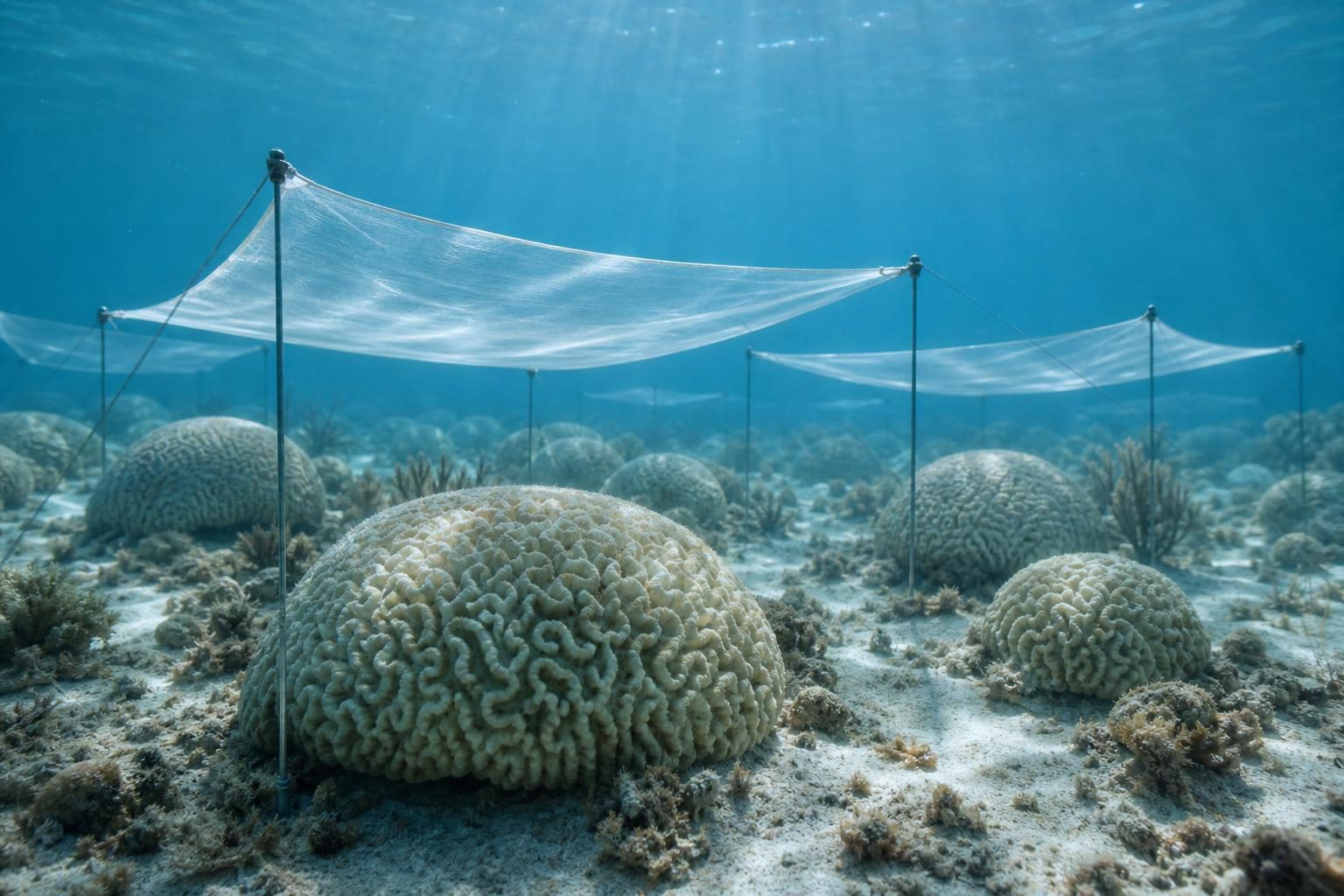
Scientists testing umbrella-like shades in the Florida Keys found that the structures can reduce some heat-related damage to vulnerable corals, according to reporting by Phys.org on a study in Frontiers in Marine Science. The result matters because it points to one of the hardest choices in conservation: when a whole ecosystem is under pressure, should people spend time and money protecting a few especially important pieces of it?
Coral reefs are living structures built by tiny animals called coral polyps. Many corals depend on algae that live inside their tissues. This relationship is symbiotic, meaning both organisms benefit: the coral gives the algae shelter, and the algae provide much of the coral’s food. The algae also help give coral its color. When ocean heat disrupts that relationship, corals can turn ghostly white in a process called bleaching. Bleached corals are not always dead, but they are stressed and can become weaker, less able to reproduce, and more vulnerable to disease.
The new study focused on brain corals in the Florida Keys after a severe 2023 bleaching event. The researchers were not trying to cool the ocean. Instead, they tested whether blocking some sunlight could reduce the extra damage caused by ultraviolet light, a high-energy part of sunlight, and irradiance, the amount of light energy hitting a surface. Heat is the main stressor, but too much light can make heat damage worse.
In summer 2024, Dr. Karen Neely of Nova Southeastern University and her team set up custom-made shades at Newfound Harbor in the Florida Keys. The shades were made from pipes and nylon cloth, temporarily tied to the seabed, and floated about 30 centimeters, or 12 inches, above the corals. They reduced light by 60 percent. The team used two species of brain coral, Pseudodiploria clivosa and Colpophyllia natans, and also selected matching unshaded corals for comparison. In an experiment, a comparison group like that is called a control, because it helps researchers judge whether the treatment itself made a difference.
Divers returned every two weeks to track coral color and take small tissue samples. Those samples helped the researchers examine the algae living in the corals. The summer’s heat stress at the site was the second-highest on record, but the shaded corals lost less color than expected. The difference between shaded and unshaded corals was greatest during the most intense heat stress. Some shaded corals even regained color after the shades were installed.
That sounds like a hopeful result, but it comes with limits. The researchers saw less bleaching overall than they expected, and no corals died in either the shaded or control groups. One possible reason is that many surviving corals were already hosting Durusdinium, a type of algae that tolerates heat well. That can help corals withstand high temperatures, but the article notes that it is also linked with lower coral growth and possibly greater disease risk. In other words, survival after one heat wave does not mean the reef is healthy in every way.
The study also did not find differences in the density or species of algae between shaded and unshaded corals. The researchers said their sampling rules may have affected that result. Their permits required them to take samples from coral edges, which receive less light and may bleach less than more exposed parts. They also could not install the shades until after the water had already become hot enough to bleach coral. If the shades had gone up earlier, the results might have looked different, but the study cannot prove that.
The biggest issue is scale. A shade over one coral colony is a targeted intervention, not a reef-wide solution. Reefs can stretch across large areas, and storms, currents, cost, permits, boat access, and labor all matter when people try to work underwater. The source article emphasizes that shading may offer temporary protection on small scales, not a substitute for reducing the climate change that is raising ocean temperatures.
That is where the real disagreement begins. Supporters of tools like underwater shades can argue that triage is better than surrender. If certain corals are rare, important for reproduction, or part of a reef restoration plan, protecting them through a heat wave could preserve options for the future. Critics can answer that these projects may distract from the larger problem, or force scientists and agencies to make uncomfortable decisions about which corals deserve help and which are left unprotected.
Both views can be true at once. The shades did not cool the sea, and they cannot protect every reef. But the study suggests they may help some corals survive moments of extreme stress. The difficult question is not whether the tool is perfect. It is how a society should use imperfect tools when the damage is already happening and the larger solution is still unfinished.
Written from reporting by Phys.org, “Underwater umbrellas for coral reefs could help protect against heat damage”.
Discussion questions
- If conservation groups can protect only a small number of corals during a heat wave, what criteria should decide which ones get help?
- Do temporary fixes like underwater shades make climate action more likely by buying time, or less likely by making the crisis seem manageable?
- What evidence would you want before public money was spent on expanding this kind of reef protection?