
Free activities › Middle school
A Blue Nebula Shows Why the Sky Is Blue
NASA’s image of the day links a faraway cloud of dust to a science idea visible from any schoolyard.
Print it — all four files
The student packet has no answers in it. The teacher copy is the same pages plus a note on each question and the answer keys. Both languages carry the same story, the same picture and the same vocabulary.
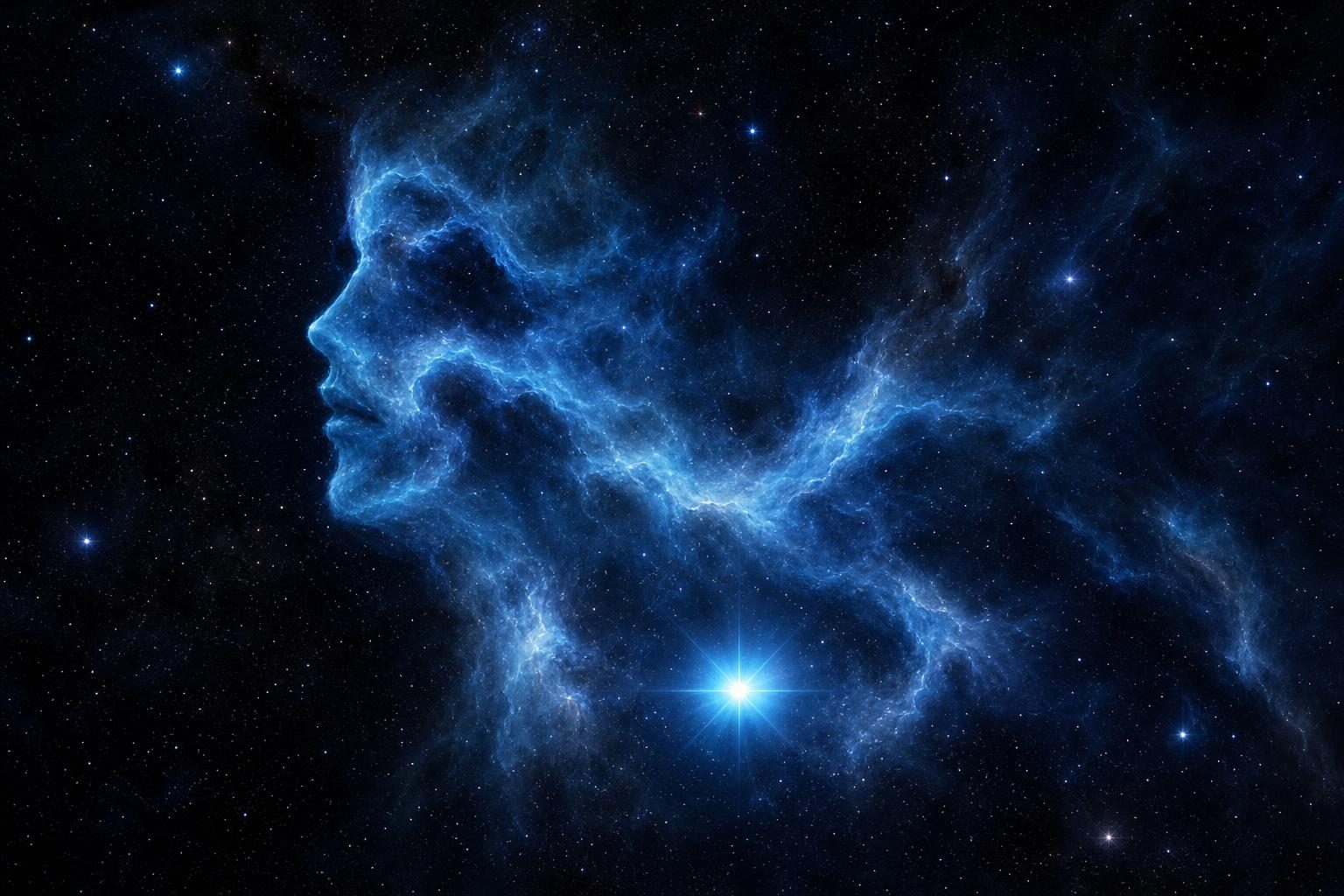
NASA’s Astronomy Picture of the Day featured a blue cloud of gas and dust called the Witch Head Nebula on Nov. 9, according to NASA’s explanation written by a professional astronomer. The object is also known as IC 2118, and it appears near Rigel, one of the brighter stars in the constellation Orion. A constellation is a named pattern of stars that people use to organize the night sky. The nebula’s nickname comes from its shape, which some viewers think looks like a Halloween witch’s head.
But the important part is not the nickname. It is what the image shows about light, matter, and scale. A nebula is a huge cloud in space made of gas and dust. NASA says the Witch Head Nebula is about 50 light-years across. A light-year is the distance light travels in one year, so it is a measure of distance, not time. That means this one cloud is much wider than anything in our solar system, even though it looks like a soft patch of blue in a picture.
NASA says the cloud points toward Rigel because it has been partly eroded by that nearby star. Eroded means worn away or shaped over time. On Earth, water and wind can erode rock. In space, the source describes a star helping shape a cloud of gas and dust. That is a reminder that stars are not just dots in the sky. They can affect the material around them.
The blue color is another clue. NASA explains that the Witch Head Nebula looks blue partly because Rigel shines with intense blue starlight. It also looks blue because tiny dust grains scatter blue light more efficiently than red light. Scatter means to send light off in many directions instead of letting it travel straight through. Blue light has a shorter wavelength than red light, and small particles can spread it around more strongly.
That same process helps explain something familiar: Earth’s daytime sky. NASA says our sky appears blue because molecules of nitrogen and oxygen in the atmosphere scatter blue light. A molecule is a tiny group of atoms joined together. The particles near Earth are not dust grains in a nebula, but the physics idea is similar. Light from a source meets small bits of matter, and different colors of light do not behave in exactly the same way.
This matters in science class because astronomy is not only about faraway things. It uses the same questions used in labs: What is the evidence? What is the material made of? How does light behave? A single space image can connect an object near Orion with the color of the sky outside a classroom window.
The Witch Head Nebula also shows how science and imagination can sit next to each other. People gave the nebula a playful name because of what they thought they saw in its shape. Scientists still use measurements, light, and physical evidence to explain what it is. The picture is interesting because it lets both things happen at once: people notice a pattern, and then they ask what is really causing it.
Written from reporting by NASA, “APOD: 2026 November 9 – Rigel and the Witch Head Nebula”.
Discussion questions
- A nickname like “Witch Head Nebula” can make space science more memorable, but it can also focus attention on imagination instead of evidence. Is that mostly helpful or mostly distracting?
- NASA connects a faraway nebula to the everyday blue sky. Why can comparing distant and familiar things be a powerful way to learn science?
- If a classroom had only one image to teach this story, what should the image emphasize: the nebula’s shape, its blue color, or Rigel’s role in shaping it? Defend your choice.