
Free activities › Middle school
Gold Bear Figurine Opens a Window Into an Ancient Grave
A rare find in Kazakhstan shows how archaeologists use objects, bones, and context to ask new questions about the past.
Print it — all four files
The student packet has no answers in it. The teacher copy is the same pages plus a note on each question and the answer keys. Both languages carry the same story, the same picture and the same vocabulary.
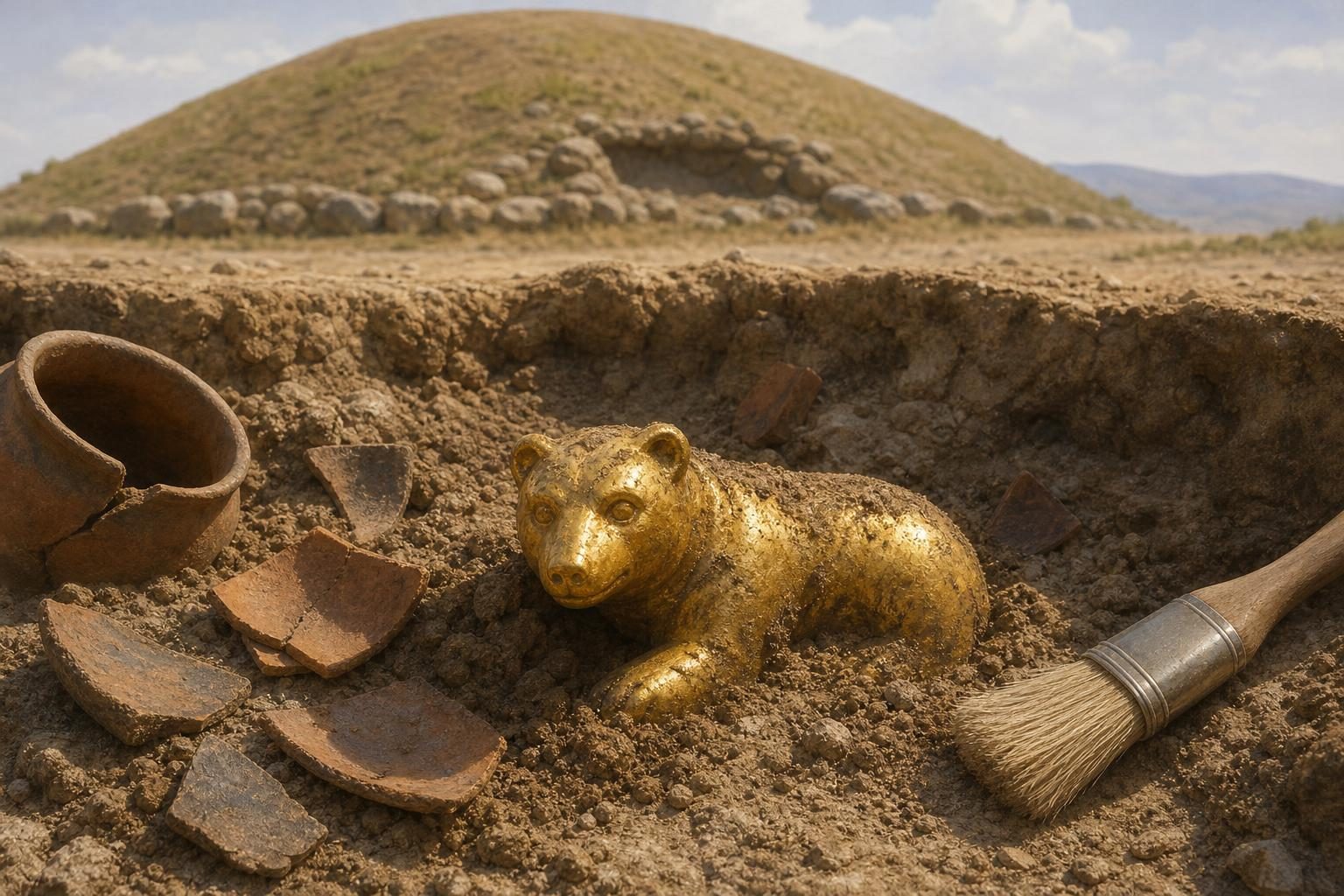
Archaeologists in Kazakhstan have found a gold bear figurine in a 2,200-year-old burial mound, according to reporting by Live Science. A burial mound is a raised pile of earth built over a grave. The mound had been hit by looters, people who steal from old sites, but they did not take everything. The bear may be the first find of its exact kind in Kazakhstan.
The sculpted bear stands on its hind limbs and holds a pot-like container between its front paws. Holes at its base suggest it could have been sewn onto a headdress, which is an item worn on the head for decoration or ceremony. That detail matters because it connects the object to a person and to a public display of identity, not just to a pretty piece of gold.
The mound was at the Karagaily burial ground in the southern city of Almaty. Researchers dated the site to the fourth to third centuries B.C., meaning more than two thousand years before today. It belongs to the Early Iron Age, a period in history when iron tools and weapons were becoming important in many places.
The find is linked to the Saka period, named for a nomadic horseback-riding people; nomadic means they moved from place to place instead of staying in one town all year. Live Science reported that researchers have found other gold animal decorations in Kazakhstan, including a leopard-shaped headdress piece and a sheep-shaped decoration on the famous “Golden Man” headdress. The new bear stands out because no similar bear has been reported there before.
Animal art can be a clue, but it is not a simple answer key. The bear might point to animals people knew, stories they told, or symbols important to leaders or families. The article notes that modern Kazakhstan is home to two subspecies of brown bear; a subspecies is a smaller group within a species with some shared traits. But researchers do not yet know which kind of bear the gold figure was meant to show.
One surprise was not gold at all. Researchers found an unusually large number of human bones for one mound. Based on what they excavated, or carefully dug up and recorded, experts suspect it may have held four adults and three children. That would be unusual because mounds of similar size in Kazakhstan were usually for one or two people. This is the kind of detail that can change a historian’s work from identifying an object to asking what was happening in a community.
Because the mound was looted in ancient times, the evidence is messy. Pieces of Saka pottery had been scattered, and thieves left a looting pit about 10 feet, or 3 meters, deep. Still, archaeologists can learn from context, meaning an object’s position and the clues around it. A gold bear found with a mound, pottery, and bones can say more than the same object with no record of where it came from.
This story matters because it shows how social studies and science overlap. The past is not only written in books; it is also studied through careful measuring, comparisons with other finds, and evidence from human remains. The Karagaily research is still ongoing, and anthropologists, scientists who study humans and human remains, are expected to help work out how many people were buried there. After the investigations finish, some artifacts are expected to go on display at the Almaty Museum.
Written from reporting by Live Science, “2,200-year-old gold bear figurine and surprising number of bones found in massive burial mound in Kazakhstan”.
Discussion questions
- When archaeologists find a beautiful object in a grave, how should they balance studying it as art with studying it as evidence about people’s lives?
- Looting damaged this site, but researchers still learned from what remained. What kinds of information are lost when artifacts are removed from their original place?
- Should museums display artifacts from ancient graves, or should some objects stay out of public view? Defend your position.