
Free activities › Middle school
A Telescope Finds a New Way to Map the Young Universe
A Canadian telescope used hydrogen signals to study how matter spread through space billions of years ago.
Print it — all four files
The student packet has no answers in it. The teacher copy is the same pages plus a note on each question and the answer keys. Both languages carry the same story, the same picture and the same vocabulary.
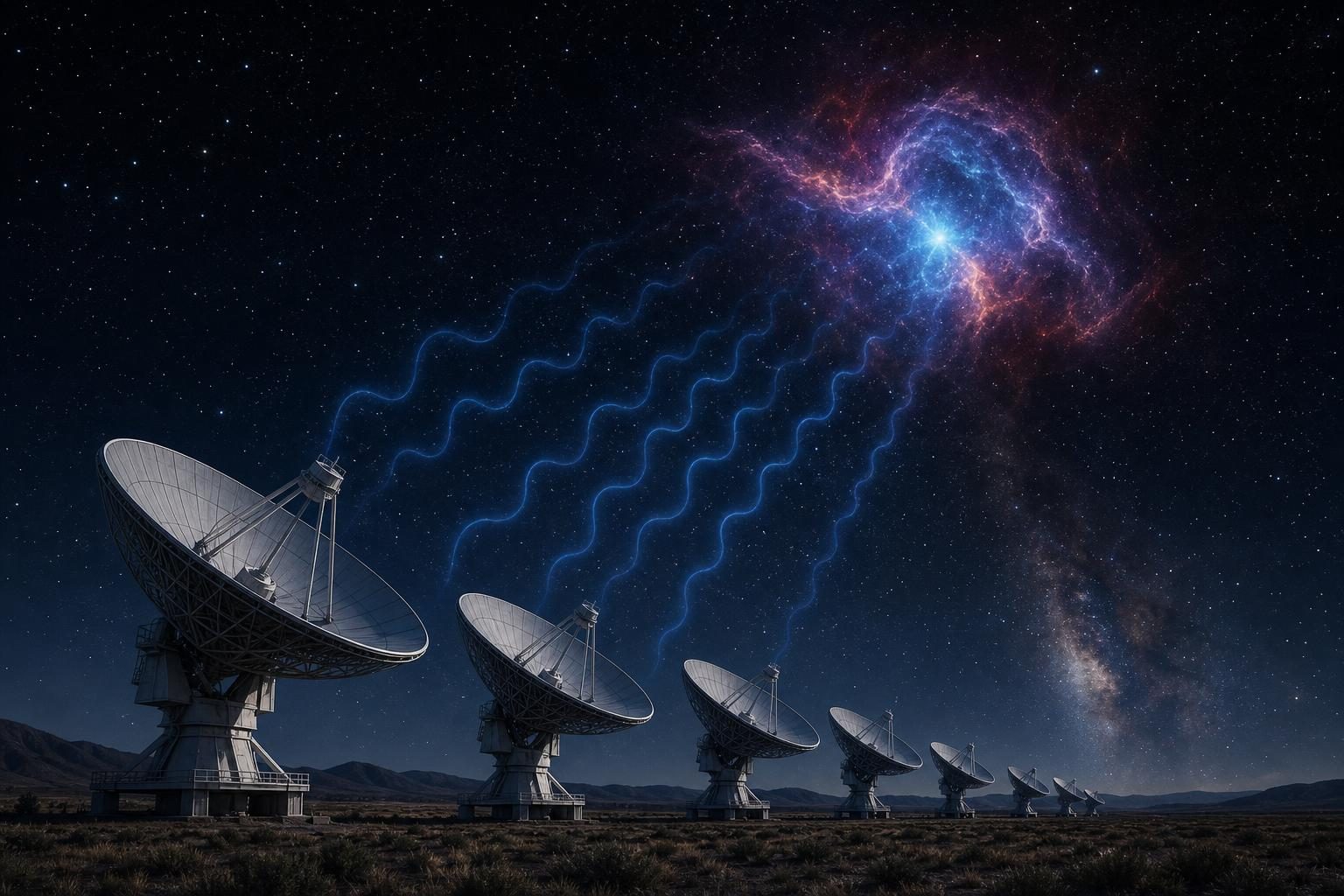
Scientists have shown that a Canadian telescope can map hydrogen gas from the ancient universe using only its own data. According to reporting by Live Science, the Canadian Hydrogen Intensity Mapping Experiment, or CHIME, proved it can detect this distant hydrogen without having to check its results against other telescopes. That matters because it could give astronomers a new way to study one of the biggest mysteries in science: why the universe’s expansion is speeding up.
CHIME is a set of radio telescopes near Penticton, British Columbia. A radio telescope is an instrument that collects radio waves, a kind of light people cannot see with their eyes. CHIME maps the entire northern sky every day. Its goal is to find faint radio signals from hydrogen, the most common element in the universe. Hydrogen is the simplest atom and is one of the main materials that stars form from.
The new result comes from a study published Monday in The Astrophysical Journal. The research was based on 94 nights of observations from 2019. The scientists spent years checking the data before publishing it. That slow pace may sound frustrating, but it is part of how science works when the signal is extremely faint. The team had to make sure the signal was not a mistake, noise from Earth, or a problem with the instrument.
The hydrogen CHIME studied is very old. The telescope can detect signals from about 3 billion years after the Big Bang, the event scientists use to describe the beginning of the universe. That means CHIME is not looking at the universe as it is today. It is looking into the past. Light takes time to travel, so a signal from very far away shows what space was like long ago.
Scientists care about this because hydrogen can act like a cosmic tracer. A tracer is something that helps reveal where other things are, the way dye can show how water moves. By finding where hydrogen was spread through space, researchers can learn how matter was arranged at different times in the universe’s history. That can help them study dark energy, the name scientists use for the poorly understood cause of the universe’s faster and faster expansion.
Before this study, CHIME’s hydrogen measurements had to be compared with data from other telescopes. That made the work more expensive and slower. Now the team says CHIME has shown it can stand as an independent measurement. Independent evidence is important in science because it gives researchers another way to test an idea.
A second related paper studied where hydrogen is found in the cosmos, meaning the universe as a whole. It found that about 2 percent of hydrogen is neutrally atomic, which means each atom has one proton and one electron, so it has no overall electric charge. The researchers said that result fits broadly with measurements from other telescopes.
For someone studying science in school, this story is a reminder that major discoveries are not always sudden. They often depend on instruments, careful checking, and math. CHIME did not take a picture like a phone camera. It listened for radio waves, sorted through years of data, and turned tiny signals into evidence about space billions of years ago. The team now plans to study CHIME’s other seven years of observations to learn more.
Written from reporting by Live Science, “CHIME telescope unlocks new way to study the universe's bafflign expansion”.
Discussion questions
- When evidence is hard to detect, how should scientists decide when they have checked it enough to share it with the world?
- Is it more valuable for science to build one very powerful tool or many different tools that can check each other’s results?
- How does studying something billions of years old help people understand the universe today?