
Free activities › Middle school
NASA Space Telescope Ends a 22-Year Watch
The Swift observatory studied powerful space explosions far longer than planned, but its orbit has dropped too low to keep working.
Print it — all four files
The student packet has no answers in it. The teacher copy is the same pages plus a note on each question and the answer keys. Both languages carry the same story, the same picture and the same vocabulary.
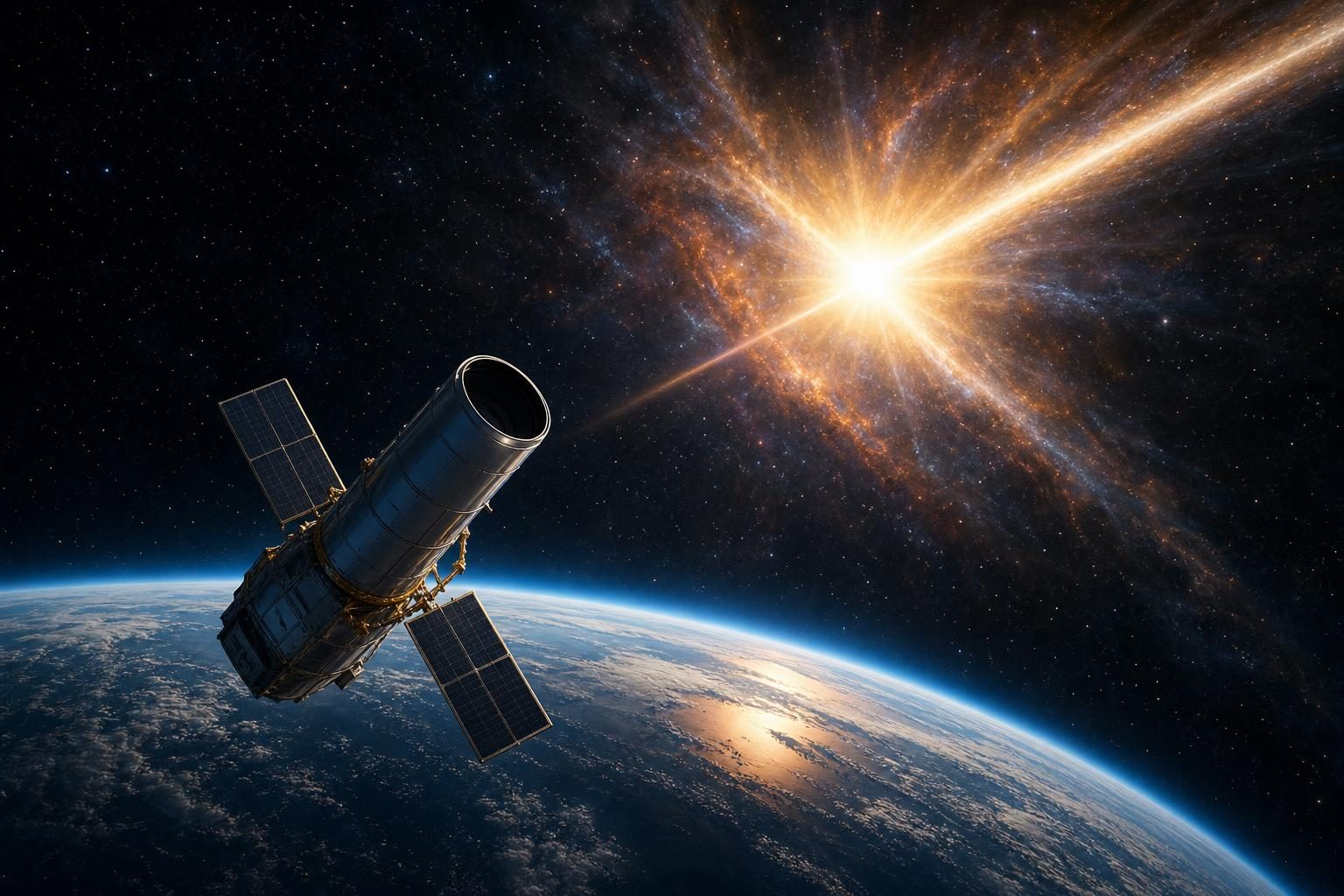
NASA’s Neil Gehrels Swift Observatory has ended its science mission after 22 years in space, according to reporting by Live Science, citing NASA. The spacecraft had been watching some of the universe’s most powerful explosions. Now it has fallen too low in orbit, the curved path an object follows around Earth, to collect reliable data. NASA expects it to reenter Earth’s atmosphere in the next few weeks. Reentry means falling back into the layer of gases around our planet. The spacecraft is expected to break apart as it comes down.
Swift matters because it helped scientists study events that happen fast and far away. Space can seem still from Earth, but it is not. Stars explode. Black holes, which are objects with gravity so strong that even light cannot escape, can tear apart nearby stars. Bursts of energy can flash and fade before a normal telescope has time to point at them. Swift was built to respond quickly when those sudden events appeared.
The observatory launched in November 2004. Its main mission was planned to last only two years, but it kept working for more than 10 times that long. During its life, Swift made thousands of observations of supernovas, which are exploding stars, gamma-ray bursts, which are huge blasts of high-energy light, and violent events linked to black holes. NASA says its data contributed to about 7,000 scientific papers. That means many teams of scientists used Swift’s measurements to ask new questions and test ideas.
Swift was a multiwavelength observatory, meaning it could study more than one kind of light. Human eyes see visible light, but space also gives off ultraviolet light and X-rays, which are forms of light our eyes cannot see. Looking at the same event in different kinds of light can reveal different clues, like studying a mystery with several tools instead of one. Swift’s speed was also important. When an explosion appeared, engineers could turn the spacecraft toward it within minutes.
The mission ended because Earth orbit is not empty. The article reports that intense solar activity made the upper atmosphere puff outward more than usual. Solar activity means changes on the sun, including storms and bursts of energy. When the atmosphere expands upward, satellites meet more drag, a slowing force like air pushing against a moving bike rider. That drag slowly lowered Swift’s orbit. A planned August mission to raise the observatory’s orbit using a private spacecraft failed after hardware problems, and that rescue craft burned up in the atmosphere.
Swift’s ending shows a real trade-off in space science. Telescopes in orbit can see things that are hard or impossible to study from the ground. But they are also machines in a tough place, where fuel, aging parts, sunlight, and Earth’s atmosphere all matter. For a middle school science class, this story connects to gravity, light, engineering, and how evidence becomes knowledge. Swift did not last forever, but it lasted long enough to change what scientists could notice about a universe that is always changing.
Written from reporting by Live Science, “NASA's Swift observatory ends 22-year mission, will crash to Earth 'in the next few weeks'”.
Discussion questions
- If NASA has limited money, should it spend more on rescuing older spacecraft or building new ones? Defend your answer using the Swift story.
- Swift was useful partly because it could react quickly. Why might speed matter in science, and where else could fast data collection change what people learn?
- What information would you want before judging whether Swift’s mission was a success?