
Free activities › Middle school
NASA Spots a Rare Cloud Cap Above a Wildfire
A Montana fire built its own stormlike cloud, giving scientists a close look at smoke, heat, and weather.
Print it — all four files
The student packet has no answers in it. The teacher copy is the same pages plus a note on each question and the answer keys. Both languages carry the same story, the same picture and the same vocabulary.
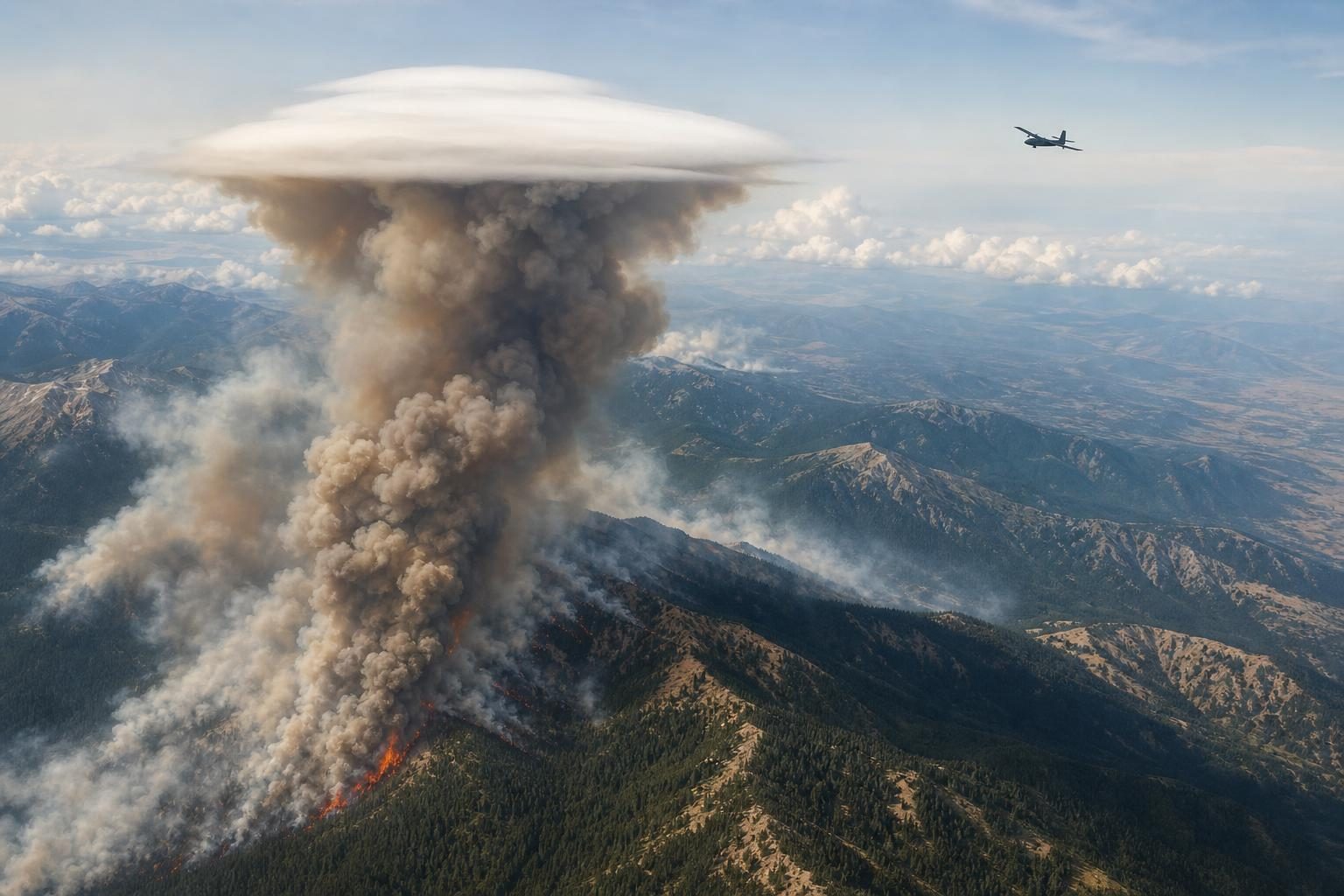
NASA scientists flying over a Montana wildfire saw something rare: a smooth, thin cloud sitting like a cap on top of a huge smoke-filled cloud. According to NASA Earth Observatory, the cloud appeared on August 11 above the Sand Creek fire during a research flight in summer 2026.
The cap cloud is called a pileus cloud, a short-lived cloud that forms above a powerful rising column of air. Pileus comes from a Latin word for “cap.” The larger cloud underneath was a pyrocumulus cloud, meaning a cloud made when fire-heated air rises and carries smoke and water vapor upward. Water vapor is water in gas form.
The fire supplied the heat. Hot air from the wildfire rose quickly, creating an updraft, or a fast column of rising air. That updraft pushed into a moist layer of air above it. When moist air is forced higher, it cools. As it cools, its water vapor condenses, meaning it changes from gas into tiny droplets or ice crystals. Those droplets or crystals became the thin pileus cloud.
NASA compared the process to air being forced up over a mountain. In this case, the rising fire cloud acted like the mountain. That is an important idea in Earth science: air does not have to rise only because of landforms. Heat can also lift air and help build clouds.
The flight was part of NASA’s INSPYRE project, a research campaign studying smoke and fire-made clouds. Scientists used a high-flying research aircraft to look at the fire and the cloud from above. One instrument collected images in natural color. Another used shortwave infrared light, a kind of light humans cannot see but instruments can use to detect heat and burned areas. Radar instruments, which send signals and read what bounces back, studied the structure of the cloud.
The pileus cloud did not last long. NASA said pileus clouds often survive only a few minutes before the growing cloud below overtakes them. During this flight, scientists gathered images about every 30 minutes, and the pileus showed clearly in just one scene. That brief timing is part of what made the observation useful.
This matters because wildfires do more than burn land. Large fires can push smoke high into the atmosphere and help create their own weather-like clouds. Scientists want to understand how heat, wind, moisture, smoke, and clouds work together. That can help them study fire behavior and the movement of smoke.
For a middle school science class, this story connects several topics that often seem separate. Heat transfer explains why hot air rises. The water cycle explains how water vapor becomes cloud droplets. Weather science explains convection, the movement of warm air rising and cooler air sinking. Earth systems science asks how land, air, water, and living things affect one another.
The scene over the Sand Creek fire was unusual, but the basic science is familiar. Warm air rises. Moist air cools as it rises. Clouds form when water vapor condenses. What made this case special was the wildfire’s power, the short-lived cloud cap, and the chance for scientists to catch the process with several kinds of instruments at once.
Written from reporting by NASA, “Fire Cloud with a Pileus on Top”.
Discussion questions
- When scientists study a dangerous event like a wildfire, what benefits and limits come from observing it from aircraft instead of only from the ground?
- Should rare events like this pileus cloud change how people think about wildfires, or are they mainly useful for scientists? Defend your view.
- How does this story show that Earth systems are connected rather than separate subjects?