
Free activities › Middle school
Satellite Spots a Desert Bloom in Western Australia
After unusually wet months, a dry region filled with wildflowers bright enough to stand out from space.
Print it — all four files
The student packet has no answers in it. The teacher copy is the same pages plus a note on each question and the answer keys. Both languages carry the same story, the same picture and the same vocabulary.
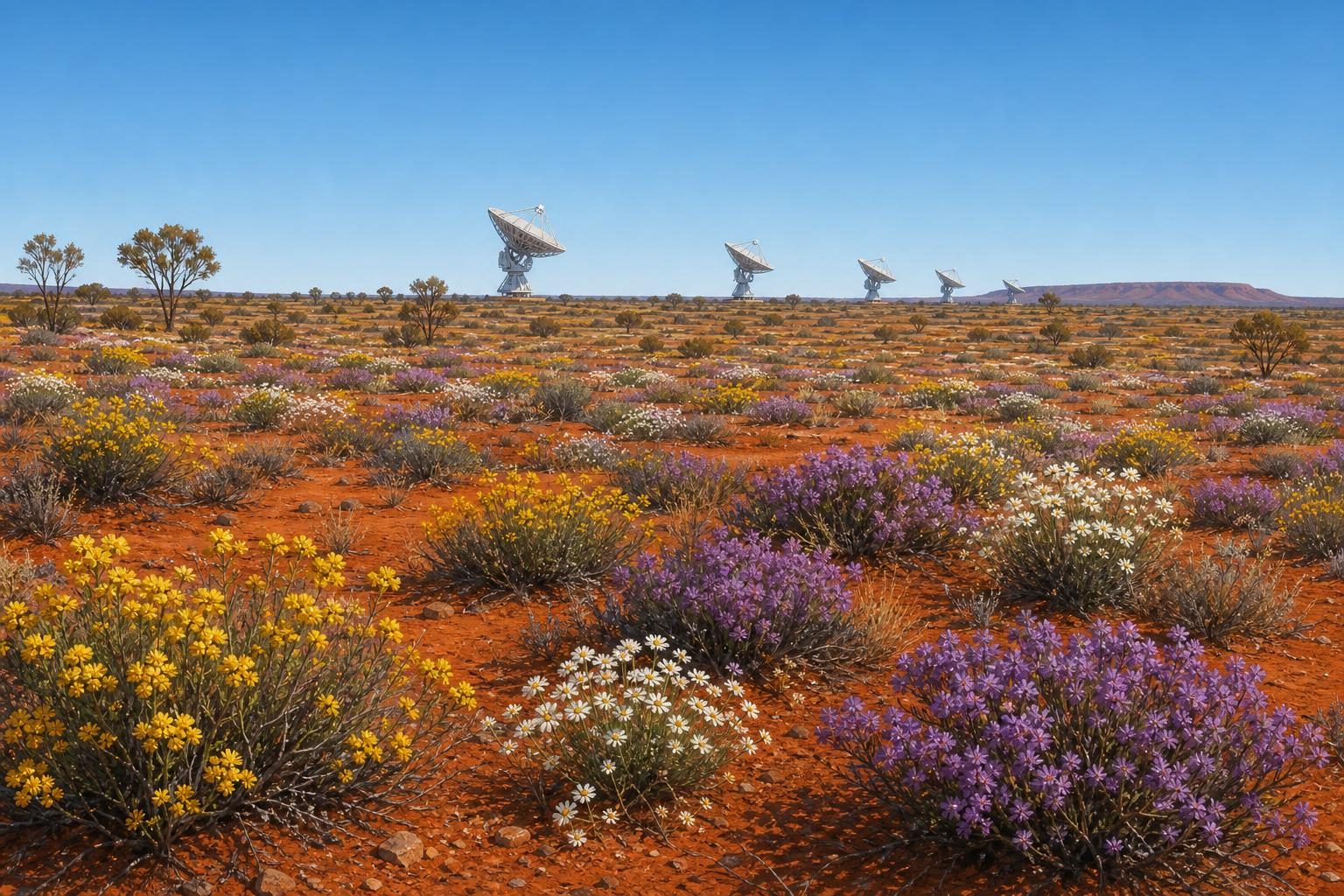
A very dry part of Western Australia has turned colorful after months of extra rain, according to NASA Earth Observatory. In late austral winter 2026, which means winter in the Southern Hemisphere, wildflowers spread across rusty-colored land in the Murchison region. Local experts think the bloom could be the best the area has seen in nearly 20 years.
The Murchison region is about 600 kilometers, or 370 miles, north of Perth. It is one of Western Australia’s main areas for grazing sheep and cattle. The land is arid, meaning it gets little rain. Its usual plants include grasses, saltbush, and the slow-growing evergreen mulga tree. But after wet weather, seeds that had been waiting in the soil began to grow. Dormant seeds are alive but inactive, almost like they are paused until conditions improve.
NASA showed the change with images from Landsat 8, a satellite that circles Earth and takes pictures of the planet’s surface. The satellite’s Operational Land Imager, a camera-like instrument, captured the area in late August 2026 and compared it with a similar time in 2025, when the region was drier. In the newer image, the land looked greener because more plants were growing.
Rainfall was above average in June and very much above average in August, according to Australia’s Bureau of Meteorology. A bureau is a government office that collects and studies information. The article says several cold fronts helped bring the rain. A cold front is the leading edge of cooler air moving into an area, and it can cause clouds and rain when it pushes warmer air upward.
The bloom also appeared at a radio astronomy site run by CSIRO, Australia’s national science agency. Radio astronomy is the study of space by collecting radio waves, a type of energy that travels through space. The site’s full name is Inyarrimanha Ilgari Bundara, the CSIRO Murchison Radio-astronomy Observatory. Its main job is not studying flowers. It uses groups of antennas to observe and catalog objects in the southern sky.
That makes the scene unusual. On the ground, wildflowers were drawing attention. Above the ground, antennas were listening for signals from deep space. The observatory sits in a “radio quiet” zone, an area where electronic devices and communications are limited. That matters because electromagnetic interference, unwanted signals from electronics, can disturb the sensitive instruments used to study space.
The flower display included some threatened species, which are plants or animals at risk of disappearing from an area or becoming extinct. The observatory has helped monitor those species on land that was formerly pastoral, meaning it was once used for grazing animals.
This story matters because it shows how quickly an ecosystem can respond when conditions change. It also shows why long-term observations are useful. One rainy season can be exciting, but comparing one year with another helps scientists see the difference more clearly. Satellites make that possible because they can watch large areas that would be hard to study only from the ground.
It also connects two kinds of science that may seem separate. Earth science studies our planet’s weather, land, water, and living things. Space science studies objects beyond Earth. In the Murchison, the same remote place is important for both. Rain woke up seeds underfoot, while antennas kept searching the sky overhead.
Written from reporting by NASA, “Boom Year for Desert Blooms”.
Discussion questions
- What can satellite images show about an ecosystem that people on the ground might miss, and what can they not show?
- Should remote science sites like the Murchison observatory be managed mainly for research, for protecting local ecosystems, or for both? Defend your view.
- How could a short burst of unusual rain help scientists ask bigger questions about dry places?