
Free activities › Middle school
Midterms Shift Power in Washington
Democrats won control of Congress, setting up two years of divided power and big civics lessons about checks and balances.
Print it — all four files
The student packet has no answers in it. The teacher copy is the same pages plus a note on each question and the answer keys. Both languages carry the same story, the same picture and the same vocabulary.
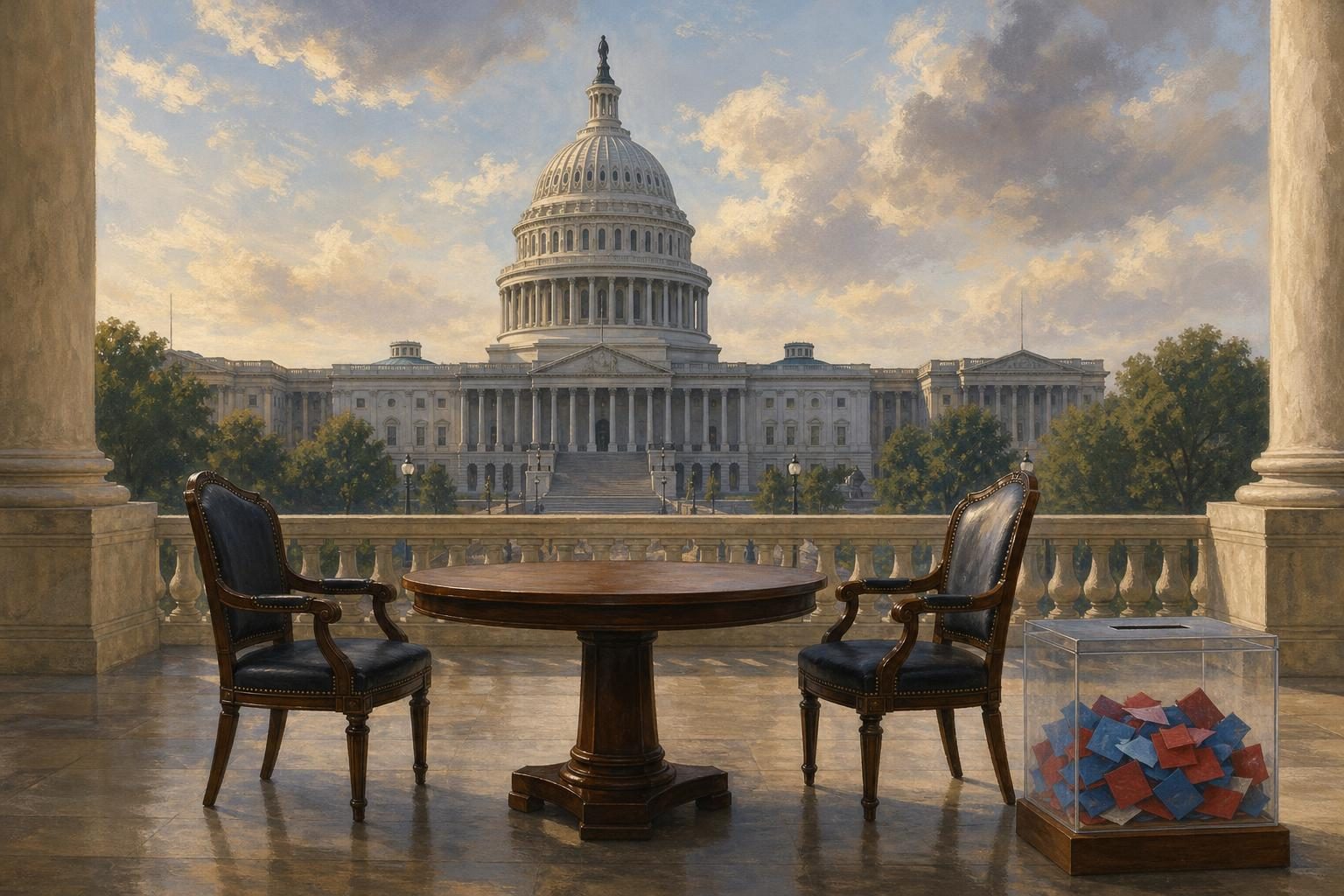
Voters changed the balance of power in Washington in the 2026 midterm elections. According to reporting by PBS NewsHour, Democrats won control of both chambers of Congress, meaning both the House of Representatives and the Senate. Midterms are national elections held halfway through a president’s four-year term. They often become a report card on how voters think the president and his party are doing.
The result matters because Congress writes laws, approves federal spending, and can investigate the executive branch, which is the part of government led by the president. President Trump is now entering what is often called a lame-duck period. A lame duck is an elected leader who is still in office but is nearing the end of a term and has less political power than before.
PBS reported that Trump said he was prepared to work with Democrats, even though he also pointed to his veto power. A veto is when a president rejects a bill passed by Congress, stopping it from becoming law unless Congress has enough votes to override, or cancel, that veto. This is one example of checks and balances, the system in the Constitution that keeps one part of government from having all the power.
The election also showed how voters can respond to national problems. Vice President J.D. Vance said the Republican Party lost because of the Iran war. Trump said prices were the main reason. Those explanations point to two issues many voters care about: foreign policy, which means how the United States deals with other countries, and the cost of everyday life.
For people in middle school, the connection is closer than it may seem. Congress helps decide how federal money is spent. It also debates laws that can affect families, communities, and schools. Even when people are too young to vote, they live with the choices voters and elected officials make. Studying this election is a way to see civics moving in real time, not just in a textbook.
The election also changed who will be represented in government. PBS reported several historic firsts. Abdul El-Sayed of Michigan will become the first Muslim elected to the Senate. Chris Pappas of New Hampshire will become the first openly gay man elected to the Senate. Illinois Democrat Juliana Stratton’s win means three Black women will serve in the Senate for the first time. In governor’s races, Deb Haaland will become the first Native American woman to lead a U.S. state, and Keisha Lance Bottoms will become the first Black woman governor in U.S. history. Melat Kiros will become the first woman from Generation Z elected to Congress.
Those firsts do not mean every problem is solved. They do show that the group of people making laws is changing. Representation means who gets a seat at the table when decisions are made. In a country as large and different from place to place as the United States, that can shape which questions leaders ask and which experiences they bring to debates.
Not every race was finished when PBS reported the story. Some votes were still being counted, including in places where ballots can take longer to collect. But the larger result was clear: voters gave Democrats control of Congress, while Trump remained president. That means the next two years will test whether leaders use divided government to compromise, to block one another, or some mix of both.
Written from reporting by PBS NewsHour, “Midterm voters rebuke Trump, handing Democrats both chambers of Congress”.
Discussion questions
- When voters give one party Congress and another party the presidency, is that more likely to improve government or slow it down? Defend your answer with a trade-off.
- How much should one election result be seen as a judgment on a president, and how much should it be seen as many local choices added together?
- Why might representation matter in Congress or a governor’s office even if elected officials from the same group do not all think alike?