
Free activities › Middle school
NASA Says Goodbye to a Space Telescope Called Swift
After nearly 22 years studying powerful space explosions, Swift burned up in Earth’s atmosphere this week.
Print it — all four files
The student packet has no answers in it. The teacher copy is the same pages plus a note on each question and the answer keys. Both languages carry the same story, the same picture and the same vocabulary.
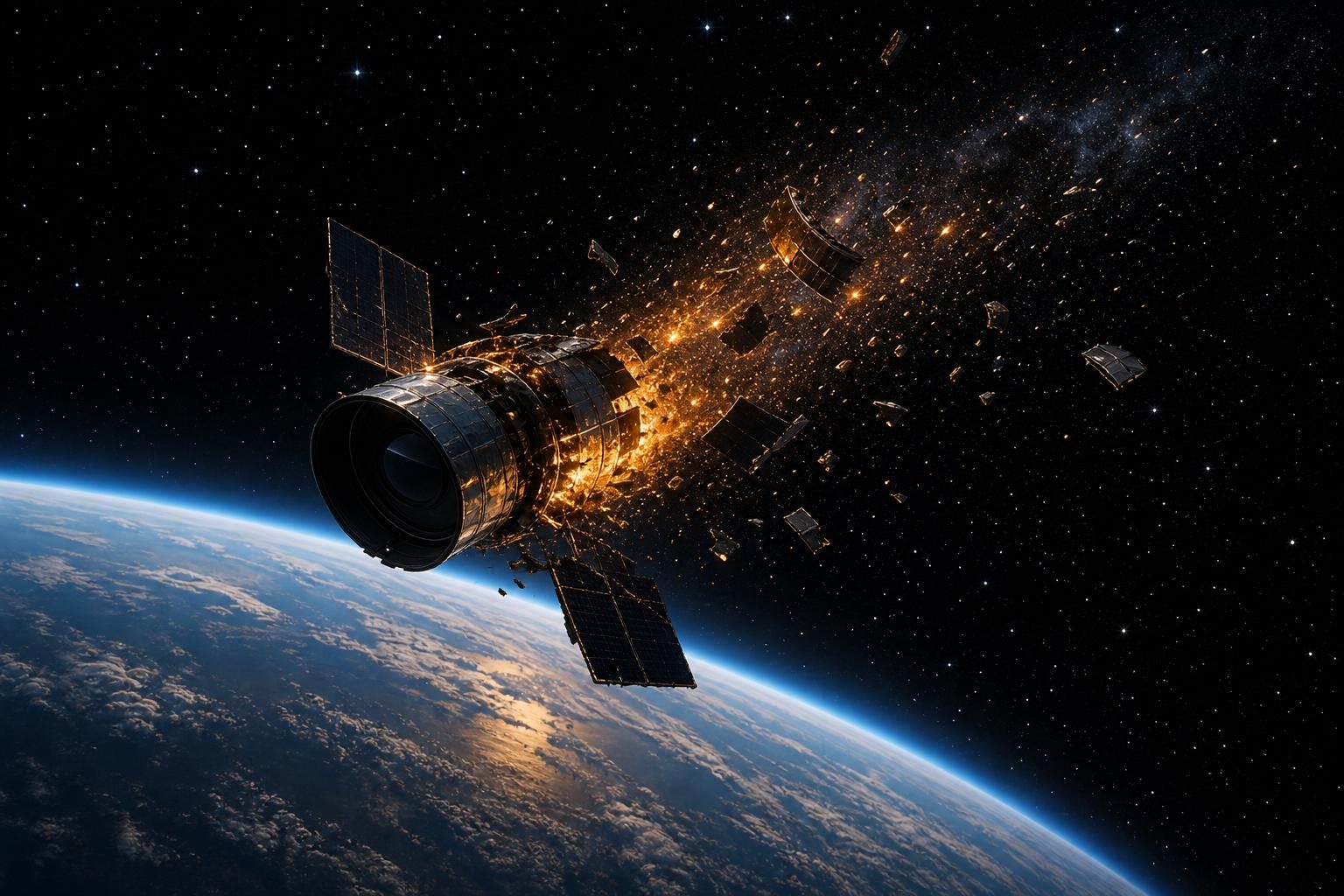
NASA’s Neil Gehrels Swift Observatory ended its mission this week after nearly 22 years in space. According to NASA’s Astronomy Picture of the Day, the satellite re-entered Earth’s atmosphere on November 4 at 7:39 EST over the North Sumatra region of Indonesia. Re-entry means a spacecraft comes back into the blanket of gases around Earth. Swift burned up like a shooting star, which is the bright streak people see when an object heats up while falling through the atmosphere.
Swift mattered because it helped scientists study some of the fastest and most energetic explosions in the universe. The observatory was not a telescope on a mountaintop. It was a satellite, meaning a human-made object sent to travel in a path around Earth. From there, it could observe kinds of light that are hard or impossible to study well from the ground.
Swift carried several instruments that worked together. One was an Ultraviolet/Optical Telescope, which studied visible light and ultraviolet light, a type of light with more energy than the light human eyes can see. Swift also had an X-ray telescope and a gamma-ray telescope. X-rays and gamma rays are high-energy forms of light. Doctors use X-rays for images of bones, but in space, X-rays and gamma rays can also come from extreme events.
NASA says Swift’s instruments let people study these explosions in unprecedented detail. Unprecedented means something had not been done that well before. That is a reminder that science is not only about having a big question. It is also about building tools that can collect better evidence than earlier tools could.
The spacecraft’s end came because its orbit, or path around Earth, had been getting lower. NASA says the most recent solar maximum sped up the decay of Swift’s orbit. A solar maximum is a time when the Sun is especially active. That activity can affect the upper atmosphere around Earth, which can make low-orbiting satellites slow down and sink faster. NASA also says an innovative rescue mission tried to boost Swift into a higher orbit, but it did not succeed.
That part of the story is important for engineering. A spacecraft can be designed well and still face limits. It can run into problems caused by the space environment, the Sun, fuel, distance, and time. Engineers often have to decide whether a rescue attempt is worth the risk and effort. In Swift’s case, the attempt did not save the satellite, but it shows that space missions are not simply launched and forgotten.
NASA’s picture for the day showed a mosaic made in 2018 from the first one million images taken by Swift’s Ultraviolet/Optical Telescope. A mosaic is one large picture made from many smaller ones. That image is a visual reminder of how much information one mission can gather. Even though the satellite is gone, the data it collected remains. Scientists can keep studying that data, asking new questions, and comparing it with future observations.
For a middle school science class, Swift connects to topics that may already feel familiar: light, energy, gravity, the Sun, Earth’s atmosphere, and how technology helps people observe what they cannot visit. It also shows how scientific knowledge can be cumulative, which means it builds over time. A satellite can stop working, but the evidence it gathered can continue helping people understand the universe.
Written from reporting by NASA, “APOD: 2026 November 6 – A Farewell to Swift”.
Discussion questions
- When a space mission is near the end of its life, how should scientists and engineers decide whether to spend resources trying to save it?
- Swift is gone, but its data remains. In what ways can stored scientific data be as valuable as a working machine?
- What does Swift’s ending show about the relationship between Earth, the Sun, and human technology in space?