
Free activities › Middle school
Scientists Say Earth’s Life-Support Systems Are Under Strain
A new report says seven of nine key natural systems have passed safer limits, but researchers say there is still time to act.
Print it — all four files
The student packet has no answers in it. The teacher copy is the same pages plus a note on each question and the answer keys. Both languages carry the same story, the same picture and the same vocabulary.
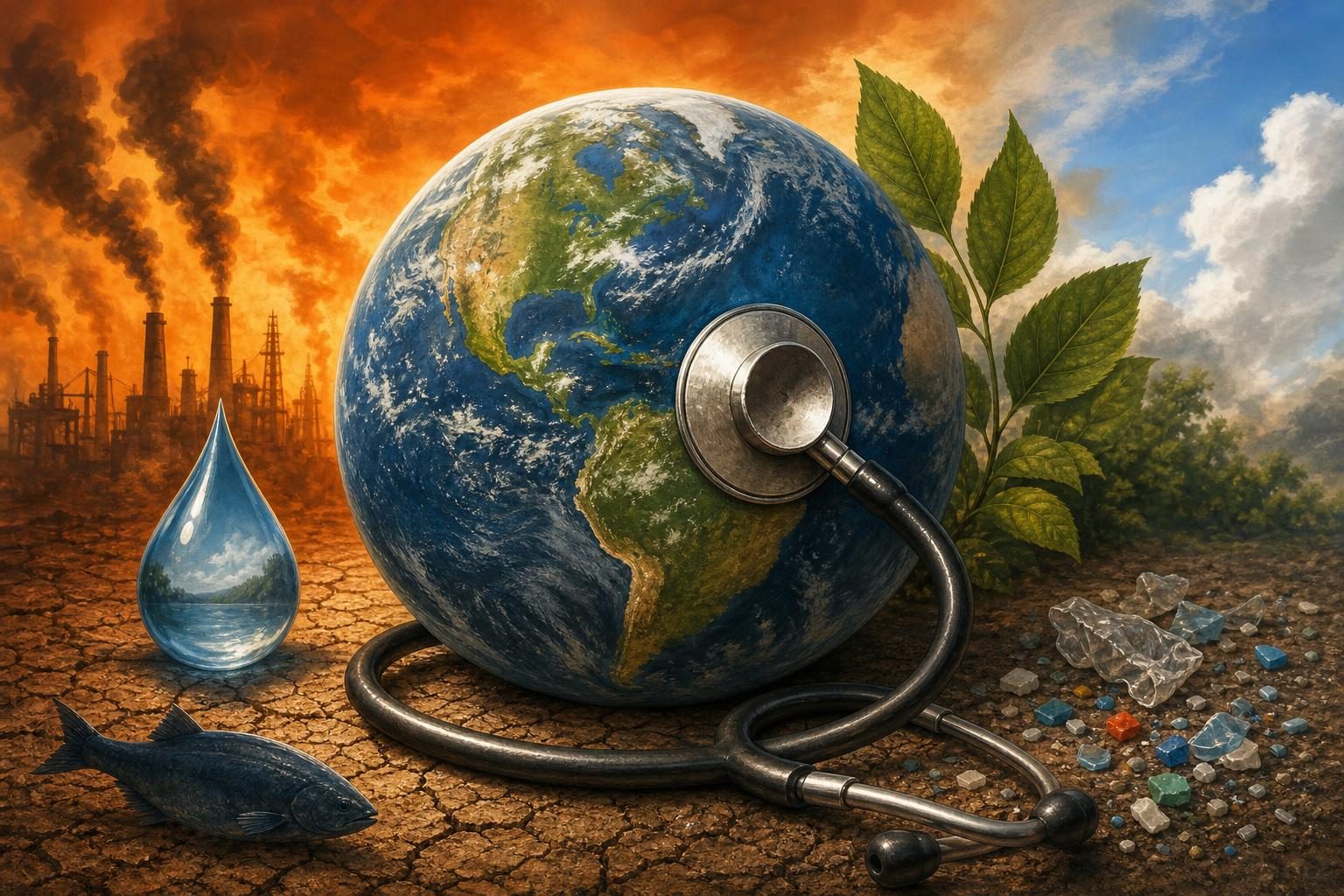
A new scientific report says Earth’s natural life-support systems are under growing stress. According to Live Science, the 2026 Planetary Health Check found that seven of nine planetary boundaries have been breached. Planetary boundaries are limits scientists use to describe the conditions that keep Earth stable for human life. Breached means a system has moved past the safer range and into higher risk.
The report was written by more than 60 scientists and published by the Planetary Boundaries Science Lab at the Potsdam Institute for Climate Impact Research in Germany. It looks at connected systems, not one problem at a time. That matters because Earth works like a web. A change in forests can affect climate, and a change in climate can affect oceans, farms, and fresh water.
The breached boundaries include climate change, ocean acidification, biosphere integrity, freshwater change, land system change, changes in biogeochemical flows, and novel entities. Ocean acidification means seawater is becoming more acidic, which can make life harder for some ocean animals. Biosphere integrity means the health and variety of living things. Biogeochemical flows are the movement of life-linked chemicals, such as nitrogen and phosphorus, through air, water, soil, and living things. Novel entities are human-made substances such as microplastics and long-lasting chemicals.
The report says four of the breached boundaries are already in the danger zone: climate change, biogeochemical flows, novel entities, and biosphere integrity. The other three breached boundaries are in an increasing risk zone. Scientists use these categories like a traffic light: green for safer conditions, yellow or orange for rising risk, and red for likely danger. The article says there is uncertainty because natural systems are complex, but the overall direction is getting worse.
Some examples are easy to picture. The Amazon rainforest is at risk of a tipping point, which is a point where a system may change in a major way and not easily change back. The seafloor is being damaged by bottom trawling, a fishing method that drags heavy nets along the ocean floor. The article also notes the possible future threat of deep-sea mining, which means removing minerals from the deep ocean.
The report connects several problems to human activity. Greenhouse gases are gases that trap heat in the atmosphere, and people add them by burning fossil fuels such as coal, oil, and gas. Too much nitrogen and phosphorus can wash from fertilizers into water, helping create oxygen-poor dead zones where many animals cannot live. Microplastics are tiny plastic pieces, and some long-lasting chemicals are called forever chemicals because they break down very slowly in nature.
Two boundaries remain within safe levels globally: stratospheric ozone depletion and atmospheric aerosol loading. The stratospheric ozone layer is a high layer of gas that helps block harmful sunlight. Aerosols are tiny particles in the air, such as smoke or dust. The word globally matters. A system can look safer for the whole planet while still causing serious trouble in certain places.
This matters to someone in middle school because it connects to science topics already in class: food webs, the water cycle, the carbon cycle, oceans, and how evidence is used. The report is not saying the planet is doomed. It says the window for action is closing, but still open. The hard part is deciding what actions are fair, fast enough, and realistic when people also need food, energy, jobs, and safe communities.
Written from reporting by Live Science, “'We're rapidly running out of time': 7 of Earth's 9 life support systems already breached, and the situation is getting worse, report warns”.
Discussion questions
- Is it more useful to focus public attention on one problem, such as climate change, or on many connected planetary boundaries at once? Defend your view.
- When leaders have limited money and time, how should they balance local needs, such as jobs and energy, with global environmental limits?
- What information would you want before judging whether a proposed solution to one breached boundary is a good solution?