
Free activities › Middle school
Tiny Air Particles May Be Linked to Eye Disease
A review connects PM2.5 pollution with higher odds of glaucoma and cataracts, but it does not prove cause.
Print it — all four files
The student packet has no answers in it. The teacher copy is the same pages plus a note on each question and the answer keys. Both languages carry the same story, the same picture and the same vocabulary.
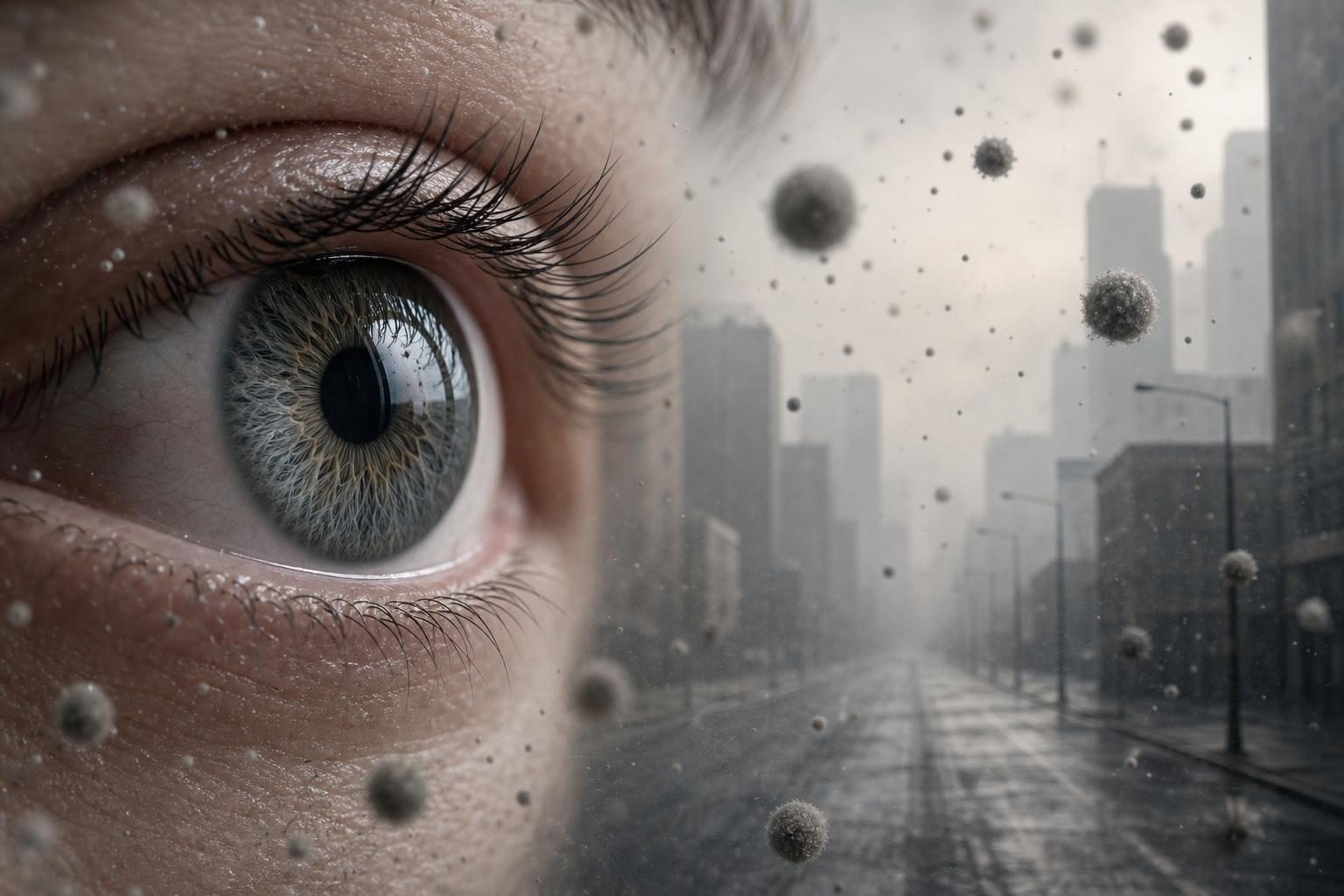
Scientists reviewing dozens of studies have found a link between air pollution and two serious eye diseases, according to reporting by Live Science. The review looked at 41 studies involving millions of people in East Asia and the United Kingdom. It found that people exposed to higher levels of fine particle pollution had higher odds of glaucoma and cataracts.
Glaucoma is a group of diseases that damage the optic nerve, the part of the eye that sends visual information to the brain. It can cause permanent vision loss. Cataracts happen when the lens of the eye becomes cloudy, making vision blurry and sometimes leading to blindness. Both conditions are more common as people get older. Some health conditions, such as diabetes, also raise the risk.
The pollution that stood out most was called PM2.5. That means tiny particles in the air that are 2.5 micrometers wide or smaller. A micrometer is much smaller than the width of a human hair. Because PM2.5 is so small, it can get deep into the body. The studies in the review estimated people’s long-term exposure by looking at pollution around their homes and communities. Researchers used tools such as government air monitors, satellites, and computer models.
The review found that people with the highest PM2.5 exposure had 70% higher odds of glaucoma than people with the lowest exposure. The review also found links between higher PM2.5 exposure and cataracts. Other pollutants, such as nitrogen dioxide, ozone, sulfur dioxide, carbon monoxide, and larger particles called PM10, did not show the same clear pattern for these eye diseases.
This does not mean scientists have proved that PM2.5 causes glaucoma or cataracts. The studies were observational, which means researchers watched for patterns in real life instead of controlling every detail in an experiment. Observational studies can show that two things are connected. They cannot, by themselves, prove that one thing causes the other. For example, people who live in more polluted areas may also face other risks that affect health.
Still, the review matters because it changes the way people think about eye health. Eye disease is often explained as something caused by age, family history, or personal health. This research suggests that the air around a person may also matter over time. That connects eye health to questions communities already debate, such as traffic, industry, clean energy, and who gets to live near cleaner air.
For middle school science, the story is also a useful example of how evidence works. One study can raise a question. Many studies can make a pattern look stronger. But scientists still have to ask whether the pattern is caused by pollution itself, by another factor, or by a mix of both. That is why careful language matters. Saying “linked to” is not the same as saying “caused by.”
The review also shows why public health is not only about hospitals and medicine. Public health means protecting the health of whole communities. If tiny particles in the air are connected to eye damage, then choices about transportation, factories, fires, and air rules could affect vision years later. The next step for researchers is to keep testing the connection and learn more about how pollution might harm the eye.
Written from reporting by Live Science, “'A uniquely direct route that might cause damage': Scientists uncover link between air pollution and eye diseases like glaucoma”.
Discussion questions
- When should a community act on a health risk if scientists have found a strong link but have not proved cause and effect?
- How might this research change the way people think about fairness in health?
- What kind of evidence would make the pollution-and-eye-disease connection more convincing?