
Free activities › Middle school
Amazon Fires Grow as El Niño Dries the Rainforest
Satellite images show smoke and spreading fires in a rainforest that is usually too wet to burn easily.
Print it — all four files
The student packet has no answers in it. The teacher copy is the same pages plus a note on each question and the answer keys. Both languages carry the same story, the same picture and the same vocabulary.
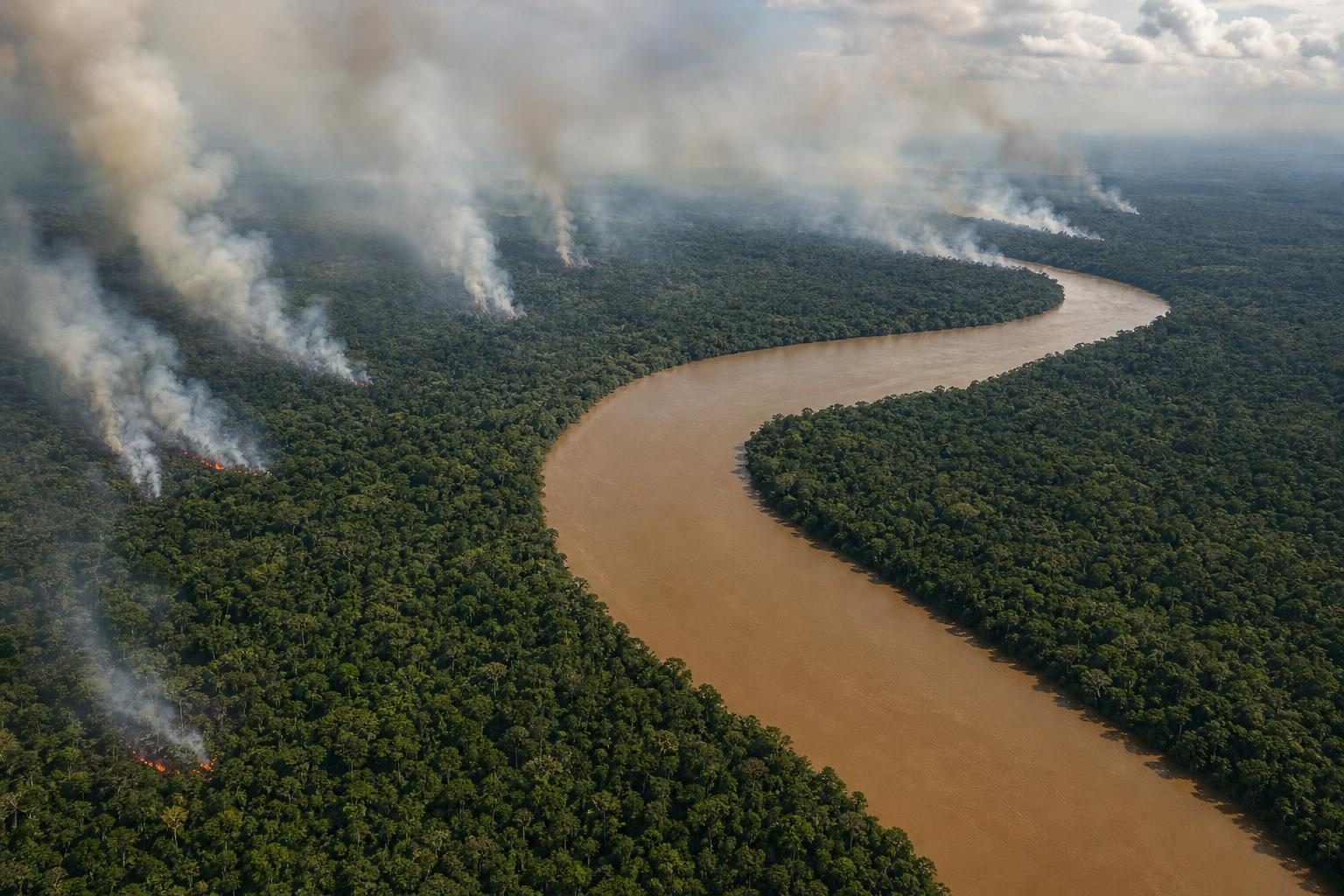
Fires and thick smoke have spread across parts of the central and eastern Amazon rainforest as a strong El Niño helps dry out the region. El Niño is a natural warming pattern in the Pacific Ocean that can change rain and weather around the world for months. According to NASA Earth Observatory, satellites began detecting sharp increases in fire activity and smoke in the Amazon in September 2026.
The fires are burning in areas around Manaus and Santarém, two important cities in Brazil, and toward the mouth of the Amazon River. On October 12, a NASA satellite saw smoke streaming from fires on both sides of the river. That same day, officials in Manaus reported extremely poor air quality. Manaus is a city of more than 2 million people, and the smoke affected daily life there. Schools closed, city events were canceled, and children’s sports leagues were called off.
One reason the smoke is dangerous is fine particulate matter, or PM2.5. These are tiny pieces of pollution small enough to get deep into the lungs. NASA reported that PM2.5 levels in Manaus rose above 135 micrograms per cubic meter, which means 135 millionths of a gram of these particles were measured in a box of air one meter wide, one meter long, and one meter tall. That was the second-worst rating on a regional air quality index.
The Amazon is often called a rainforest for a reason. It is usually so wet that lightning starts less than 1 percent of fires there, NASA scientist Douglas Morton said. That means most fires now burning were started by people. Some began as management fires, which are fires set on purpose to clear shrubs from pastures or old crops from fields. But drought made the forest floor so dry that some of those fires escaped and began burning through the understory, the layer of plants and fallen leaves beneath the taller trees.
Scientists are especially worried because many rainforest plants and animals are not adapted to fire. In some ecosystems, fire is a normal part of life. In the Amazon, it can cause serious damage. Morton said some forests that burned during earlier El Niño years, including 2015 and 2023, are burning again. When trees are partly charred, or burned on the outside, the forest can become weaker and easier to burn the next time.
NASA scientists also see a larger pattern. During El Niño years, fire risk can move across tropical regions like a line of falling dominoes. This year, drought and fire affected parts of Indonesia first. Now the Amazon is seeing the next stage. Scientists expect the fires near Manaus and Santarém to keep burning until the rainy season arrives in December 2026 or January 2027.
Satellites are important in this story because the rainforest is huge and hard to watch from the ground. Instruments on satellites can detect heat and smoke from space. But even satellites have limits. Dense smoke, clouds, and the tree canopy, which is the rooflike top layer of the forest, can block sensors from seeing smaller fires below. One researcher working with NASA said satellite analysis has found many more possible fires near Santarém than standard fire counts show.
This matters far beyond Brazil. The Amazon is part of Earth’s water cycle, the movement of water through air, land, plants, rivers, and oceans. It is also home to many species and many communities. The story shows how ocean temperatures, rainfall, human choices, air pollution, and space technology can all connect in one event.
Written from reporting by NASA, “Fires Arrive in the Amazon Rainforest”.
Discussion questions
- If most Amazon fires are started by people but made worse by drought, who should be responsible for reducing the damage: local land users, governments, or the wider world?
- Should officials close schools and cancel events when air quality becomes very poor, even if families depend on schools for meals, child care, or work schedules?
- What are the strengths and limits of using satellites to understand disasters like these fires?