
Ancient Bones, Climate Clues, and the Work of Archaeology
A new study from Peru shows how researchers test big claims about climate stress, violence, and human choices.
Print it — all four files
The student packet has no answers in it. The teacher copy is the same pages plus a note on each question and the answer keys. Both languages carry the same story, the same picture and the same vocabulary.
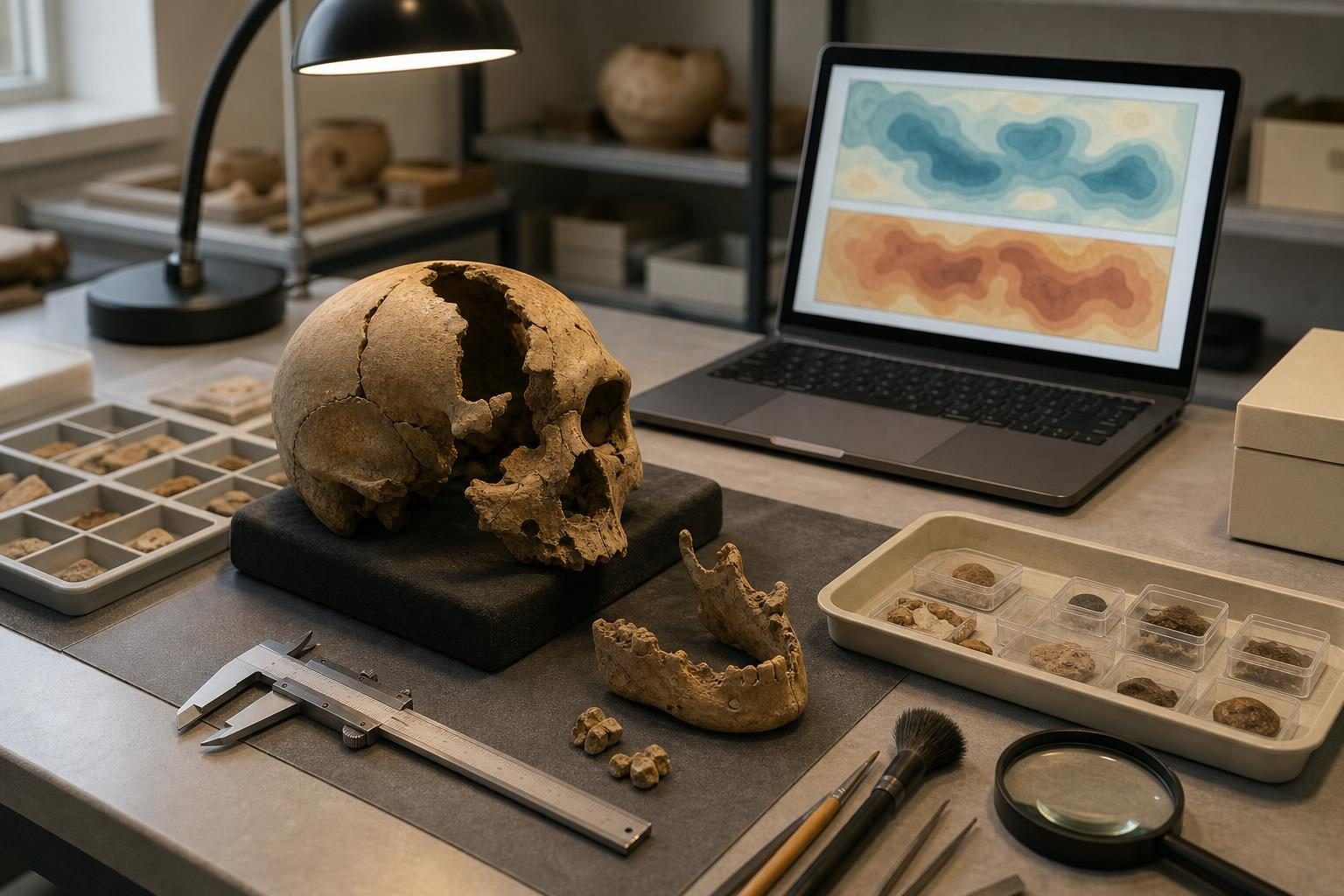
A new archaeology study of Peru’s Lambayeque Valley found that everyday violence appears to have been rare across thousands of years, even during periods when El Niño flooding disrupted food systems. According to reporting by Phys.org on a new article in Frontiers in Environmental Archaeology, researchers studied skeletal remains from 30 sites and compared injuries on those bones with long-term evidence about rainfall and water availability.
That matters because the Lambayeque Valley includes dramatic evidence of mass ritual sacrifice after catastrophic El Niño events. El Niño is a climate pattern in the Pacific Ocean that can shift weather, warm ocean waters, kill off fish stocks, and bring heavy rain to places that are usually dry. On the desert coast of northern Peru, extreme flooding could damage farms and throw local food production into crisis. A reasonable question for researchers was whether that kind of environmental stress also led to broader social violence in daily life.
The answer, in this study, was mostly no. The research team examined the Lambayeque Valley Biohistory Project’s skeletal record, which covers more than 3,000 years. Of 1,633 individuals whose deaths could be placed into a rough time period, only 25 showed evidence the researchers interpreted as violence. That is 1.6% of the sample. Another 77 individuals showed signs of accidental trauma, or injury not usually caused by an attack. The researchers found no link between those injury patterns and periods of ecological instability.
The work behind that conclusion is not guesswork from a dramatic ruin. It is technical, slow, and careful. Bioarchaeology is the study of human remains from archaeological sites to understand past lives, health, injury, diet, and social conditions. In this project, researchers looked for cranial trauma, meaning damage to the skull, because skull injuries are often used as evidence of interpersonal violence. They also looked for postcranial trauma, meaning injuries below the skull, which are more often treated as accidental in this kind of analysis.
The key word is “often.” A broken bone does not come with a label explaining exactly what happened. That is why the researchers call these injury categories proxies, meaning indirect evidence used when the thing being studied cannot be observed directly. A skull fracture might come from an attack, but context still matters. A person could be injured in a fall, during work, in a ritual, or in a conflict. Good scientific work does not turn one clue into a whole story without testing it against other clues.
The climate side of the project also depended on specialized work. The researchers compared injury patterns with paleoclimatic modeling, which means using evidence from the past to estimate old climate conditions. In this case, they were interested in precipitation and water availability over long spans of time. That lets archaeologists ask whether injuries rise during periods of flooding, drought, or other environmental stress. In Lambayeque, the long-term pattern did not show that connection.
For a career and technical education classroom, the important part is how many kinds of work are inside one study. Field archaeologists locate, excavate, document, and protect sites. Lab workers clean, catalog, and examine materials so that the evidence can be checked by others. Specialists in human osteology, the study of bones, identify injuries and separate patterns from one-time damage. Data workers organize records across sites and time periods. Climate researchers build models that can be compared with the archaeological record. None of those jobs works well if the notes are sloppy or the chain of evidence is unclear.
The study also shows why technical workers need to understand limits, not just results. The researchers did not radiocarbon date every individual. Radiocarbon dating is a method that estimates age by measuring a radioactive form of carbon left in once-living material. It can be expensive and time-consuming, so large projects often combine direct dates with other dating evidence. That means the study is strongest at showing broad, long-term patterns, not every short-term crisis or local event.
There are other limits. Not every injury reaches the skeleton. Soft-tissue wounds can disappear from the archaeological record. Some violence may leave no bone damage at all. The study also cannot prove exactly why Lambayeque had less evidence of violence than some other Andean sites. The source notes possible explanations, including access to the sea, which may have eased food shortages, or social organization that reduced conflict. Those are possibilities, not final answers.
That difference between a possibility and a proven conclusion is part of the job. Archaeologists often work with incomplete evidence, but they still have to make their methods transparent enough for other researchers to challenge. A strong technician in this field needs patience, measurement skills, comfort with databases, respect for human remains, and the ability to work across disciplines. The work is not just finding objects. It is building an evidence trail strong enough to support or reject a claim about people who cannot speak for themselves.
The larger finding is not that ancient Lambayeque was simple or peaceful in every moment. The same region had ritual sacrifices linked to political and religious systems, and those events were real parts of the record. The finding is narrower and more useful: extreme climate stress did not automatically turn into widespread everyday violence in the evidence researchers studied. That is a technical conclusion, but it also shows why careful work matters. Without the bones, dates, climate models, and cautious interpretation, the story could easily become a myth instead of an investigated claim.
Written from reporting by Phys.org, “Despite sacrificing people after catastrophic El Niño flooding, ancient societies were generally peaceful”.
Discussion questions
- When researchers use skeletal injuries as evidence of violence, what are the strengths and risks of relying on that kind of physical evidence?
- If a research budget could fund either more radiocarbon dating or more excavation at additional sites, which would you choose for a study like this and why?
- How could the skills used in this archaeology study transfer to a different technical field, such as construction inspection, forensic science, environmental monitoring, or medical lab work?