
Cargo Jet Overrun Puts Aviation Safety Work Under Review
Investigators are examining a Miami runway overrun that raises questions about landing decisions, aircraft systems, and airport design.
Print it — all four files
The student packet has no answers in it. The teacher copy is the same pages plus a note on each question and the answer keys. Both languages carry the same story, the same picture and the same vocabulary.
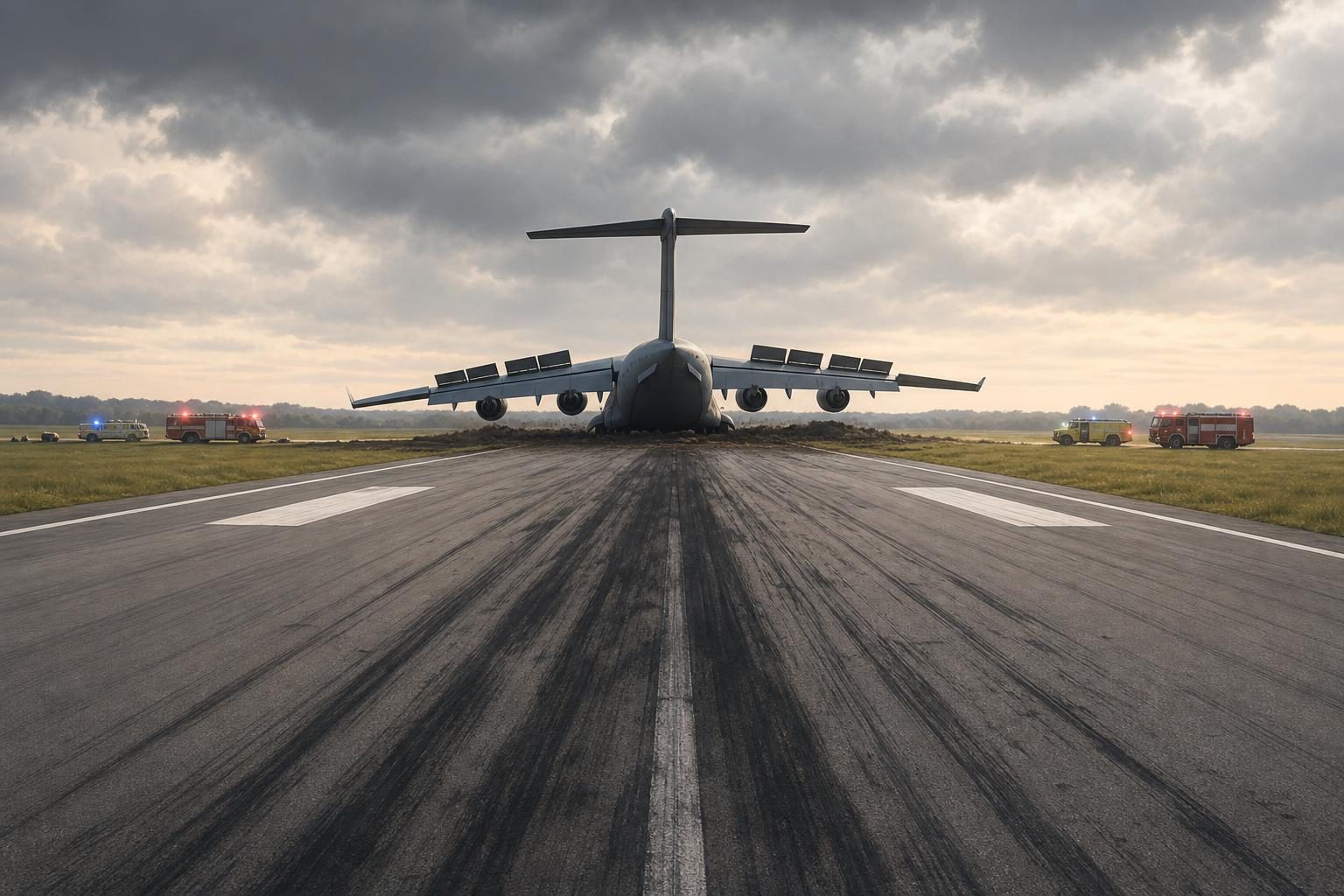
A Boeing 767 cargo jet operating as an Amazon cargo aircraft overran a runway at Miami International Airport after landing, struck two vehicles, and killed five people, according to reporting by PBS NewsHour. The flight had come from Puerto Rico. Federal investigators are now trying to determine why the airplane touched down so far down the runway and why it left the paved surface at high speed.
The basic event is clear, but the cause is not. Video posted on social media showed the aircraft still in the air far down the runway before touchdown. PBS aviation correspondent Miles O’Brien said the landing appeared to involve an unstabilized approach, which means the airplane was not lined up with the correct speed, descent path, and configuration early enough for a normal landing. In aviation work, that matters because a safe landing is not just about reaching the runway; it is about arriving at the right place, at the right speed, with the aircraft ready to stop.
O’Brien described gusty wind, a tailwind, and a crosswind as factors investigators will study. A tailwind blows from behind the aircraft and increases its speed over the ground, even if the airplane’s airspeed indicator shows something different. A crosswind blows from the side and can push one wing or landing gear differently than the other. He also said the aircraft was above the glide slope, the imaginary slanted path that guides a plane down to the runway, and then appeared to descend steeply to try to get back on that path.
Those details point to the kind of judgment that aviation jobs require. A flight crew can continue a landing only if the approach is stable enough to be completed safely. If not, the crew can perform a go-around, which is a planned maneuver in which the pilots add power, climb away, and circle back for another attempt. A go-around is not a failure; it is a safety tool. The hard part is deciding in real time when correcting a bad approach has become riskier than abandoning it.
O’Brien said the aircraft appeared to land at about 185 miles per hour, much faster than expected, and about halfway down a 9,000-foot runway. He also said the left landing gear did not fully settle onto the concrete. That detail is important because modern aircraft use weight-on-wheels signals, which tell onboard systems that the airplane is on the ground. Without the wheels firmly down, the crew may not be able to deploy reverse thrust, which redirects engine force to help slow the aircraft, or spoilers, which are panels on the wings that pop up to kill lift and put more weight on the wheels for braking.
The airport itself will also be part of the safety review. At the end of the runway, Miami had about 1,000 feet of runway safety area, which PBS reported is what the Federal Aviation Administration requires for runways used by large aircraft. The FAA is the federal agency that regulates civil aviation in the United States. A runway safety area is meant to give an aircraft extra room if it overruns the pavement. In this case, the plane crossed grass, went through a fence, and struck a van and an SUV.
Investigators and airport engineers may also look at EMAS, short for engineered material arresting system. EMAS is a bed of crushable concrete-like material placed beyond some runways; when an aircraft rolls into it, the wheels sink in and the material helps slow the plane, somewhat like deep gravel or quicksand. PBS reported that Miami did not have EMAS at this runway because the airport had the required 1,000-foot safety area. O’Brien said EMAS is designed for aircraft entering at about 80 miles per hour, while this jet left the runway area at about 130 miles per hour, so investigators cannot assume it would have stopped this accident. It might still become part of a larger discussion about extra layers of protection.
The National Transportation Safety Board, the federal agency that investigates transportation accidents and recommends safety improvements, will examine the wreckage, runway marks, weather, crew decisions, and aircraft data. The cockpit voice recorder captures sounds and conversation in the cockpit, while the flight data recorder stores technical information such as speeds, control inputs, and system status. Those records should make the timeline more precise than video alone can.
For people headed into aviation, transportation, diesel and heavy equipment, electronics, machining, construction, or emergency operations, the case shows how many trades meet on one runway. Pilots make go/no-go decisions. Aircraft maintenance technicians keep landing gear, brakes, sensors, and reverser systems reliable. Airport operations workers inspect pavement, markings, fencing, and safety areas. Engineers decide what systems to install and where. Investigators read physical evidence and data without jumping to a conclusion. Being hired into that world is not only about knowing tools or terminology; it is about proving that, under pressure, procedures and evidence still come first.
Written from reporting by PBS NewsHour, “What went wrong before an Amazon cargo jet barreled off the runway in Miami”.
Discussion questions
- When should aviation professionals be expected to stop a task and reset, even if continuing seems faster or more convenient?
- Should airports add systems like EMAS even when they already meet federal runway safety requirements?
- What kinds of evidence should investigators trust most in a case like this, and what evidence might be misleading if used alone?