
A New Space Telescope Gets Ready for Launch
NASA’s Roman telescope is set to ride a rocket from Florida and study huge parts of the sky.
Print it — all four files
The student packet has no answers in it. The teacher copy is the same pages plus a note on each question and the answer keys. Both languages carry the same story, the same picture and the same vocabulary.
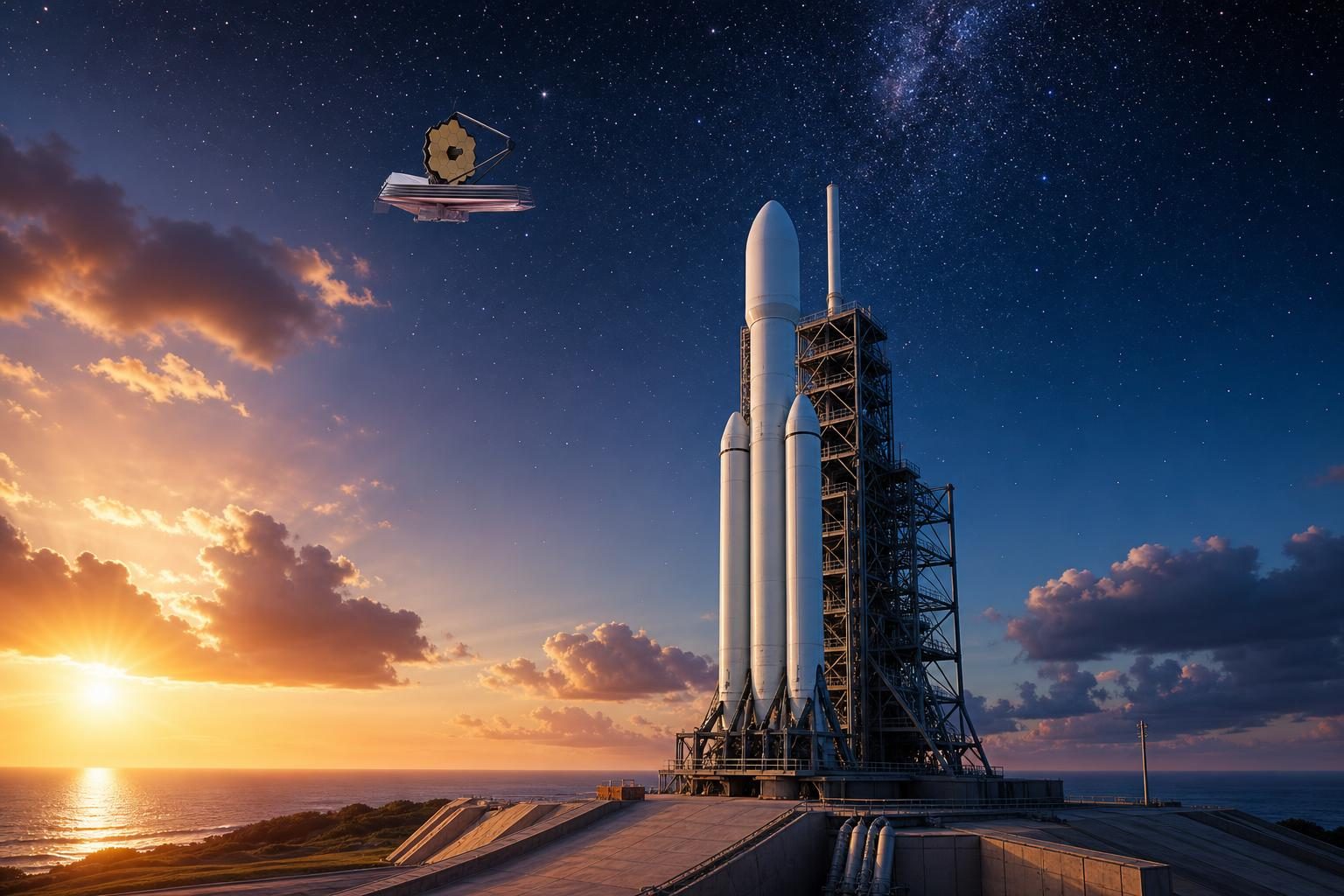
NASA says it is getting ready to launch the Nancy Grace Roman Space Telescope from Florida. The launch is planned for no earlier than Sunday morning, Aug. 30. A SpaceX Falcon Heavy rocket is set to carry it from Kennedy Space Center.
If you were nearby, the morning would feel like waiting for a giant science project to begin. People would watch clocks, weather, and rocket systems. Online viewers would hear countdown words and see the rocket on the pad before liftoff.
Roman is a space telescope. That means it works above Earth’s air. Air can blur and block some light. From space, Roman can get a clearer view of faraway objects.
According to NASA, Roman will use infrared vision. Infrared light is a kind of light people cannot see with their eyes. It can help telescopes study things that are very far away, very cool, or hidden by dust.
Roman will also see a very wide patch of sky at one time. NASA says its view will be at least 100 times larger than Hubble’s view. Hubble is another NASA space telescope. Think of one sharp photo of a whole playground, not one swing set.
That wide view matters. Roman is made to survey, or carefully scan, huge parts of the sky. Scientists plan to use it to study billions of galaxies. A galaxy is a huge group of stars, gas, dust, and planets.
The telescope will also help study dark energy and dark matter. Dark energy is a mystery linked to why the universe is spreading out faster. Dark matter is unseen stuff scientists think helps hold galaxies together.
Roman may also find and study exoplanets. An exoplanet is a planet that circles a star outside our solar system. Finding more of them helps scientists learn what kinds of planets exist.
After launch, Roman is planned to travel about one million miles from Earth. Its home will be near a place called L2. There, the pull of the sun and Earth helps a spacecraft stay in a steady area.
NASA says Roman’s main mission is planned for five years. The goal is to keep it working for 10 years. Its science data will be shared with the public after processing. That means scientists will prepare the information before others use it.
A launch is only the first step. If Roman reaches its place and starts work, it could help people ask bigger questions with better pictures.
Written from reporting by NASA, “NASA Sets Coverage for Roman Space Telescope Launch from Florida”.
Discussion questions
- Roman can see a much wider part of the sky than Hubble. When might a wide view be more useful than a close-up view?
- NASA plans to share Roman’s science data after it is processed. What are the benefits and possible challenges of sharing it widely?
- If Roman could focus first on galaxies, dark energy, or exoplanets, which would you choose and why?