
A Star That May Shine Green
NASA shared a new space image showing how a white dwarf star can get an unexpected color.
Print it — all four files
The student packet has no answers in it. The teacher copy is the same pages plus a note on each question and the answer keys. Both languages carry the same story, the same picture and the same vocabulary.
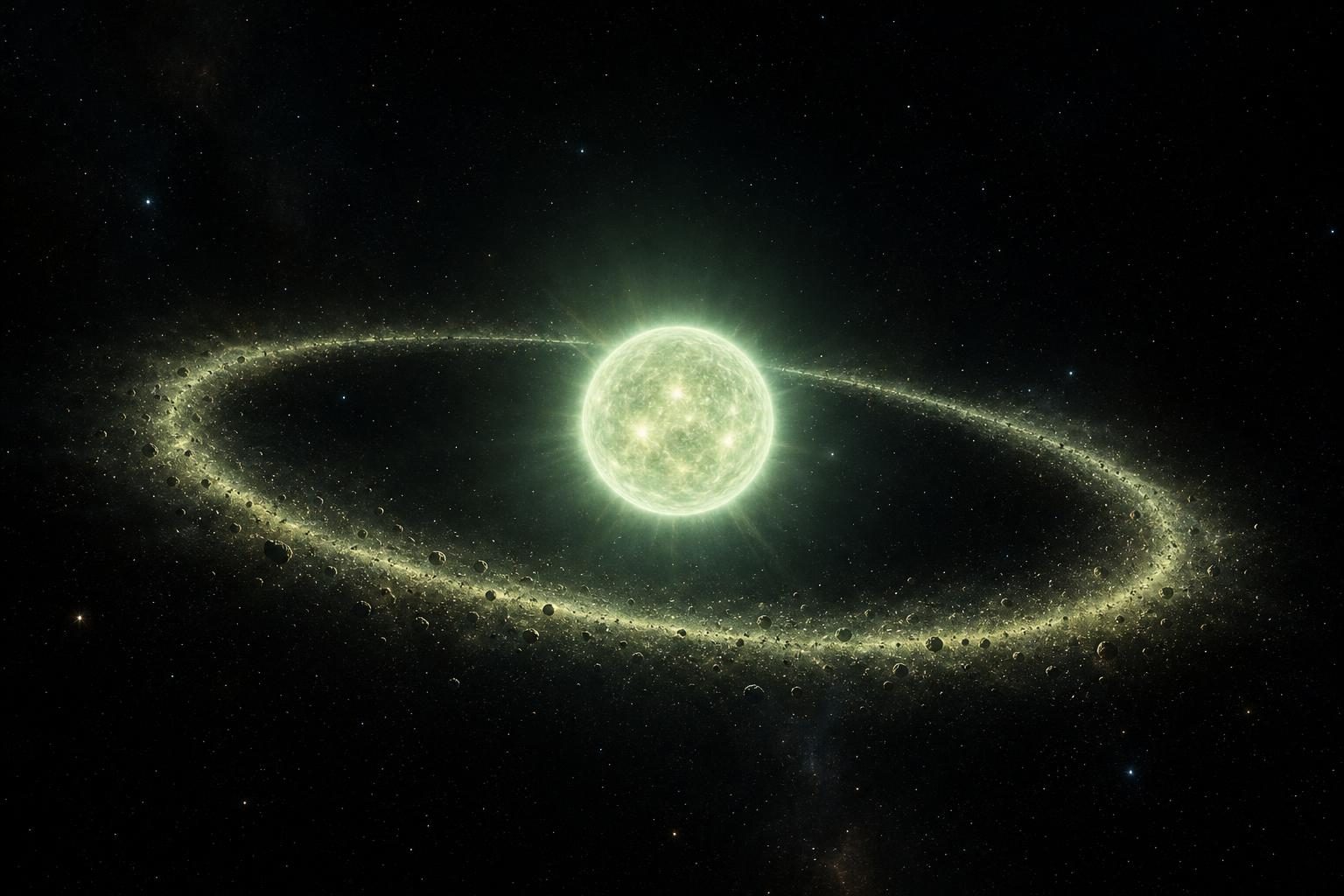
NASA’s Astronomy Picture of the Day shared a new space image on October 22. It shows WD J1330+6435, a white dwarf star. A white dwarf is the small, faint leftover core of a star like the Sun. This one is shown with a ring of gas and rocks around it. That ring is called an accretion disk, which means material is circling the star.
The surprising part is the color. According to NASA’s Astronomy Picture of the Day, astronomers recently found that some white dwarf stars may not look plain white. Some could appear yellow, green, cyan, pink, or purple. Cyan means a blue-green color, like bright pool water. These stars are still too faint for people to see with just their eyes. So this is not a new green dot to find in the night sky. It is a clue found by scientists using careful observations.
Most stars we see look white from Earth. Some look red or blue. NASA explains that a star’s color is often tied to temperature. Blue stars are hotter than red stars. White dwarfs are different in this story. Tiny bits of other materials can mix with the gas around them. Scientists call those tiny bits trace elements. When those elements interact with the star’s atmosphere, or outer gas layer, they can shift the color.
Imagine standing under a dark sky. Stars would mostly look like tiny points, not colored balls. They are so far away that even giant stars shrink to pinpricks. This new idea is not about seeing a big green sun overhead. It is about learning that starlight can carry hidden information. The color of light can tell scientists what is happening at a star’s surface.
The disk around WD J1330+6435 also makes the scene feel familiar. It is a little like crumbs circling a drain, but in space. Gas and rocks move around the star. The article says these materials were accreted, which means pulled in and added to the star. That material can change what the starlight looks like.
This matters because color is one of astronomy’s tools. A telescope does not just take pretty pictures. It helps scientists ask what something is made of. If a white dwarf seems green, that color is evidence, or a sign scientists can study. It may show the star picked up material.
Written from reporting by NASA, “APOD: 2026 October 22 – The First Green Star, WD J1330+6435”.
Discussion questions
- An artist’s illustration can show a star we cannot see with our eyes. Is that helpful, risky, or both?
- Should scientists spend time studying stars that are too faint for most people to see? Defend your answer.
- Color is a clue in this story. Where else can color give important information, and how is that similar or different?