
Antarctica’s Ozone Hole Reaches Its Yearly Peak
NASA says the 2026 ozone hole was wide, but not as deep as some past ones.
Print it — all four files
The student packet has no answers in it. The teacher copy is the same pages plus a note on each question and the answer keys. Both languages carry the same story, the same picture and the same vocabulary.
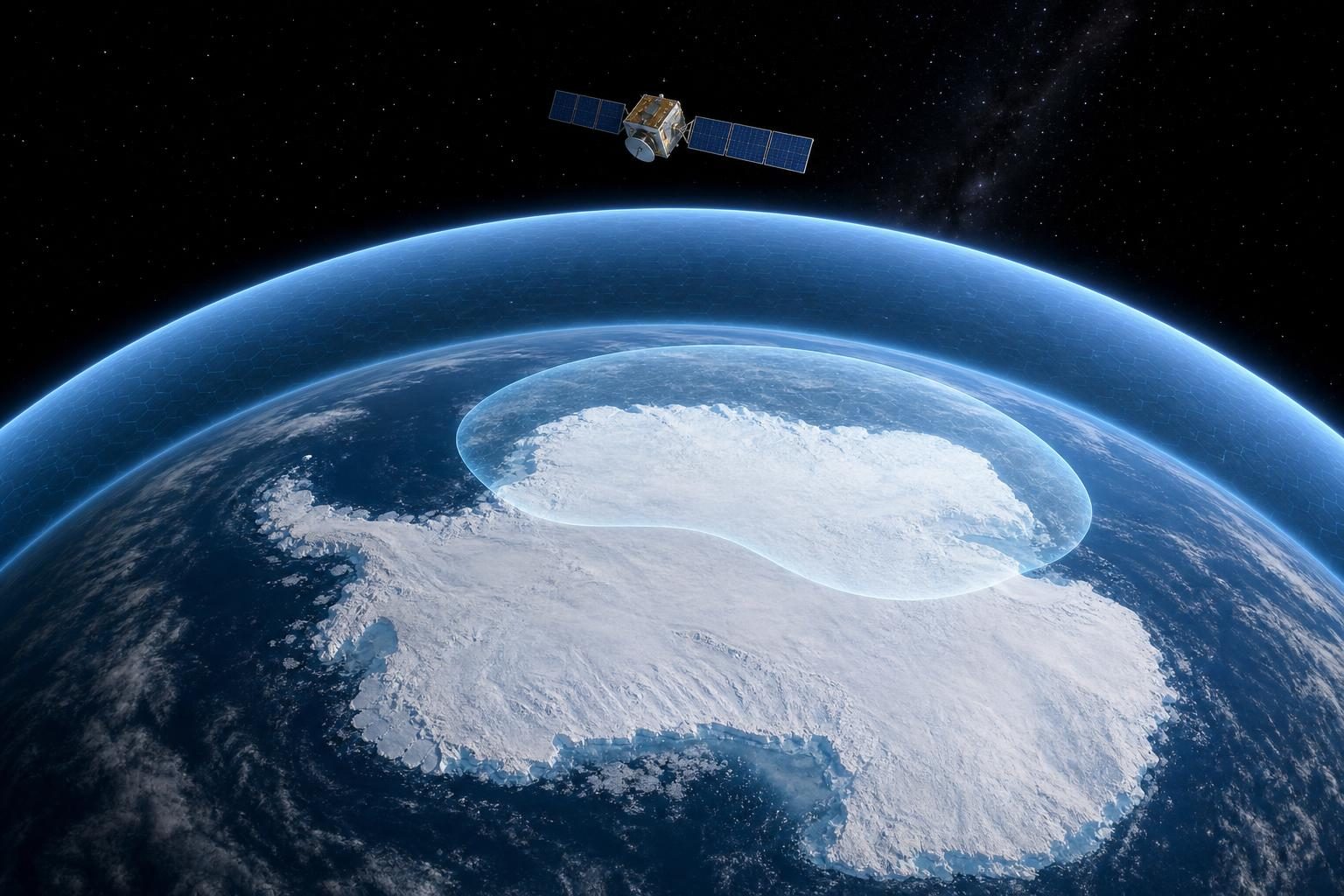
NASA’s Earth Observatory reported today that the ozone hole over Antarctica reached its 2026 maximum. It was the seventh largest by area in 48 years of watching from satellites and ground stations. But it was not as deep as some other large ozone holes.
Ozone is a gas high above Earth. It forms a thin layer in the stratosphere, a part of the atmosphere far above weather clouds. This layer works like sunscreen for the planet. It absorbs ultraviolet light, a strong kind of sunlight that can harm living things.
The “hole” is not an empty place in the sky. NASA says scientists use that word for a place where ozone gets very thin. Imagine a raincoat with a worn patch. The coat is still there, but that patch gives less protection.
The ozone hole forms over Antarctica each spring there. Antarctica is the icy continent at the bottom of Earth. In 2026, very cold, spinning winds high above Antarctica helped the hole spread over a large area. Scientists call that ring of winds a polar vortex. The hole reached its largest area on September 18.
This story matters because people helped cause the problem, and people also worked to fix it. For many years, chemicals called CFCs were used in refrigerators and spray cans. CFC stands for chlorofluorocarbon. These chemicals can last a long time. When they rise high into the stratosphere, sunlight breaks them apart. Then they release chlorine, which can destroy ozone again and again.
Countries made a treaty, or world agreement, in 1987 to phase out many ozone-harming chemicals. Phase out means to stop using something step by step. NASA says scientists have already seen signs of recovery. In 2018, they reported direct satellite evidence that less ozone was being destroyed in Antarctic winter months.
The repair is slow. Some of those chemicals stay in the air for decades. Scientists estimate the Antarctic ozone layer will return to 1980 levels in the 2070s.
A familiar connection is sunscreen on a bright day. You cannot see it working, but it matters. The ozone layer is like that, only much higher and much bigger. Scientists keep watching it each year, using instruments on satellites. Their measurements show how Earth changes across seasons, years, and choices people make.
Written from reporting by NASA, “Ozone Hole Reaches Its 2026 Maximum”.
Discussion questions
- Should people keep spending time and money to measure the ozone hole every year, even while it slowly heals? Defend your answer.
- What makes the 1987 treaty a useful example of solving a shared problem, and what might make agreements like it hard?
- If you were explaining this news to a younger child, would you focus more on the large size or the not-as-deep part? Why?