
Curiosity Finds Odd Disc-Shaped Lumps on Mars
NASA's rover is studying strange rocks to learn what minerals they hold.
Print it — all four files
The student packet has no answers in it. The teacher copy is the same pages plus a note on each question and the answer keys. Both languages carry the same story, the same picture and the same vocabulary.
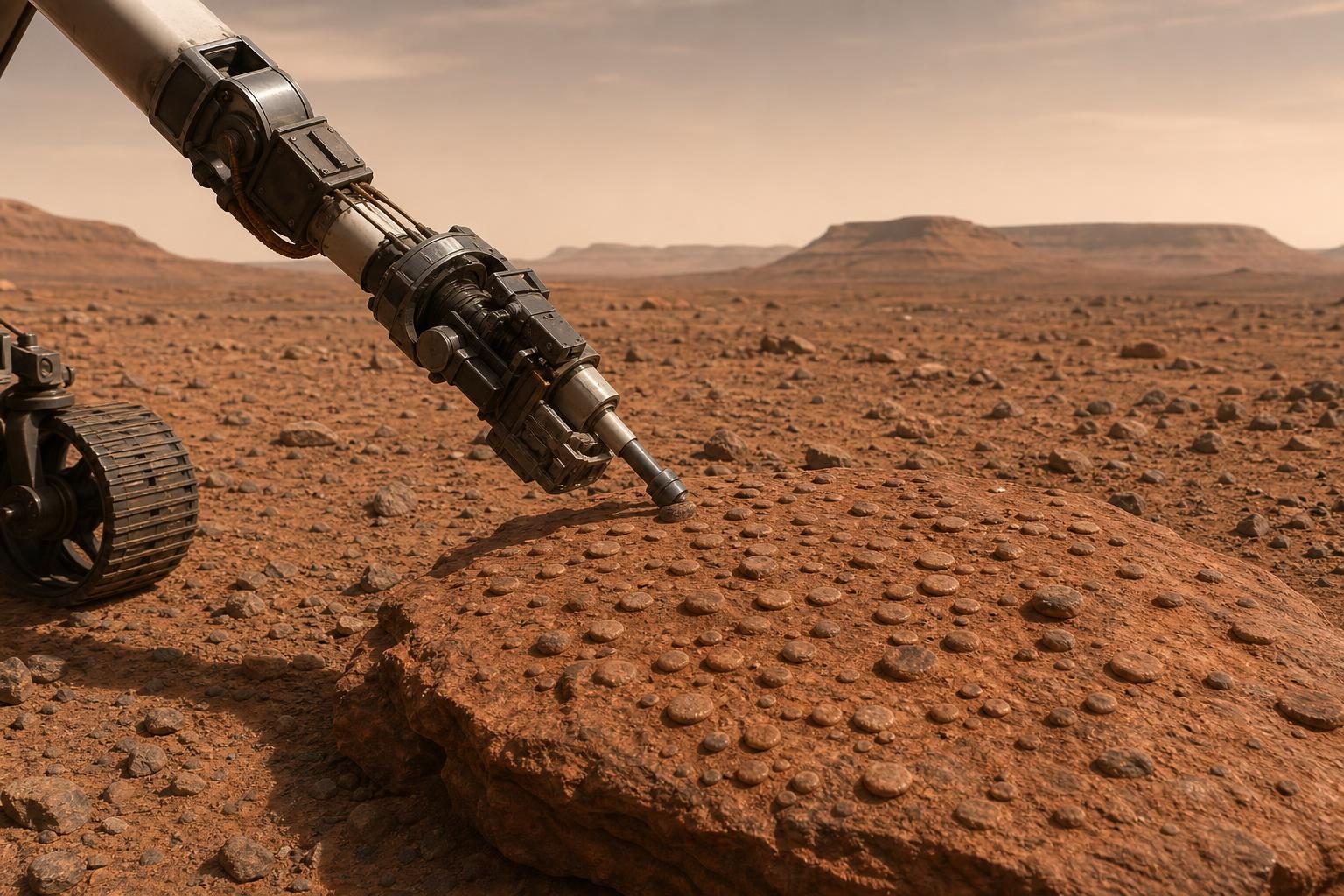
NASA’s Curiosity rover rolled up to a strange new patch of Martian rock this week. Instead of flat, fine layers, the robot saw blocks covered with small, round disc-shaped lumps. Some blocks may even be filled with them.
According to a NASA Curiosity mission blog written by planetary scientist Lucy Lim, the change surprised the science team. Curiosity is a rover, a rolling robot that studies Mars. Mars is the cold, rocky planet next outward from Earth.
The find matters because rocks can hold clues about a place’s past. A mineral is a natural solid, such as quartz or salt. Minerals can grow in different shapes. On Earth, similar disc-like shapes sometimes appear where minerals came out of an evaporating liquid. Evaporating means changing from liquid into gas.
The team does not know yet what made these Martian lumps. One idea is that a crystal-shaped mineral grew that way. A crystal is a solid with an ordered pattern inside. Another idea is simpler. The discs could be bits of a harder rock layer that broke apart and piled up there.
Curiosity cannot pick up a rock and carry it to a school lab. Instead, it brings a small lab with it. Its cameras take close pictures. Its tools can test what rocks are made of. To name the minerals, the rover needs a tool called CheMin. That instrument uses X-rays, a kind of energy that can pass through small samples, to study the pattern inside crushed rock.
That means Curiosity must drill. Drilling on Mars is careful work. The rover has driven more than a kilometer since its last drill site. That is more than half a mile. The team guided it toward a promising spot. They chose a target and planned a tiny drive to place it within reach of the rover’s arm.
Before drilling, Curiosity will touch the rock with arm tools. Then it may press its drill against the target for a test. If that goes well, the rover can drill and send powder to its lab.
Curiosity is also taking faraway pictures of hills called buttes near a place named Valle Grande. Buttes are steep, flat-topped hills. Those pictures help scientists trace rock layers and see how wind and time wore them away.
No person is standing beside Curiosity. The robot is alone on the surface. Still, each careful move lets scientists on Earth read another page of Mars.
Written from reporting by NASA, “Curiosity Blog, Sols 5016–5021: Fantastic Minerals and How To Detect Them”.
Discussion questions
- If rover time is limited, should the team drill this strange rock or keep driving to new places? Defend your choice.
- Scientists have more than one idea about how the lumps formed. What kind of evidence would make one idea stronger?
- How is Curiosity's work like investigating a rock near your school, and how is it different?