
Do Dolphins and Elephants Have Names for Each Other?
Scientists are testing whether some animal calls point to one special individual, almost like a name.
Print it — all four files
The student packet has no answers in it. The teacher copy is the same pages plus a note on each question and the answer keys. Both languages carry the same story, the same picture and the same vocabulary.
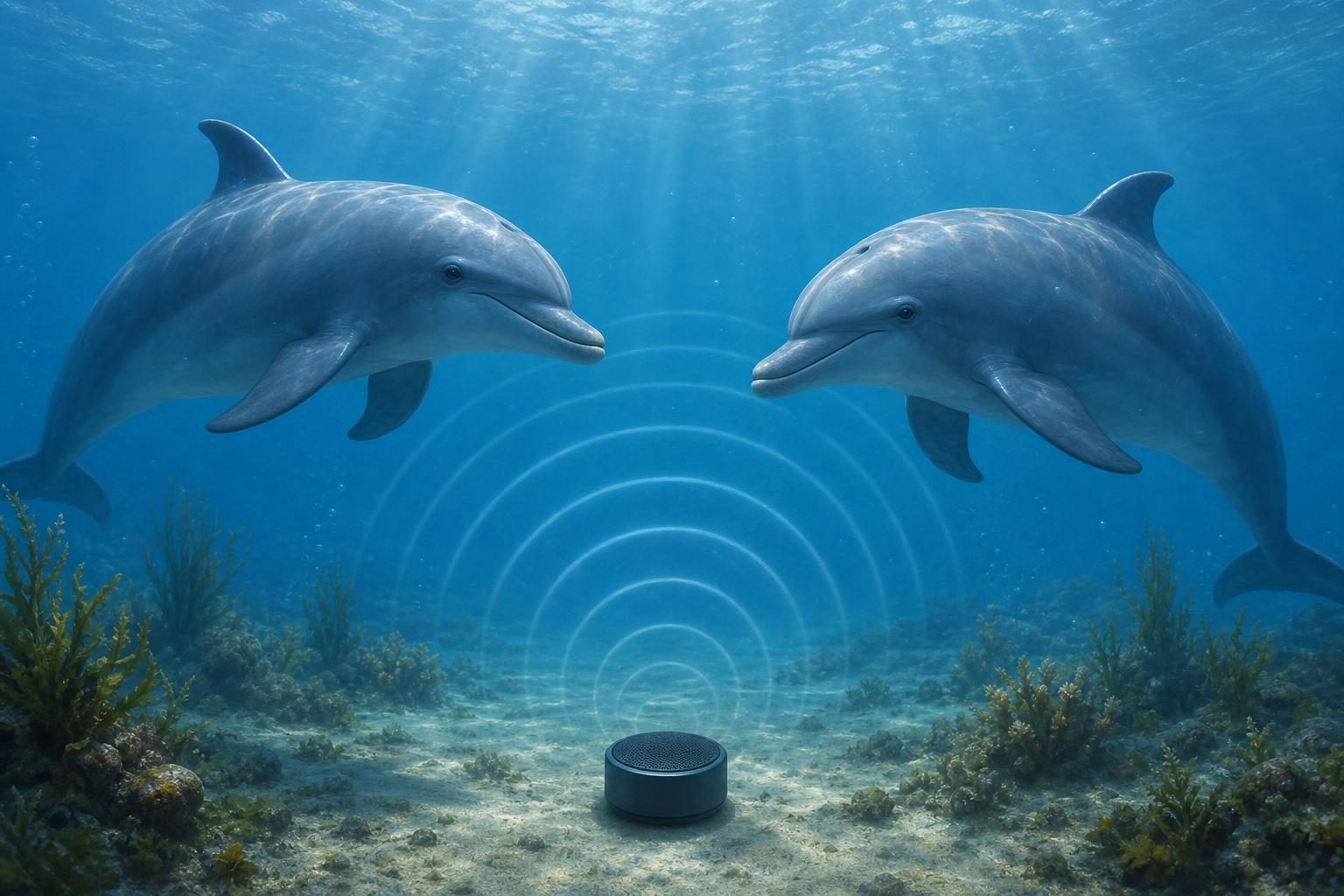
Researchers are trying to decide whether some animal sounds work like names. According to reporting by Live Science, the strongest evidence comes from bottlenose dolphins. Young dolphins make their own special whistles. Scientists call them signature whistles, meaning sounds that identify one dolphin.
That matters because names help us find one person in a busy place. A dolphin group can be busy too. Dolphins travel, hunt, and work together in water where seeing far is hard. A whistle can reach through the water when a fin or face cannot be seen.
Scientists have tested this by playing dolphin whistles through underwater speakers. Dolphins can copy another dolphin’s special whistle when they want contact. They can also recognize the shape of that whistle, even when a different dolphin makes it. That is a bit like knowing a friend’s name in a new voice.
Elephants may do something similar. Researchers have studied wild African elephants and their low rumbles. A rumble is a deep sound you may feel as much as hear. In tests, elephants moved toward a speaker faster when it played a call meant for them. They also called back more. But that elephant study was a preprint, which means other experts had not fully checked it yet.
Small parrots called spectacled parrotlets may use special calls too. Pet parrots can learn the names of people and animals at home. Still, scientists are careful. A parrot repeating a word may not be thinking about names the same way a person does.
In a July 2026 paper, researchers set rules for stronger proof. A real animal name should point to one individual. It should be a symbol, which means the sound stands for that individual in the caller’s mind. At least two animals should share that meaning.
Not every case meets those rules yet. Some small monkeys called marmosets may aim calls at certain family members. Other scientists think they might just be copying sounds.
The big idea is not that animals talk exactly like humans. The idea is that some animals may keep track of each other in surprisingly careful ways. If a dolphin hears its own whistle, it may respond as if the call is for it.
Written from reporting by Live Science, “Do other animals call each other by name?”.
Discussion questions
- What kind of proof would convince you that an animal is using a name, not just making a familiar sound?
- Is it fair to use the word “name” for animal calls, or should scientists use a different word? Defend your view.
- Scientists sometimes play recorded calls to animals to learn how they respond. What are the benefits and risks of that method?