
Hubble Spots a 10-Sided Cloud Shape on Saturn
NASA shared a new image showing a decagon around Saturn’s South Pole, giving scientists a fresh puzzle to study.
Print it — all four files
The student packet has no answers in it. The teacher copy is the same pages plus a note on each question and the answer keys. Both languages carry the same story, the same picture and the same vocabulary.
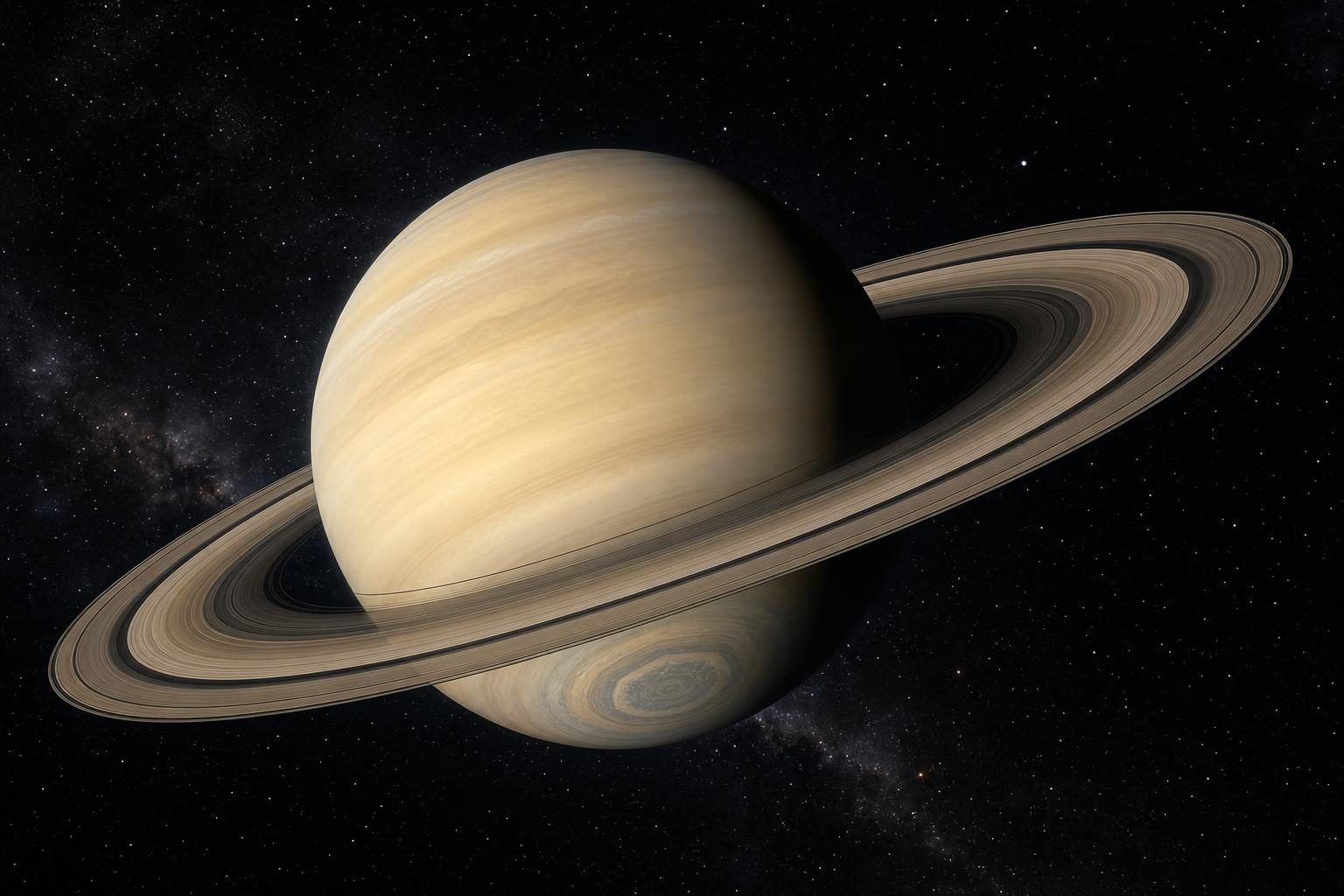
NASA shared a new space image today that shows a strange shape around Saturn’s South Pole, according to NASA’s Astronomy Picture of the Day. The South Pole is one end of Saturn as it spins, like the bottom of a globe. Around it, Hubble saw a decagon, a shape with 10 sides, made of clouds.
This matters because scientists do not often see weather making such neat shapes. On Earth, clouds can look messy and soft. On Saturn, huge bands of clouds can line up in a pattern from geometry class. It is like seeing a cloud draw a shape from math.
The picture came from the Hubble Space Telescope, a telescope that travels in space. The Saturn image was made from observations taken last year. NASA shared it now as a daily space picture.
Saturn has done something like this before. Its North Pole has a hexagon, a shape with six sides. Scientists first found that northern shape in 1987. They saw it in information from NASA’s Voyager spacecraft. Those spacecraft flew past Saturn in the early 1980s and sent back data.
The northern hexagon has lasted for more than 40 years. That is a long time for a cloud pattern. The new southern decagon is different. Scientists still need to watch it. They want to know if it will stay, change, or fade.
NASA says the shape may form because gases move at different speeds. Farther from the pole, some gas moves fast. Closer to the pole, other gas moves more slowly. When these moving gases meet, they may make waves. These are not ocean waves. They are pushes and bends in flowing gas. Those waves may help draw the edges of the decagon.
Imagine watching cream swirl in a cup of hot cocoa. Some parts move faster than others. Lines and loops can appear for a moment. Saturn’s clouds are not cocoa, of course. But moving stuff can make patterns in both places.
The discovery also shows why scientists keep looking at places they already know. Saturn is not new to us. Its rings are famous. Yet a telescope can still spot a surprise. A familiar planet can still ask a fresh question.
Written from reporting by NASA, “APOD: 2026 September 8 – Hubble: Decagon Around Saturn’s South Pole”.
Discussion questions
- Why might a cloud shape on Saturn be more than just a pretty picture?
- Should space telescopes spend more time revisiting familiar planets or looking for new places? Defend your choice.
- How does comparing Saturn's clouds to cream in cocoa help, and how could that comparison be misleading?