
Mars Rover Reaches 5,000 Days on the Red Planet
NASA’s Curiosity rover is still climbing, testing wind-shaped sand after 5,000 Martian days.
Print it — all four files
The student packet has no answers in it. The teacher copy is the same pages plus a note on each question and the answer keys. Both languages carry the same story, the same picture and the same vocabulary.
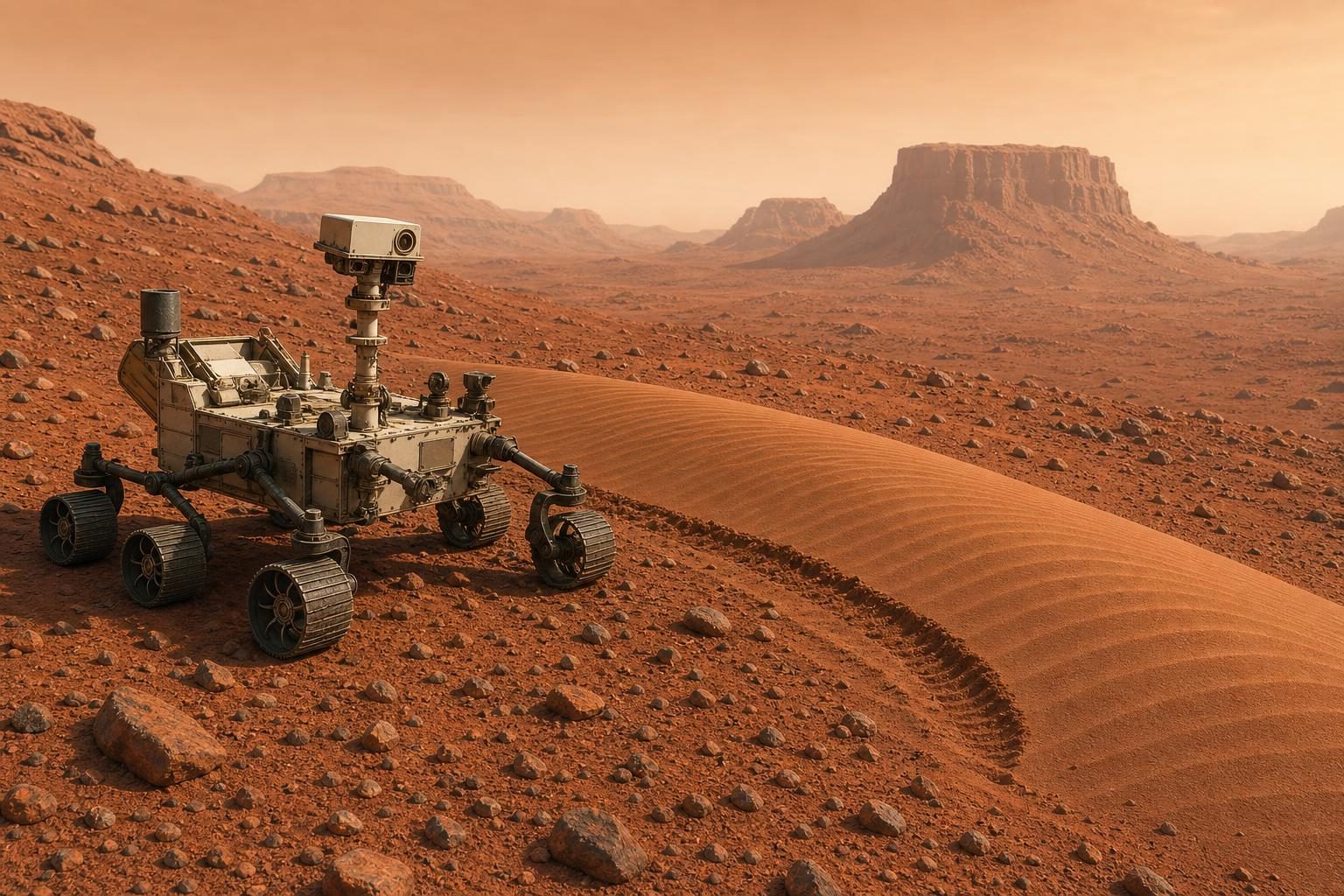
NASA’s Curiosity rover has now worked on Mars for 5,000 Martian days, according to NASA’s Curiosity rover blog. A Martian day is called a sol. It lasts 24.6 hours, a little longer than a day on Earth. That means Curiosity has been exploring for more than 5,137 Earth days.
Curiosity is a rover, which is a robot car built for science. It rolls slowly over rocks and sand. It takes pictures and uses tools to study what the ground is made of. No astronaut is driving it from the seat. Engineers on Earth send plans, and the rover follows them on Mars.
This milestone matters because Mars is far away and rough on machines. Dust, rocks, slopes, and time can wear parts down. Curiosity has kept going long enough to climb more than 1 kilometer above its landing place. That is about 0.62 miles. For a robot on another planet, that is a mountain-sized achievement.
Right now, Curiosity is studying a long, narrow sand ripple named Chocolatal. A ripple is a small ridge made when wind pushes grains of sand. Scientists want to know if Chocolatal is a kind of feature called a transverse aeolian ridge. That means a wind-made ridge that lies across the usual wind direction.
If you could stand near Curiosity, you would see a quiet, rocky place. There would be pale bedrock nearby and darker coatings on some rocks. Ahead would be the ripple, like a low stripe of sand. The rover would not rush. It would stop, look, test, and wait for new directions.
The team even drove one wheel into Chocolatal and backed up. That made a small trench, or cut, in the ripple. Then Curiosity could study the inside, not just the surface. Its cameras looked for layers. Its instruments checked grain sizes and the chemistry of the sand and rock.
These details help scientists read Mars like a very old book. Wind can move grains, build ridges, and leave patterns behind. By studying one ripple closely, scientists learn how the Martian surface changes. They also learn how today’s Mars compares with places Curiosity visited lower on Mount Sharp.
Curiosity’s 5,000 sols are not just a birthday. They show what careful planning can do. A robot the size of a small car is still asking new questions, one slow drive at a time.
Written from reporting by NASA, “Curiosity Blog, Sols 4995-5001: 5,000 (Martian) Days on Mars”.
Discussion questions
- Should a rover spend extra time studying one small place, or keep driving to see more places? Defend your choice.
- What makes Curiosity’s work similar to a classroom science project, and what makes it very different?
- What information would help scientists decide whether Chocolatal is still being changed by wind?