
Monkeys Play Shape Games, and Scientists Learn
A new study finds monkeys and people may spot shapes in similar ways.
Print it — all four files
The student packet has no answers in it. The teacher copy is the same pages plus a note on each question and the answer keys. Both languages carry the same story, the same picture and the same vocabulary.
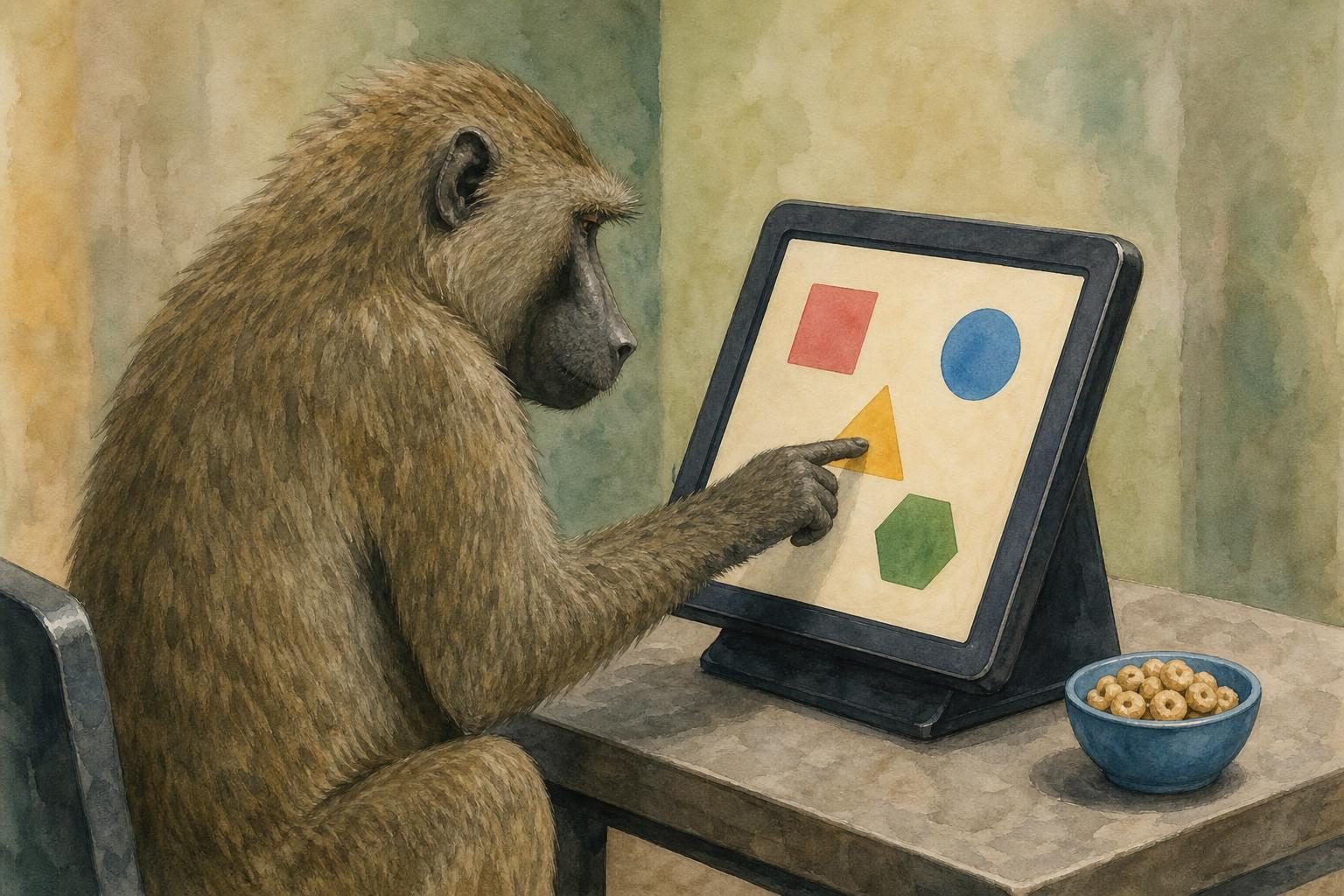
A new study suggests that monkeys and people may understand shapes in surprisingly similar ways, according to Science News Explores. The work compared preschool children, adults who had not learned geometry in school, and two kinds of monkeys. Geometry is the math of shapes, lines, and angles.
The test looked like a simple screen game. A shape appeared first. Then two more shapes appeared. The player had to pick the matching shape. Preschoolers could earn stickers. Monkeys could earn small cereal treats. Some monkeys liked the games so much that they kept playing.
The researchers did not only ask who got more answers right. They looked at mistakes. Mistakes can show how a mind is sorting a problem. If two groups make similar mistakes, they may be using similar ideas.
The people in the study included U.S. preschoolers. They also included Tsimane’ people from Bolivia and Himba people from Namibia. Those adults had not gone to schools where they studied shapes the way many U.S. children do. The monkeys were rhesus monkeys in a lab and olive baboons at a zoo.
The team compared the answers with computer models. A model is a computer-made way to test an idea. In this case, the models tried to copy different ways of thinking about shapes. Both monkey groups and all the human groups made similar kinds of mistakes. That suggests their brains may notice shapes in related ways.
The result does not mean monkeys are ready for math class. The researchers said humans did better. It also does not prove exactly what a monkey is thinking. Other scientists noted that a computer model is not the same as a mind. A different model might show other differences.
Still, the study changes an old question. People often ask what makes humans special. Language, tools, and math are common answers. But this work suggests that at least some shape sense may be older than humans. It may be something we share with other primates. Primates are mammals that include monkeys, apes, and humans.
There was also a kid-size part of the story. Elementary students in New York have been coding games for baboons. Coding means writing instructions for a computer. They chose pictures and built matching games. They also had to think like game designers. If pictures were too much alike, the monkeys might not understand the task.
That makes the research feel less far away. It is not only about scientists in labs. It is also about screens, games, rewards, and careful choices. A shape game can become a window into how another animal sees the world.
Written from reporting by Science News Explores, “Monkeys might share our instincts for math”.
Discussion questions
- If scientists want a fair shape game for both monkeys and children, what choices should they make?
- Do similar mistakes prove that monkeys and people think the same way about shapes? Defend your view.
- Should elementary students help design real science games for animals? Why or why not?