
New Space Telescope Begins a Wide-Eyed Sky Search
NASA says Roman can see much more sky at once than Hubble, helping scientists find stars and planets faster.
Print it — all four files
The student packet has no answers in it. The teacher copy is the same pages plus a note on each question and the answer keys. Both languages carry the same story, the same picture and the same vocabulary.
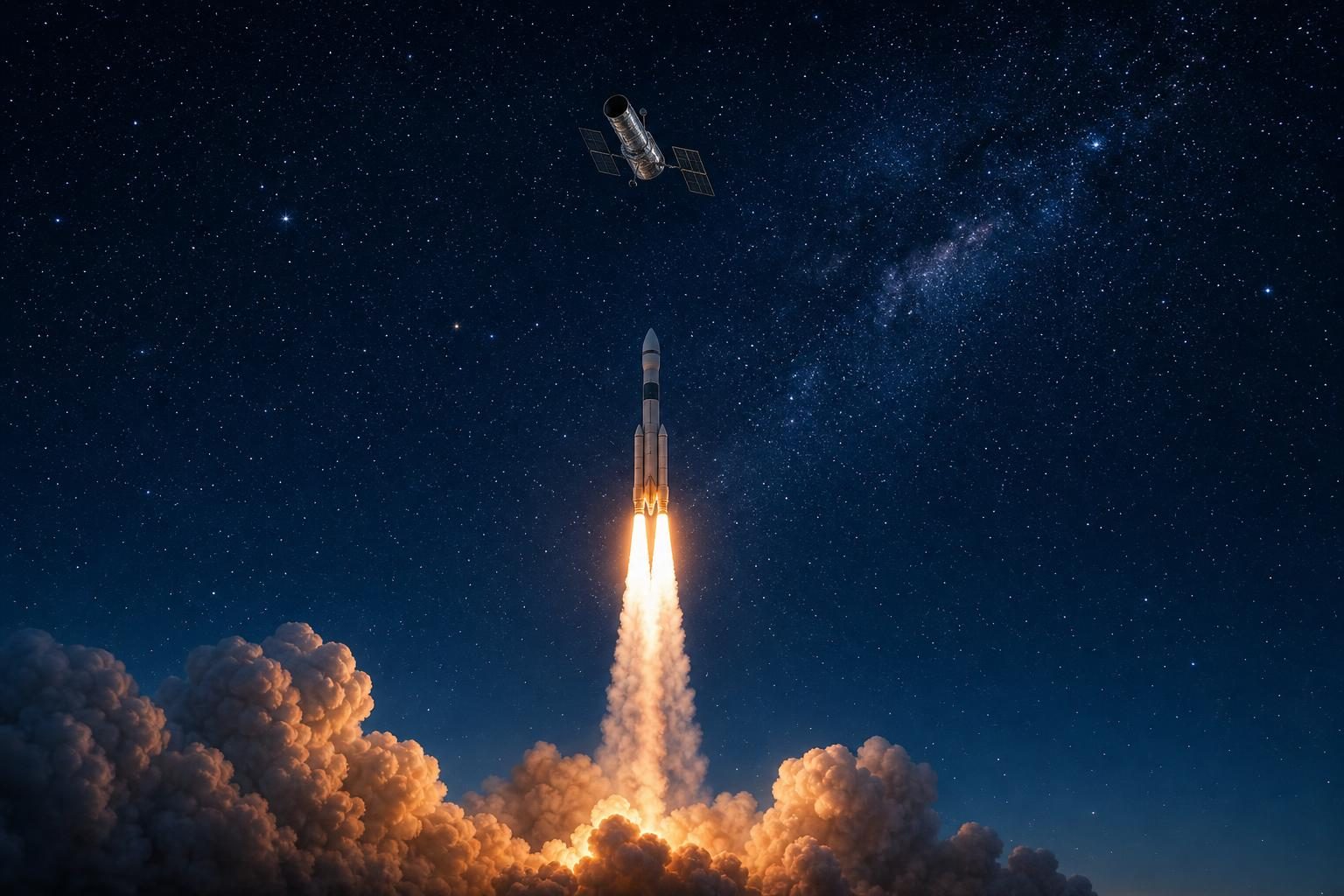
According to NASA’s Astronomy Picture of the Day, a new space telescope launched on Aug. 30. It lifted off from Kennedy Space Center in Florida. The Nancy Grace Roman Space Telescope rode into space on a Falcon Heavy rocket made by SpaceX. Its job is to look at huge parts of the sky. It will help scientists learn what is out there.
The Roman telescope has a main mirror the same size as the Hubble Space Telescope’s mirror, according to NASA. A main mirror is the big curved piece that gathers light. But Roman can see 100 times more sky in one snapshot. A snapshot is one picture taken at one moment.
That wider view comes from its design. NASA says Roman’s main mirror is more curved than Hubble’s. Its smaller second mirror sits closer. Its main camera is larger. Put together, those parts let Roman cover more sky faster. It is like a flashlight with a wider beam.
This matters because the sky is enormous. If a telescope can check more places quickly, it has a better chance to catch rare events. One target is supernovas, which are exploding stars. They can help scientists study how fast the universe is expanding, or stretching out. They can also help scientists learn what the universe is made of.
Roman will also search for planets around other stars. These are called exoplanets, which means planets outside our solar system. Finding more of them helps scientists ask a big question: where else could life exist? Roman will not answer that question all by itself. But it can point scientists toward places worth studying.
This telescope will not circle Earth the way many satellites do. NASA says it will orbit the Sun. That means it will travel around the Sun on a steady path. The James Webb Space Telescope does that too. From there, Roman can keep watching space without Earth filling much of its view.
Imagine watching the launch from far away. The rocket would be a bright column lifting off the pad. It would carry a tool built to see things no person can see with just their eyes. In a classroom, it is like switching from looking through a paper towel tube to using a wide window. More sky fits in the view. So more discoveries can fit in the search.
Written from reporting by NASA, “APOD: 2026 August 31 – Launch of the Roman Space Telescope”.
Discussion questions
- When might a wide view be better than a close view, in space or in everyday life?
- If Roman finds many new planets, how should scientists choose which ones to study next?
- Do you think building tools to study faraway space is worth the effort? Defend your answer.