
Northern Lights Glow Above an Iceland Waterfall
NASA’s picture of the day shows how the sun can help paint the night sky.
Print it — all four files
The student packet has no answers in it. The teacher copy is the same pages plus a note on each question and the answer keys. Both languages carry the same story, the same picture and the same vocabulary.
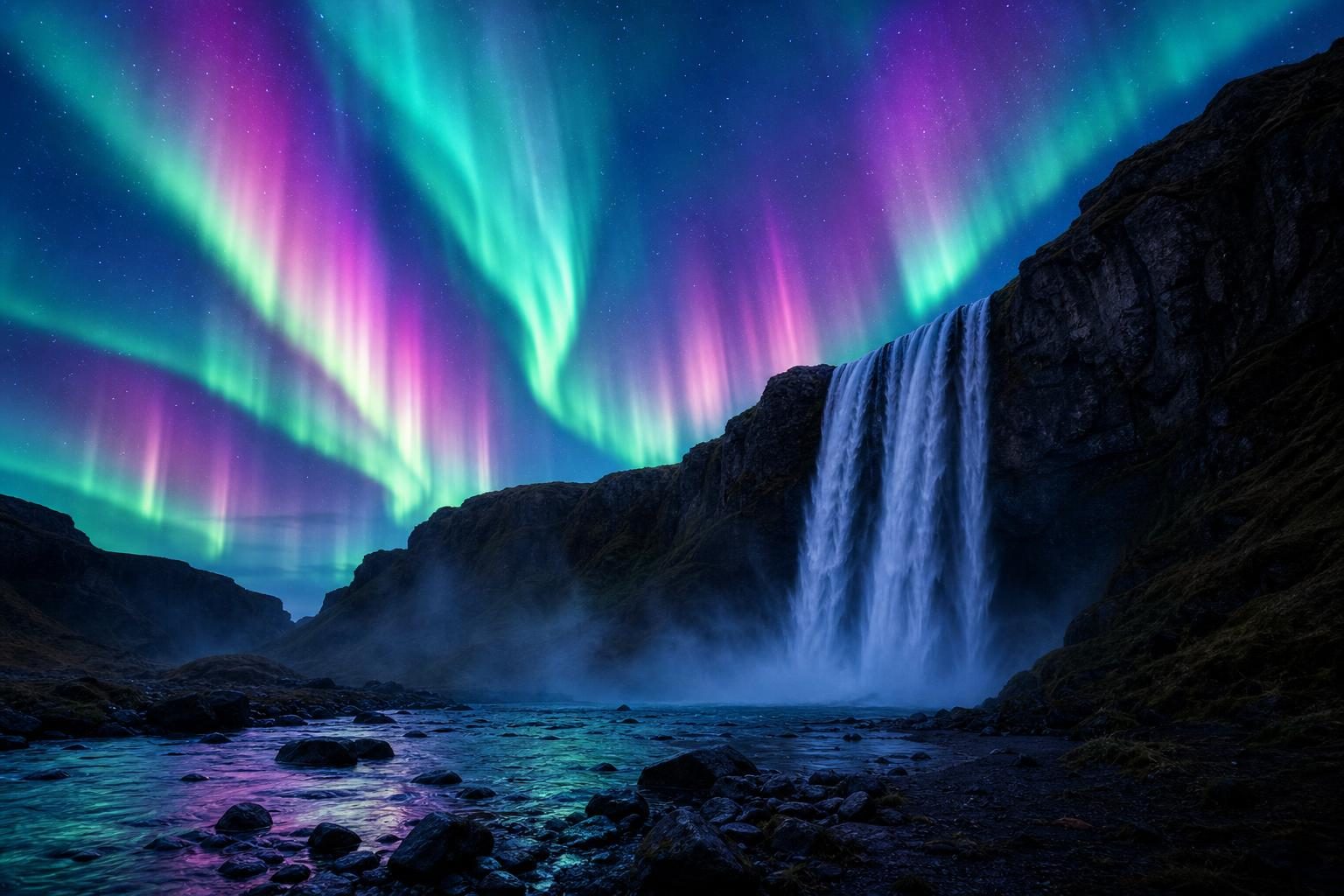
Today, NASA shared a photo of bright northern lights over Skógafoss waterfall in Iceland, according to NASA’s Astronomy Picture of the Day. The picture was taken in April 2025. The camera was open for five seconds. That means it caught several seconds of light in one image.
A person standing there would have seen a dark waterfall, a black sky, and curtains of color overhead. The colors looked like they were raining down toward the water. It would not be like fireworks. Auroras move more softly and slowly, like glowing sheets in the sky.
An aurora is a natural light show near Earth’s poles. The northern lights are auroras near the North Pole. The southern lights happen near the South Pole.
Auroras do not happen every clear night. Several things have to line up. The sun must be active. The sky must be dark and clear. The viewing place usually has to be at a high latitude. High latitude means far north or far south on Earth.
That is why Iceland can be a good place to see the northern lights. It sits far north. NASA says the southern lights are harder for many people to see. There is less land in the Southern Hemisphere near the Antarctic Circle. That gives people fewer places to stand and watch.
The science starts at the sun. The sun sends out solar wind, which is a stream of tiny particles. Some of those particles are charged. Charged particles carry a tiny electric push or pull.
Earth has a magnetosphere, which is a magnetic shield around the planet. It helps catch some particles from the solar wind. Earth’s magnetic field then guides many of them toward the polar regions.
High above the ground, those particles hit gases in the atmosphere. The atmosphere is the blanket of air around Earth. When the particles hit the gases, the gases glow.
Different gases can make different colors. NASA says oxygen can glow red or green. Nitrogen can glow blue or pink. So the colors in the photo are not paint or clouds. They are clues about what is happening high in the air.
The photo matters because it shows something beautiful and real at the same time. It connects a waterfall on Earth to activity on the sun. It is a reminder that space weather can sometimes be seen from the ground.
Written from reporting by NASA, “APOD: 2026 August 27 – Colorful Aurora over an Icelandic Waterfall”.
Discussion questions
- Would you rather see an aurora in person or study one from a photo? Defend your choice.
- Why might a waterfall make this science photo easier for people to care about?
- If a class could plan one night to look for auroras, what would be the most important things to consider?