
Sea Stars May Use Their Skeletons to Guide Light
Tiny cones in chocolate-chip sea stars act like little light pipes, but scientists are still testing what they do.
Print it — all four files
The student packet has no answers in it. The teacher copy is the same pages plus a note on each question and the answer keys. Both languages carry the same story, the same picture and the same vocabulary.
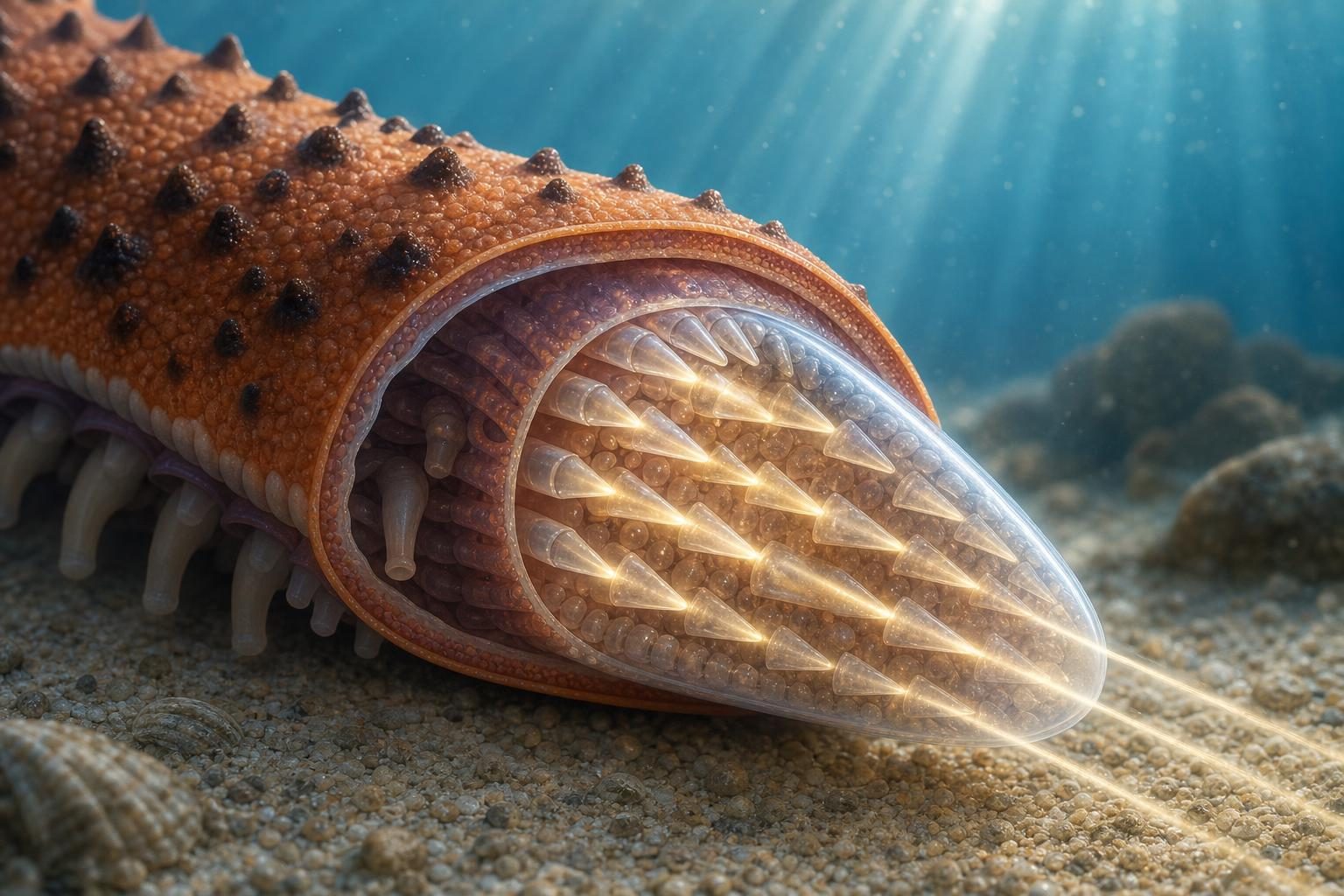
Scientists have found a surprise inside the arms of chocolate-chip sea stars. According to Science News Explores, tiny parts of their skeleton can guide light inward. They work a little like fiber-optic cables. Those are thin strands that carry light signals, including internet signals.
The discovery matters because sea stars do not have faces like ours. They still need to sense their world. A sea star may need to know where light is coming from. That could help it move across shallow tropical water. The new finding may show one way it does that.
On a shallow tropical seafloor, a chocolate-chip sea star looks dotted with dark candy pieces. It has five arms around a middle disk. At the tip of each arm is a small heart-shaped plate. This plate is part of the skeleton. Scientists found 90 to 100 tiny cone shapes inside each plate.
The team did not set out to study sight. Ling Li, a materials scientist at the University of Pennsylvania, was studying the animal’s strong skeleton. A materials scientist studies what things are made of. His team used an X-ray machine to look inside the plates.
The plates are made of calcite, a chalky mineral found in some classroom chalk. Each cone is one crystal of calcium carbonate. That crystal bends light more than seawater does. When light enters a wide cone top, it bounces along the inside walls. Then it exits the narrow end.
In lab tests, the cones focused light into a small hollow space below the plate. Other pieces of sea-star skeleton did not do this. Light on those pieces scattered in different directions. The cones also made the light stronger. Together, they could gather light from part of the scene around the arm tip.
Scientists are being careful about what this means. They do not yet know if sea stars really use the cones to see light. No one has found light-sensitive cells under the cones. Those cells would be needed to turn light into a message for the animal.
The cones may still help the sea star in another way. Computer models showed they make the arm-tip plates about three times stiffer. That could be useful. The arm tips are the first parts to bump rocks or scrape along the seafloor. So one tiny structure might help with both sensing and strength.
Written from reporting by Science News Explores, “Some sea stars channel light like fiber-optic cables”.
Discussion questions
- Should scientists say these sea stars use the cones to see light, or should they wait? Defend your answer.
- How could it help an animal if one body part does two jobs, such as guiding light and adding strength?
- Scientists compared the cones to fiber-optic cables. How can comparing nature to human technology help, and how might it mislead us?