
Seals Help Scientists Read the Deep Ocean
Antarctic seals carried tiny sensors as they dove, giving scientists clues from waters people rarely reach.
Print it — all four files
The student packet has no answers in it. The teacher copy is the same pages plus a note on each question and the answer keys. Both languages carry the same story, the same picture and the same vocabulary.
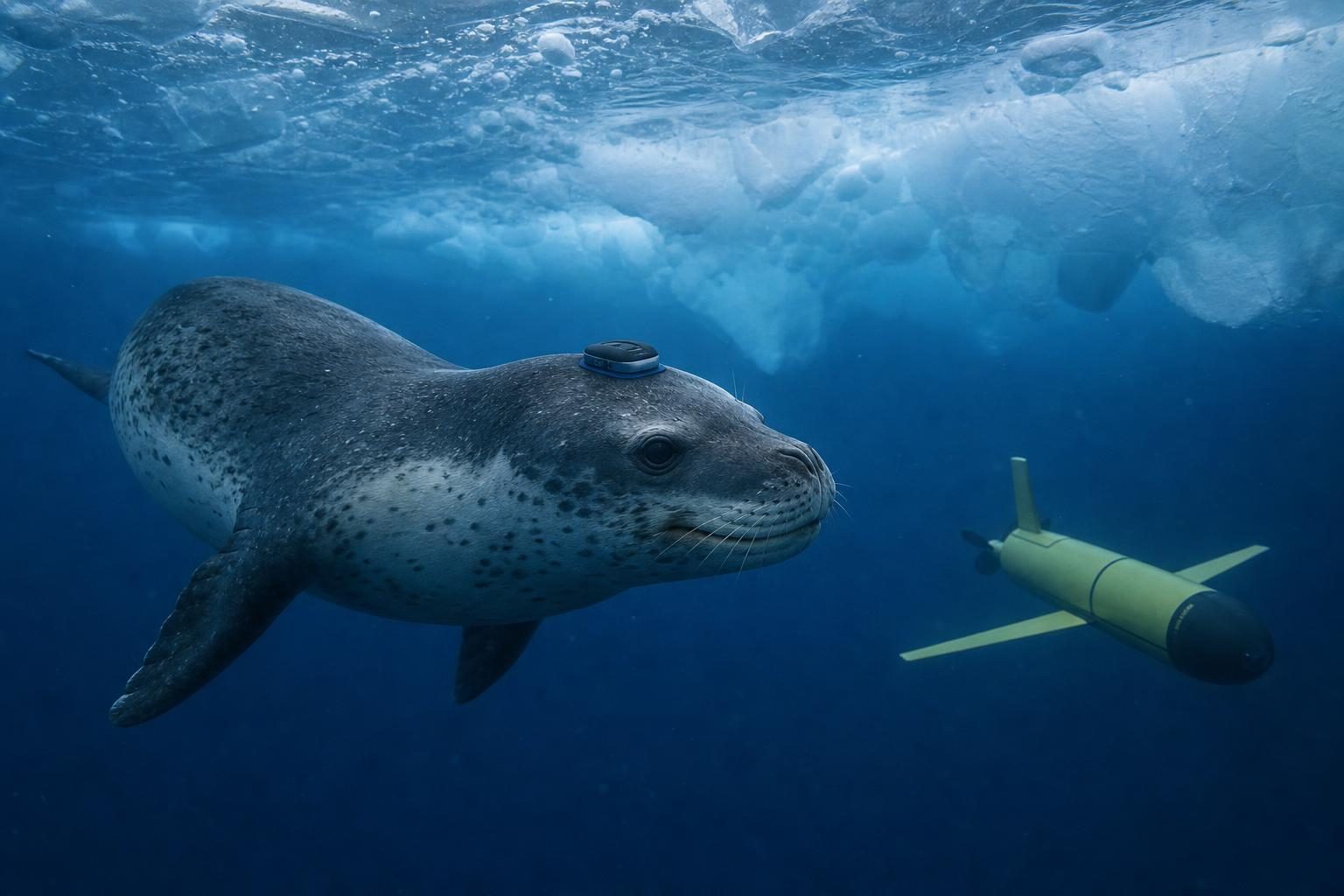
Seals are helping scientists study one of Earth’s hardest oceans to visit. According to Science News Explores, oceanographer Lily Dove studied the Southern Ocean using information gathered by Antarctic seals. An oceanographer is a scientist who studies oceans. The Southern Ocean is the wide ocean that circles Antarctica.
Scientists did not hand the seals clipboards, of course. A research program put small sensors on the foreheads of southern elephant seals and Weddell seals. A sensor is a tool that measures something. The source says the seals do not mind them. These sensors measured water temperature, salinity, and pressure. Salinity means how salty the water is. Pressure means the push from the water above.
The seals were useful because they already dive deep to find food. The story says they dive more than 100 meters, or 330 feet. That is deeper than human divers can easily go. While the seals swam, the sensors collected clues from places scientists often cannot reach.
Imagine the scene in the cold Southern Ocean. A seal slips below the surface. Its sensor records what the water is like. Far away, a scientist later studies those numbers on a computer. The seal chooses its own path. The scientist follows the data.
Dove used the seal data to study climate change. Climate change means long-term changes in Earth’s weather patterns as the planet warms. In parts of the Southern Ocean, heat from the air moves down into deep water. Once heat reaches those depths, it can stay there for hundreds of years. That matters because the ocean helps shape Earth’s climate.
Dove now works at the Georgia Institute of Technology. She studies polar oceans, oceans near Earth’s poles, with autonomous robots, machines that move without a person steering every second. Some robots float with sea currents. Others are gliders, which are underwater machines that can be sent toward certain places.
The robots are easier to guide than seals. A scientist in Georgia can tell a glider where to go, even in another half of the world. A seal does not take orders. It swims where it needs to swim.
This story shows how science can use many helpers. Sometimes the helper is a robot. Sometimes it is an animal doing what it naturally does. Both can help people learn about places too far, deep, or cold for easy visits.
Written from reporting by Science News Explores, “Seals helped this oceanographer study the Southern Ocean”.
Discussion questions
- When is it a good idea to use animals to gather science data, and when might robots be a better choice?
- If a research team had money for only one tool, should it choose seal sensors or underwater gliders? Defend your choice.
- What information is missing from this story that would help you judge the project more fairly?