
Spacecraft Sees a Full Ring of Northern Lights
A new NASA-featured view shows auroras as a giant oval around Earth, even in daytime.
Print it — all four files
The student packet has no answers in it. The teacher copy is the same pages plus a note on each question and the answer keys. Both languages carry the same story, the same picture and the same vocabulary.
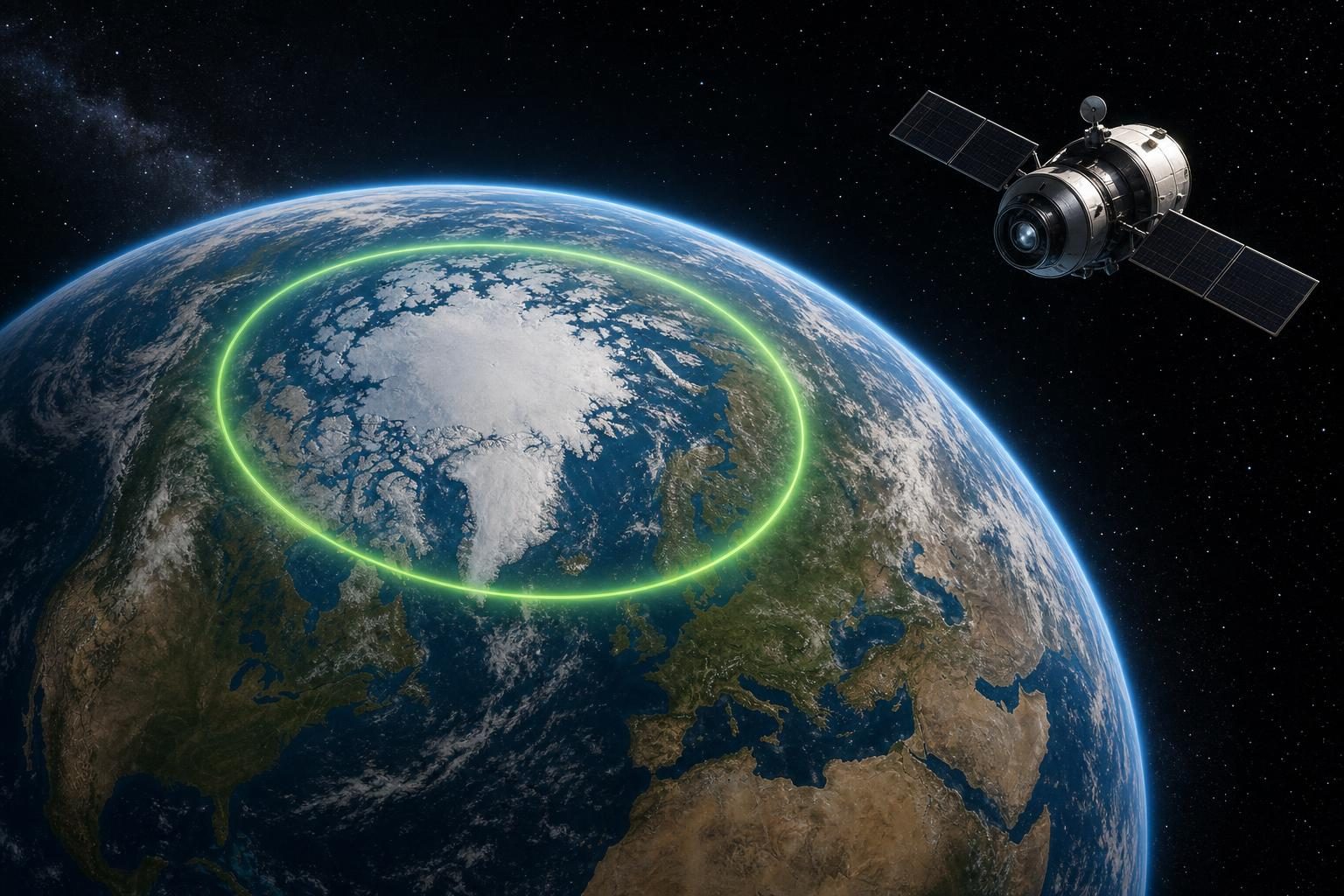
NASA shared a rare view of Earth’s lights on Oct. 6. According to NASA’s Astronomy Picture of the Day, the robotic SMILE spacecraft recorded a complete auroral oval. That means it saw the whole glowing ring of auroras around one of Earth’s magnetic poles.
Auroras are the sky lights sometimes called northern lights or southern lights. They can look like green curtains from the ground. A magnetic pole is an area near the top or bottom of Earth where Earth’s invisible magnetic field is strongest. That field helps guide charged bits from the Sun toward the polar sky.
From the ground, no one can see the whole oval. It is too wide. It wraps around the pole like a huge crown. A spacecraft high above Earth can look down and see the full shape at once.
The SMILE video is also special because the aurora happened during the day. Our eyes would miss much of that from the ground. SMILE used ultraviolet light. Ultraviolet light is light our eyes cannot see, but special cameras can measure it.
The video is a time-lapse, which means many pictures are played quickly to show change. It covers about an hour in late July. The oval does not sit still. It wiggles and changes. NASA says this shows how variable and turbulent auroras can be. Variable means changing. Turbulent means moving in a rough, busy way.
In the video, small points of light appear along the sides. Those are distant stars. They seem to move because SMILE’s camera view shifts while the spacecraft orbits Earth. Orbiting means traveling around something in space.
This matters because auroras are more than pretty lights. They show how the Sun touches Earth from far away. The Sun sends out a solar wind, a stream of tiny charged particles. Earth is surrounded by a magnetosphere, the area controlled by its magnetic field. SMILE’s job is to help scientists learn how the solar wind meets that shield.
That knowledge can help people plan. Strong activity from the Sun can affect astronauts, spacecraft, and electrical grids. Electrical grids are the wires and equipment that carry power to homes and schools. Watching the whole oval gives scientists a bigger picture. It is like seeing the whole playground instead of one corner. The full shape can show where the action is moving next.
Written from reporting by NASA, “APOD: 2026 October 6 – A Complete Auroral Oval from SMILE”.
Discussion questions
- Why might a view from space teach scientists something that a view from the ground cannot?
- If a class made a model of an auroral oval, what would be most important to show clearly, and why?
- Should people spend money on spacecraft that watch things most people never see directly? Explain your position.