
Webb Telescope Reveals a Galaxy’s Hidden Glow
A new NASA image shows how special light can uncover dust, motion, and star birth in the Black Eye Galaxy.
Print it — all four files
The student packet has no answers in it. The teacher copy is the same pages plus a note on each question and the answer keys. Both languages carry the same story, the same picture and the same vocabulary.
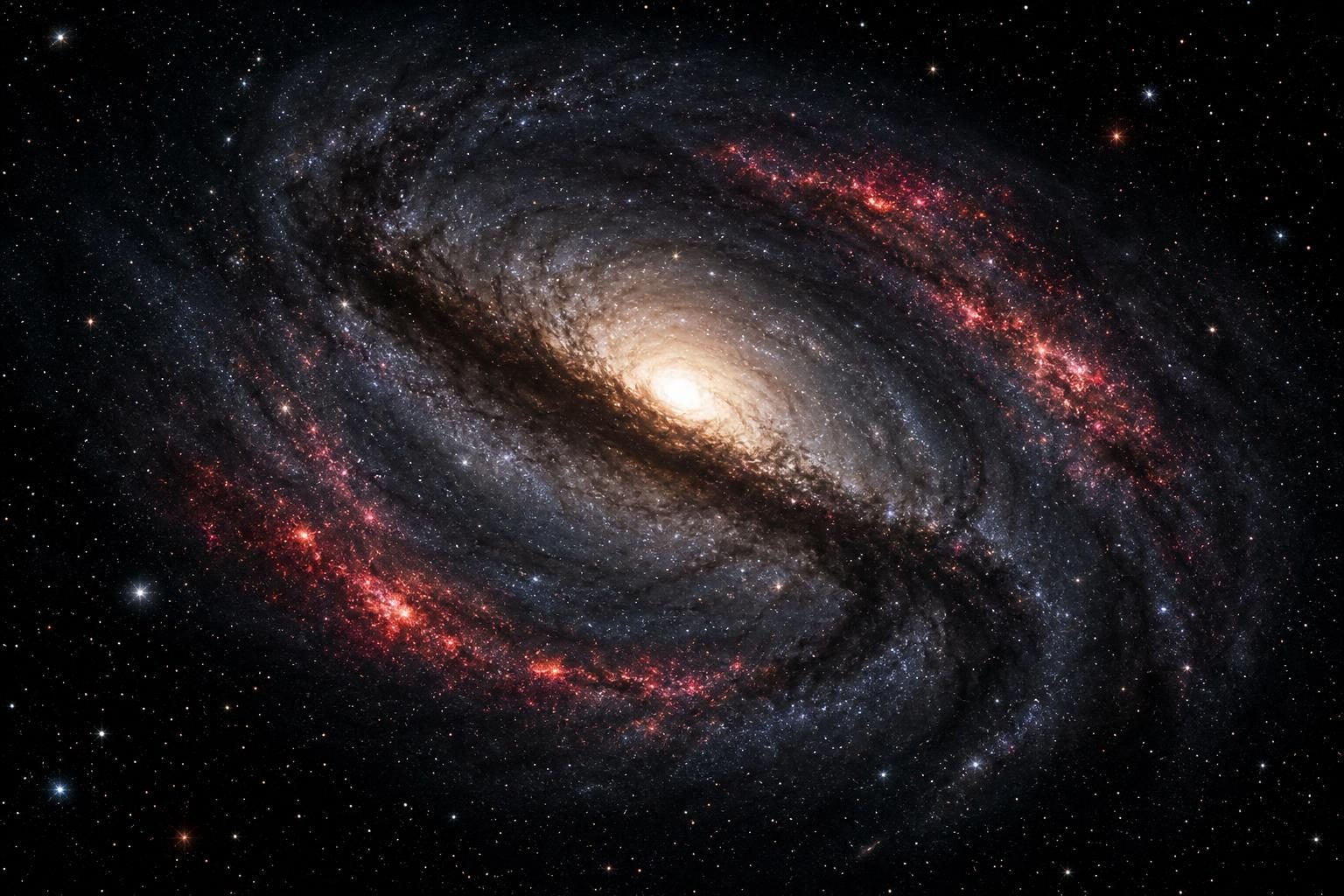
NASA shared a new space image today. It shows Messier 64, a galaxy with a dark stripe across its bright middle. That is according to NASA’s Astronomy Picture of the Day.
Messier 64 is a spiral galaxy. That means its stars, gas, and dust curve around the center like arms on a pinwheel. It is also called M64. Many people call it the Black Eye Galaxy because of the dark band that seems to cover part of its face.
The new view uses the James Webb Space Telescope, a telescope in space that studies light people cannot see. Webb looked at M64 with an instrument called MIRI, a tool that sees mid-infrared light. Infrared light is invisible to our eyes. Warm dust can glow in that kind of light.
That matters because space dust can hide things. In older Hubble telescope pictures, the dust looked dark. Webb shows some of that dust as red. NASA says the dust absorbs light from newborn stars and then gives light back out.
Imagine standing in a very dark room with a flashlight pointed at fog. You might see a wall of gray. Now imagine having special glasses that show heat. The fog would tell you more about what is inside it. Webb gives astronomers, or space scientists, a different kind of special glasses.
M64 is not just pretty. It also tells a story about motion. NASA says gas near the inside of the galaxy and gas farther out are moving in opposite directions. Where those gas currents meet, they squeeze together. That can help new stars form.
Scientists think this odd motion probably happened after M64 joined with a smaller galaxy long ago. A merger is when two galaxies come together and become one larger system. Astronomers once thought spiral galaxies usually had calm histories. M64 helped show that spirals can have busy histories too.
That includes our own Milky Way. The Milky Way is the spiral galaxy where Earth lives. NASA says galaxies like ours can also have mergers.
On the page, the first thing to notice may be color and shape. The bigger idea is change. A galaxy can look still in a photo. But inside it, gas moves, dust warms, and stars begin. One picture can help scientists ask better questions about a place no person can visit.
Written from reporting by NASA, “APOD: 2026 September 16 – Webb’s View of M64”.
Discussion questions
- Scientists often look at the same place in space with different telescopes. Is that worth the time? Why or why not?
- A space picture can make a galaxy look still. How should this story change the way people look at space images?
- If you could ask NASA for one more observation of M64, what would you want scientists to learn next?